
We may receive a commission from our partners if you click on a link to review or purchase a product or service. Click to Learn More
In short, FreshBooks is a better accounting software provider when compared with Wave. This is because FreshBooks offers a strong range of features for a competitive price, all within a user-friendly interface. For Mac users, however, it’s worth exploring the best accounting software for Mac to see if there’s a solution better suited to your specific platform and needs.
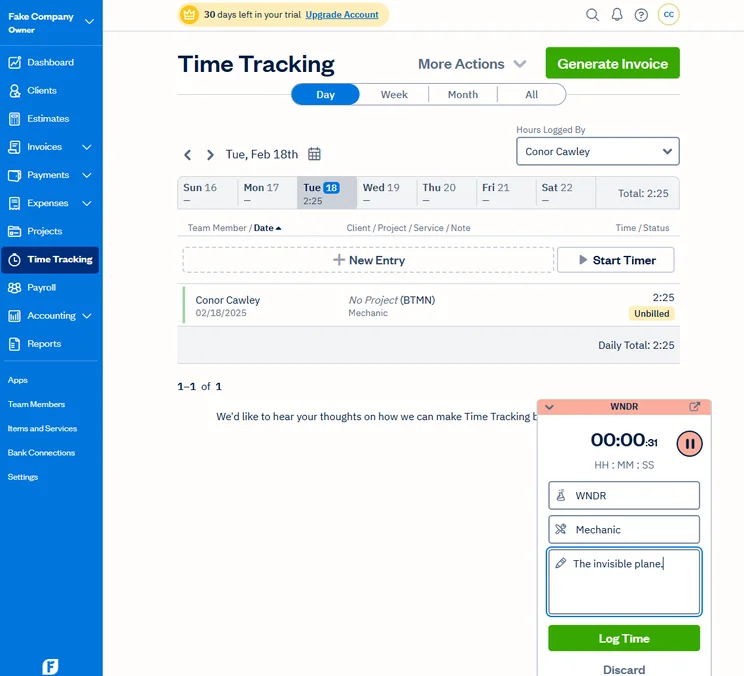
FreshBooks also has a better selection of advanced features, including time tracking, project profitability tools, and over 100 third-party integrations, whereas Wave doesn’t offer any of these features.
Read on to find out everything you need to know about these two accounting tools — or cut to the chase and check out our quick deal overview page to find and compare quotes from the best accounting software solutions.
|
Starting price
|
Free trial
|
Max users
|
Best for
|
Core Benefit
|
Payroll processing
|
Phone support
|
Try now
|
||
|---|---|---|---|---|---|---|---|---|---|
 |

|
||||||||
|
FreshBooks |
|||||||||
|
|
|||||||||
|
30 days |
It’s free, no trial needed |
||||||||
|
Unlimited |
1 |
||||||||
|
New businesses |
Overall |
||||||||
|
Inventory tools at a low price, plus a great 60% discount for the first 6 months |
Basic accounting functionality for free |
||||||||
|
|
|
||||||||
|
|
|
||||||||
| Try FreshBooks | Try Wave Starter |
Our software rankings are based on our unique, in-depth research categories, including software attributes, pricing factors, support, and more.
FreshBooks vs Wave: Head-to-Head
FreshBooks is the best accounting solution for new businesses that need help with their finances, while Wave is the best for side businesses on a budget.
Wave’s lower price point and deeper features make it the top choice for smaller operations that need a lot of bang for their buck – as long as they don’t intend to go beyond basic functionality.
On the whole, FreshBooks beats Wave for its wide variety of features. Significantly, FreshBooks is the better option for retail businesses because of its inventory management capabilities, which Wave sorely lacks. FreshBooks also offers project-tracking tools, but only in its higher-tier plans, another feature that Wave is lacking.
Likewise, businesses looking for a seamless interface where they can access their different software in one place shouldn’t consider Wave, because of its lack of integration options. FreshBooks, on the other hand, offers over 100, including Square and Slack.
Wave’s starting price is lower than FreshBooks’ because of its free plan, and even Wave’s Pro plan comes in at only $16/month, one of the most competitive prices out there. FreshBooks’ Lite plan is on the more expensive side, at $23/month. However, we feel that what FreshBooks offers compared to Wave, the price increase may be worth it.
Plus, our research finds that FreshBooks beats Wave for help and support options. While FreshBooks offers support across phone, email, live chat, and knowledge center, you’ll only be able to access live chat and email support as an add-on in Wave Starter. Luckily, however, this is available on the Wave Pro plan.

Is FreshBooks or Wave for you?
See how they compare to other providers to find the best accounting software for your business.
FreshBooks

In Short
-
Pros
- Intuitive, easy-to-use interface for beginners
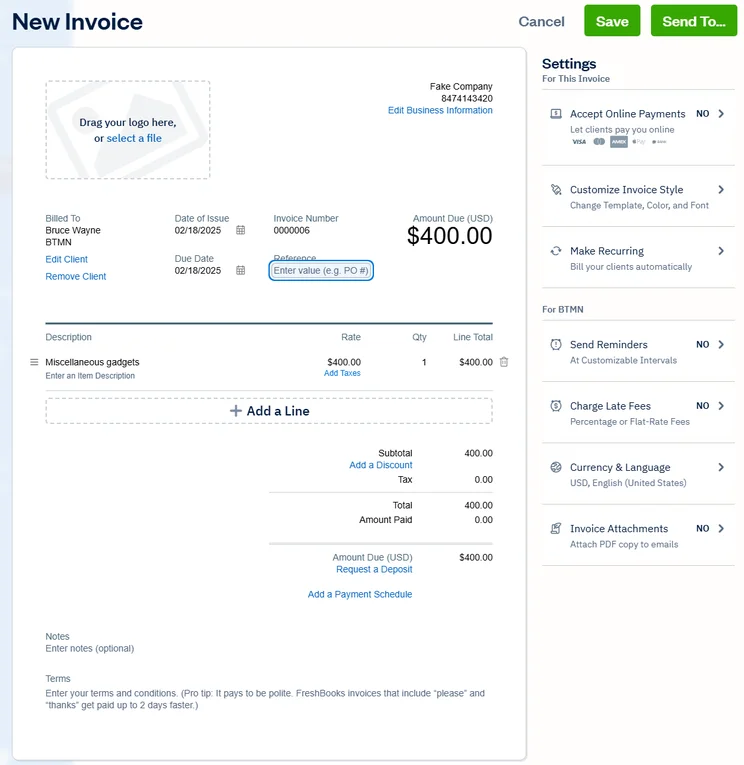
- Time tracking features with invoice compatibility
- 24/7 customer support options for platform help
- Automated reminders are included on all plans
-
Cons
- Limited functionality in mobile app
- No forecasting or budgeting features for future analysis
- Few custom reporting options
- Lower-tier plans restrict the number of active clients you can bill
Pricing
-
 Lite: $23/month
-
Plus: $43/month
-
Premium: $70/month
-
90% off all plans for the first 3 months
Images
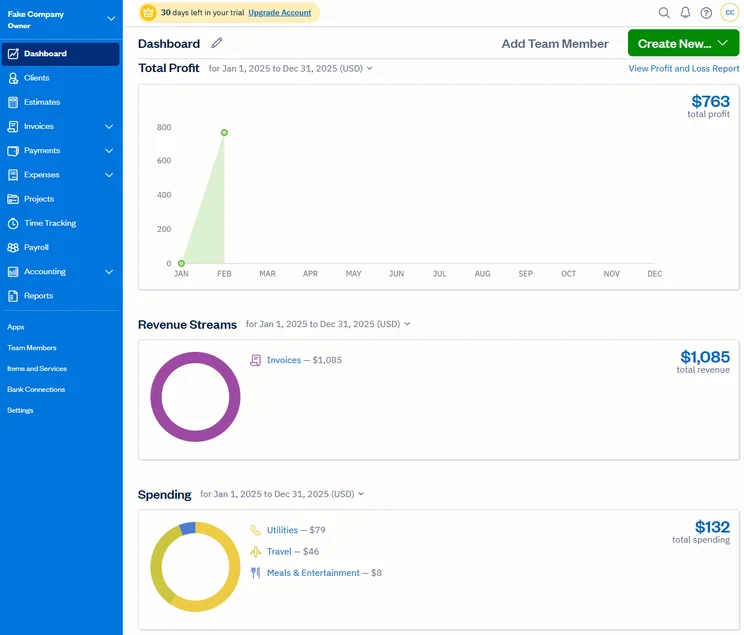
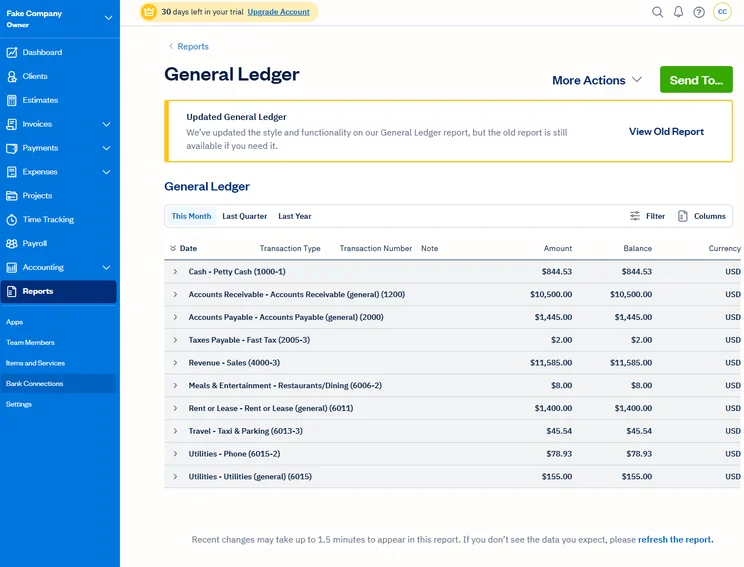
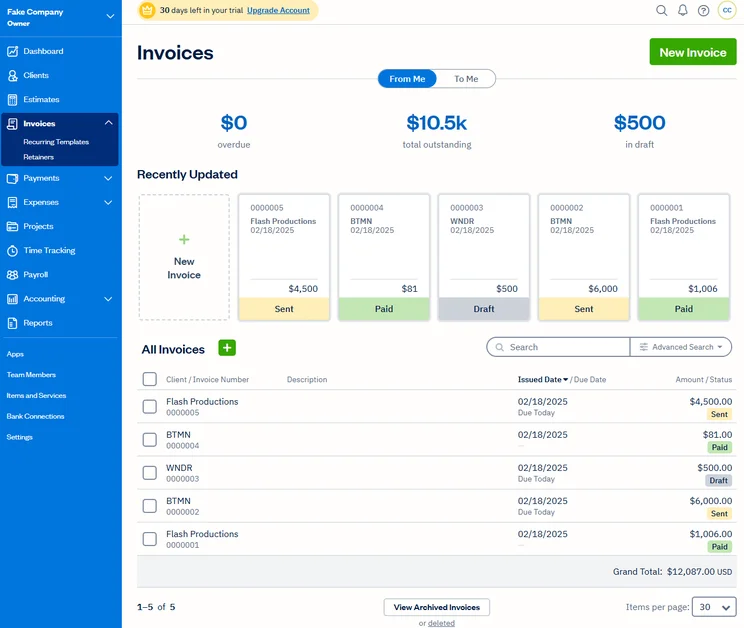
Check out our in-depth guide to FreshBooks pricing for more information.
Wave Financial

In Short
-
Pros
- Completely free tier available
- Offers affordable add-ons
- Does the basics well
-
Cons
- Lacks advanced features
- Struggles to scale with growing businesses
Pricing
-
Starter plan: Free
-
Pro plan: $19 per month
-
Transaction fee: 2.9% + 60¢ for credit card, 3.4% + 60¢ for Amex
Images
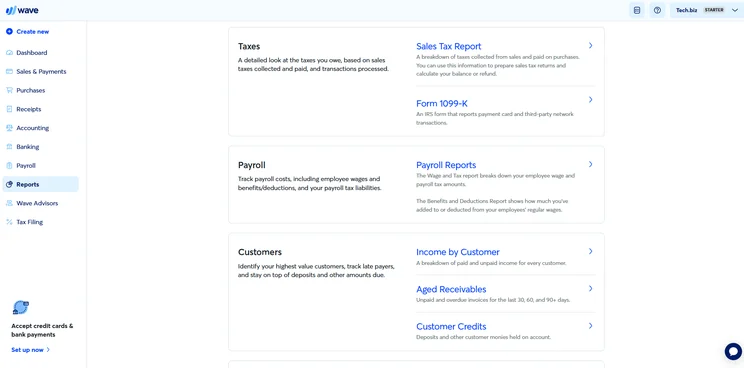
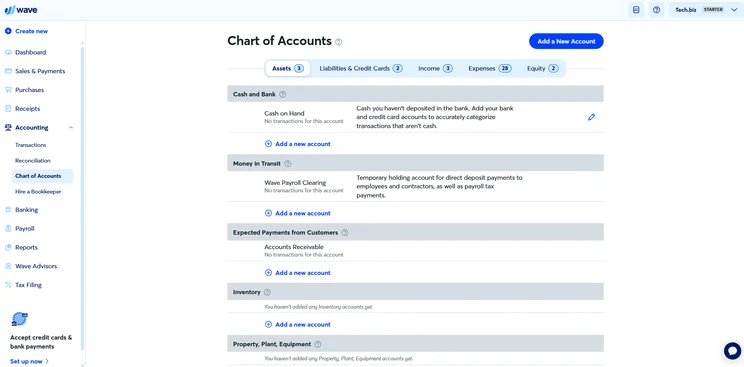
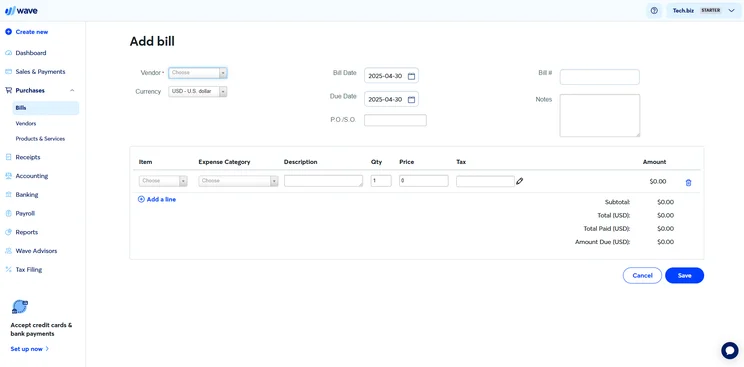
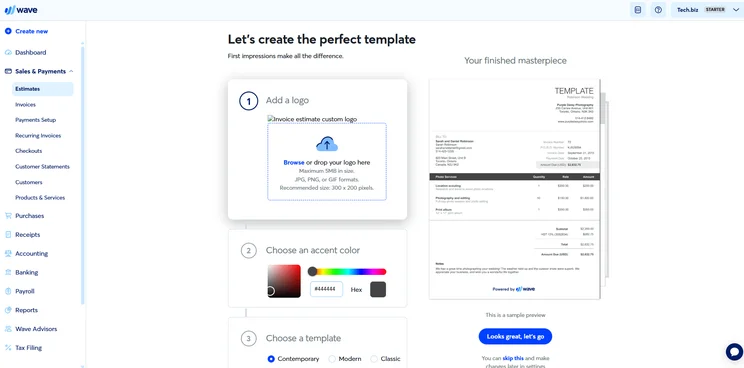
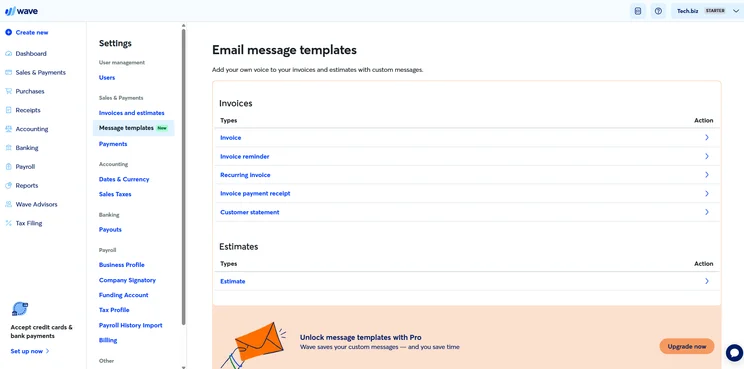
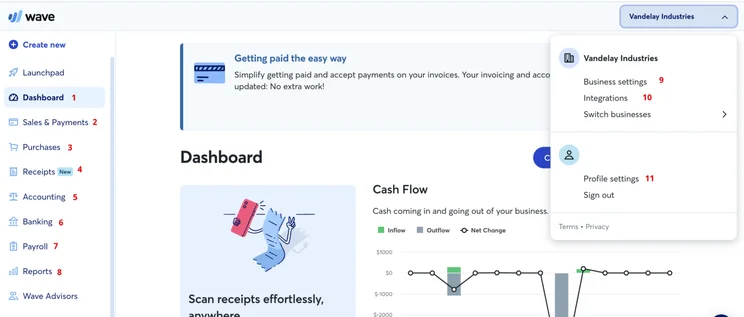
Read our full guide to Wave pricing for more information.
Best for Accounting Functionality: Draw
Overall, FreshBooks offers better functionality, but only at higher plans. Wave has a solid feature set across its plans, but for stronger features in this area, our researchers concluded FreshBooks was the better option.
Wave offers a solid amount of features with its plans, beating FreshBooks’ cheaper plans. It does lose to FreshBooks’ more expensive Premium plan, though. If your business has limited needs, we would recommend Wave as the most inexpensive solution, but if it has greater accounting needs, FreshBooks Premium is best.
When analyzing core accounting capabilities, our researchers assessed each software across six categories. Here is how FreshBooks and Wave stood up against each other:
Invoicing and quoting
- Wave has strong invoicing features with an app that lets users send invoices easily
- FreshBooks offers recurring invoices, automated invoices, and quote sending, but lacks multi-currency invoicing and quoting
Tax preparation
- Wave can generate a Payroll Wage & Tax Report, but for further features, you’ll need a payroll subscription
- FreshBooks includes automatic tax updates, and can only support a range of tax types on a separate Making Tax Digital software
Journal entry
- Wave supports documenting transactions through journal entries, recording expenses, and a receipt maker
- FreshBooks supports documenting transactions
Time tracking
- Wave doesn’t come with time tracking capabilities
- FreshBooks offers strong time tracking capabilities
Financial transactions and reconciliation
- Wave can create a reconciliation period and fix any unreconciled periods, and various bank accounts can be linked to a Wave account
- FreshBooks links with multiple bank accounts and effectively facilitates bank reconciliation
Payments and processing
- Wave has domestic transfer fees are place, and offers 40+ currencies
- FreshBooks has domestic transfer fees in place with each payment type, and it accepts all major currencies
You can learn more about Wave’s feature offering in our Wave accounting review
Best Value: Wave
Wave offers the best value for its price for one simple reason: it has a completely free plan available. Likewise, its Pro plan is only $16/month, making it still a great budget option for businesses.
The Wave service has plenty of additional costs for add-ons, like payroll and bookkeeping support. But its free plan comes with no limits on clients, users, invoices, estimates, or bills.
FreshBooks offers no free plans, but it has a 30-day free trial available for its four paid plans, which are Lite, Plus, Premium, and Select. Unlike Wave, all of FreshBooks’ plans have a one-user limit, except the Select plan, which is capped at two users. Additional members will cost an extra $11/month across all plans.
Here are the different FreshBooks plans:
- The Lite plan is $23 per month and includes core features such as custom invoicing and unlimited estimates, but is capped at just five billable clients.
- The Plus plan is $43 per month and adds automations for invoices, late fees, and late payment reminders, with a billable client cap of 50.
- The Premium plan is $70 per month, with unlimited billable clients. It adds features such as customized email templates and signatures, and automated client emails with dynamic fields.
- The Select plan is available for corporations at a custom price, and adds a dedicated Account Manager, training, and lower credit card transaction rates.
Businesses with limited needs should pick Wave, while those that can benefit from an expanded set of features should opt for FreshBooks Premium.
Committed to finding free software? Check out our guide to the best free accounting software for small businesses.
|
Price
|
Users
|
Bookkeeping
Does it include bookkeeping functions?
|
Accounts payable
Does it include a range of accounts payable functions?
|
Accounts receivable
Does it include a range of accounts receivable functions?
|
Project accounting
Does it offer tools to track different projects?
|
Financial reporting
Does it offer financial reporting tools?
|
Budget and forecasting
Does it offer budgeting and forecasting tools?
|
|||
|---|---|---|---|---|---|---|---|---|---|---|
|
|
|
|
|
|
|
|||||
|
Wave |
Wave |
|||||||||
|
Wave |
Pro |
|||||||||
|
|
Free |
|
|
|||||||
|
1 |
Unlimited |
1 |
Unlimited |
1 |
3 |
|||||
|
|
|
|
|
|
|
|||||
|
Expenses tracking only |
|
|
|
|
|
|||||
|
|
|
|
|
|
|
|||||
|
Time-tracking only |
|
|
|
|
|
|||||
|
|
|
|
|
|
|
|||||
|
|
|
|
|
|
|
Best for Operational Efficiency: FreshBooks
Across features, FreshBooks takes it. While Wave does boast some impressive invoicing capabilities and bookkeeping tools, it simply doesn’t include the more advanced features that are essential to some businesses.
FreshBooks is able to spot and automatically flag mismatched balances, and it provides audit trails to allow users to see who has made certain changes. FreshBooks also offers project management and profitability tools, but you’ll only be able to access these in its Premium plan and above.
However, despite faring well against basic accounting software such as Wave, we would still classify FreshBooks’ feature set as limited.
Our researchers found that, unlike QuickBooks, FreshBooks doesn’t offer robust forecasting and budgeting tools, which could be crucial for businesses looking to plan and manage finances accurately. Therefore, QuickBooks could be a better option in some cases.
If you are deciding between the two, you can check out our head-to-head to see which would suit your business better.
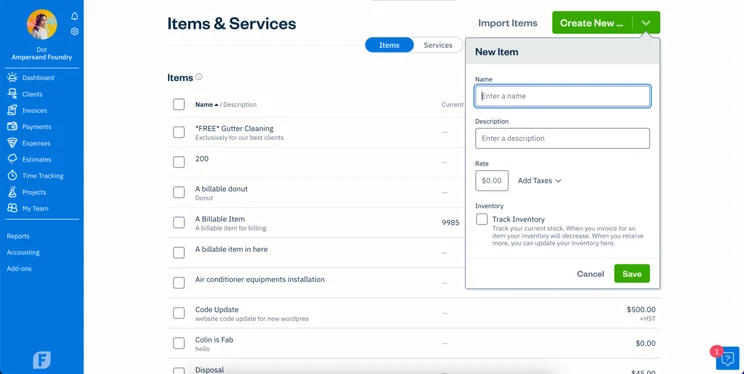
FreshBooks’ inventory tracking was easy to use in our testing, and a feature we found lacking in Wave. Source: Tech.co testing.
Similarly, in our testing, we found that users are able to connect Wave with a number of third-party apps, such as Mailchimp and Stripe. However, this is done through Zapier, and you’ll need an account to get started.
While Zapier does offer a free plan, not all of its apps are available at this tier, so you’ll be looking at another monthly subscription of at least $19.99/month. As of May 2025, you’ll also need a Wave Pro plan subscription to connect any new or existing API integrations.
Therefore, FreshBooks wins out in this category. It offers over 100 integration options, so businesses wanting to connect their payroll or customer relationship management (CRM) products are in luck. However, this doesn’t compare to the over 1,000 integrations available in Xero.
How Do FreshBooks & Wave Compare With Alternatives?
FreshBooks is the best option for new businesses with its vast help and support options, and Wave is the best free accounting software.
But they’re far from the only options. Check out our table of the best accounting services for more, and read on for a few select competitors worth considering.
|
Starting price
|
Free trial
|
Best for
|
Pros
|
Cons
|
Try now
|
||
|---|---|---|---|---|---|---|---|
|
|
 |
 |
 |
 |
|||
|
FreshBooks |
Xero |
Zoho Books |
FreeAgent |
QuickBooks |
|||
|
|
|
Free |
|
|
|||
|
30 days |
30 days |
14 days |
30 days |
30 days |
|||
|
New businesses |
Experienced accountants and established businesses with complex financial needs |
Integrations |
Budget-conscious businesses |
Businesses needing advanced financial insights and customization |
|||
|
|
|
|
|
|||
|
|
|
|
|
|||
| Try FreshBooks | Try Xero now | Try Zoho Books | Get Quotes | Try QuickBooks |
FreshBooks vs. QuickBooks vs. Wave
Our researchers didn’t choose FreshBooks or Wave as their top pick.
Instead, QuickBooks was found to be the best, especially for those needing advanced financial insights. The QuickBooks accounting service offers better features and add-ons than either Wave or FreshBooks, even though Wave does still have the best pricing overall.
Plus, QuickBooks offers a level of customizability that impressed our researchers during testing, including the option for multiple delivery addresses for clients, and customized reporting.
FreshBooks vs Zoho Books vs Wave
Zoho Books is another solid choice, with highly effective transaction documenting and at-a-glance insights into key information such as cash flow and payments.
The service’s automation features are one standout benefit, letting busy operations send regular invoices and estimates with minimum effort.
During our testing, however, we found Zoho to be less than ideal for businesses that want integrations beyond Zoho’s designated catalogue.
How Did We Score FreshBooks & Wave Against Others?
At Tech.co, we take our impartial research and analysis seriously, so you can have complete confidence that we’re giving you the clearest, most useful recommendations.
After conducting an initial investigation to identify the most relevant, popular, and established accounting tools in the market, we conducted further research, including testing six major accounting software platforms.
Based on years of market and user needs research, we’ve established an accounting software testing methodology that scores these platforms against six main categories, and 25 subcategories — with a total of 1,512 areas of investigation being considered overall.
We also put the platforms through their paces with hands-on testing to gain a deeper grasp of their average user experience. We dedicated 57 hours to carrying out 37 user tests, with a total of 555 tasks being completed in total.
Our main testing categories for accounting software are:
- Core accounting features: We check how adept a platform will be at managing accounting tasks, focusing on key bookkeeping features like invoicing, tax preparation, journal entry, time tracking, financial transactions, and payment support.
- Operational efficiency: We determine how capable a system is at ensuring day-to-day processes run seamlessly, paying close attention to third-party integrations, collaboration tools, AI automation, and customization options.
- Financial planning: We assess how capable a system will be at measuring income, profits, and losses. Specifically, we check for the presence and quality of forecasting and budgeting, inventory management, reporting, and compliance tools.
- Help and support: We assess how useful and reliable a platform’s support system is, focusing on support options, whether it’s 24/7 support or knowledge center accuracy, as well as cloud backup, and security safeguards.
- Pricing: We compare the overall cost of each platform, taking factors like monthly costs, set-up fees, hidden fees, and free plans into account. We also measure how strict contracts are, and how much it would cost for a business to terminate them early.
- User experience: An overall judgment of how easily users can interact with the platform. We tested each accounting platform and got our team to report how easy they were to use, how they felt when they were using them, and how likely they were to recommend the platform to another business.
When it comes to calculating a product’s final score, not all testing areas are weighted evenly, with factors like “core accounting features” and “operational efficiency” being prioritized for small businesses, while sector-specific features are valued more highly for businesses across different industries.
We understand that accounting software is always evolving. That’s why at Tech.co, we have full-time product researchers to re-run this testing process regularly. It’s the only way to ensure our results remain reflective of the present day.
Learn more about our research.
We recommend FreshBooks over Wave because it offers better features overall. Wave is a good pick for side businesses, since it has a free plan that offers complex tools, however, FreshBooks offers more for newer businesses and better chances for efficiency with many integration options.
Our research finds that FreshBooks it is great for retailers because it offers inventory management on all plans (Wave doesn’t offer it at all).
In the end, the best accounting solution for you depends on the unique needs of your business. Once you know what those are, there’s just one step left: compare quotes from the top options on the market. Our quick quotes form will let you do just that — within minutes.
Frequently Asked Questions
Wave Invoicing is free, along with many other accounting tools from the service. It won’t offer some key benefits, including recurring bills, inventory management, time or project tracking, and budget management, but it delivers core functionality for operations without a budget.
Our researchers found the best accounting software to be QuickBooks, due to its unbeatable features, great customer service, and fair price for its value. However, other options may be best for your business. We’ve rounded up a guide to all the top QuickBooks alternatives.
FreshBooks is a good accounting software because all of its plans allow users to add billable hours to their invoices and offer inventory management. Add in the service’s integrations with top ecommerce platforms, and you have the best available accounting solution for retailers.
FreshBooks may be a good accounting software for freelancers, but it depends on your needs: The service will let users on any plan track all billable hours and add them to invoices, which is a big benefit to many freelancers. However, the service doesn’t offer any budgeting or cash flow projection tools.
If you click on, sign up to a service through, or make a purchase through the links on our site, or use our quotes tool to receive custom pricing for your business needs, we may earn a referral fee from the supplier(s) of the technology you’re interested in. This helps Tech.co to provide free information and reviews, and carries no additional cost to you. Most importantly, it doesn’t affect our editorial impartiality. Ratings and rankings on Tech.co cannot be bought. Our reviews are based on objective research analysis. Rare exceptions to this will be marked clearly as a ‘sponsored’ table column, or explained by a full advertising disclosure on the page, in place of this one. Click to return to top of page


