
We may receive a commission from our partners if you click on a link to review or purchase a product or service. Click to Learn More
Xero is an excellent accounting platform for small businesses. It boasts some impressive core accounting and planning features, as well as a massive library of available third-party integrations, and a good selection of collaboration and AI tools.
Xero’s plans start at $25 per month for the Early plan and go up to $90 per month for the Established plan. It doesn’t have a free plan, but you can get a 30-day free trial of any one of its plans.
The provider is currently running a promotional offer, that allows you to get Xero for as little as $2.50 per month for the first six months.
During our most recent round of user testing, our researchers were particularly impressed with Xero’s billing and expense management features, but they found the software to be hard to use in general. I spent some time testing the platform myself, and my view is that it’s a great platform, but there are better alternatives out there.
In this guide, I’ll be talking you through Xero, focusing on features, pricing, pros, cons, and other options. This will help you to decide if the platform is right for you.
Xero At a Glance
Without question, Xero is one of the biggest players in the accounting space. With its advanced billing features, it’s built for larger businesses with high turnovers. Users who aren’t well-versed in accounting software will likely find it to have a steep learning curve. Below, I’ve summed up some key points that might influence your purchase decision.
- Xero has great core accounting features, including an intuitive invoice builder, easy-to-use time tracking, and payment processing available on all plans.
- Xero offers three paid plans, starting at $20 per month. There is no free plan, but you can get a 30-day free trial.
- Xero has advanced planning capabilities, with expense tracking, budget setting, and a set of AI-enhanced tools for cash flow projection, known as Xero Analytics.
- Xero offers unlimited users on all plans, meaning that it’s suitable for larger teams.
- Xero offers over 1,000 possible third-party integrations.

Get the Best Accounting Software for Your Business
Get started with a free trial today
Xero
In a nutshell
-
Xero is a robust accounting platform with excellent expenses and billing tools, accounts receivable and accounts payable functionality, and a huge selection of third-party integrations. With its outdated interface, it is geared towards experienced accounting pros. There are three paid plans available, starting at $25 per month and going up to $90 per month.
-
- Add tracked hours
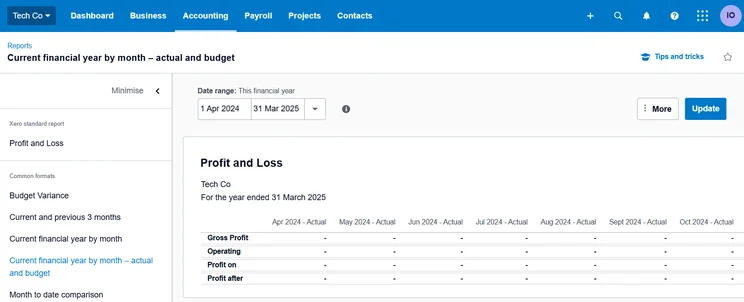
- Customisable reports
- Attach files to invoices
Pricing tiers
- Early plan – $25 per month
- Growing plan – $55 per month
- Established plan – $90 per month
Images
Xero Key Features
In this section, I’ll take you through some of Xero’s standout features, as well as areas where it falls short. You can use the links below to navigate to whichever section you’re interested in.
Core accounting features
Xero has an excellent set of core accounting features. During our latest round of testing, our researchers were particularly impressed with the expenses feature, which makes it very easy to upload receipts, input mileage, and attach expenses to specific clients.
“The expenses were really good, better than FreshBooks and QuickBooks. It was really clear where to upload the picture of the receipt. I like that you can put in your mileage and the cost…it was easy to associate to the client, too.” – Isobel O’Sullivan, Senior Writer at Tech.co and Xero researcher.
Over the course of my own research, I enjoyed the process of creating bills. You can navigate to the bills section from the dashboard, which helpfully surfaces some of the key accounting features that you might like to perform. Otherwise, you’ll find it under the “Business” tab, which isn’t necessarily the most logical place for it, but more on that later.
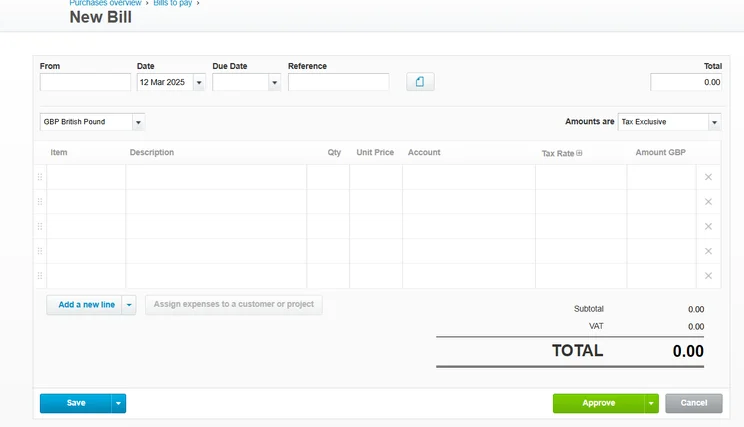
This is the template for creating bills in Xero. As you can see, it’s clearly laid out, with a nice combination of drop-down lists and text fields for inputting information. Source: Tech.co testing
There’s also an option to import bills into Xero. However, when trying to test this, I ran into some frustrating technical issues. I tried to upload my bill multiple times, and Xero rejected me every time. To make matters worse, it wasn’t clear to me why my upload attempts were unsuccessful. The whole experience was nothing short of infuriating.
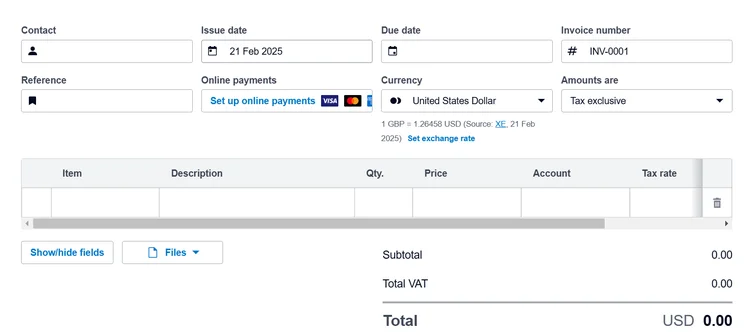
I did enjoy the process of creating invoices. The first time that you select “New invoice,” you’ll be brought to an empty invoice template. As with bill creation, there’s an interplay of drop-down lists and text fields, a neat touch that helps to improve the user experience.
You’ll also have the option to configure payments from right within the invoice, which was handy. You can choose either “cards, wallets and more,” “one-time & recurring bank payments,” or add another provider.
You can customize your invoice templates by uploading a logo, which is a nice touch. Overall, the process was intuitive and easy, and I was particularly impressed by the fact you could configure payments without having to navigate away from the invoice builder.
Financial planning
During our most recent round of testing, we were highly impressed with Xero’s financial planning features. Particular highlights include its expense tracking, cash flow projection, and budget-setting tools. There’s also Xero Analytics, the platform’s dedicated AI arm for accessing detailed cash flow predictions up to 180 days in advance.
The Xero dashboard surfaces a lot of insights that you might need, including cash in and out, outstanding bills, business bank balance, outstanding invoices, and tax and reporting insights. However, our researchers found it “overwhelming,” with poorly organized headings and cluttered visuals. This will be off-putting to novice users, but seasoned accounting pros will appreciate the depth of insight at their fingertips.
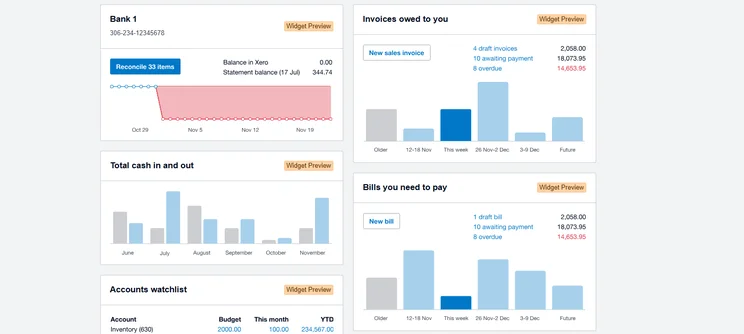
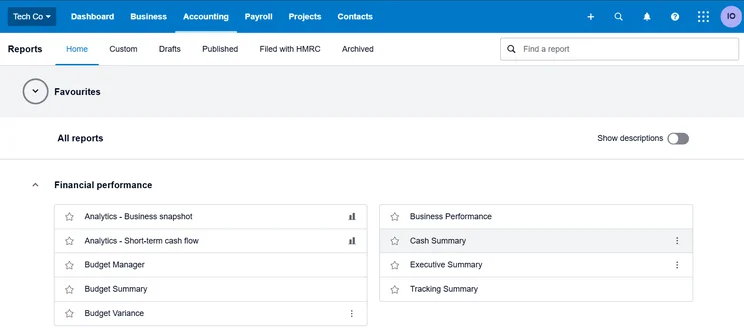
Xero’s reporting dashboard gives you an instant overview of how your business is tracking. Source: Tech.co user testing
In terms of reports, Xero has a decent array at its disposal. These are divided into “Financial performance,” “Financial statements,” “Payables and receivables,” “Payroll,” “Projects,” “Reconciliations,” “Taxes and balances,” and “Transactions.”
While I was impressed by the sheer volume of options, I didn’t think the page was well laid out. In particular, there’s a lot of text on the page – some visual elements would go a long way to improving readability.
Operational efficiency
This is another area in which Xero excels. To begin with, the platform boasts over 1,000 available third-party integrations, including options for ecommerce, payments, reporting, CRM, and more. It’s an impressive selection that testifies to how widely used Xero is across the business landscape.
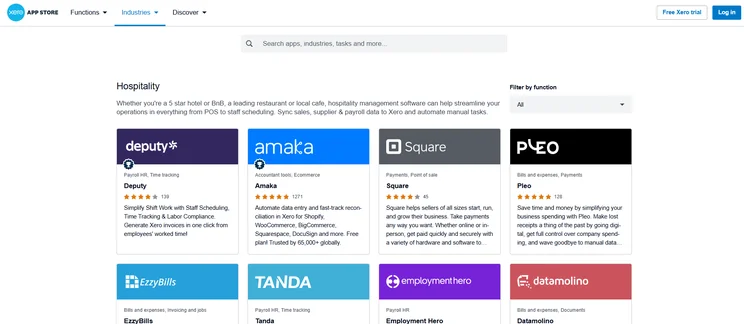
Xero’s app store lets you connect with tons of restaurant-focused apps like Square POS and Fresho Inventory. Source: Tech.co user testing
Let’s say you operate a chain of restaurants. You’ll find several hospitality-focused integrations to make sure you’re getting the most out of Xero, including Lightspeed POS, REKKI, and more.
What’s more, Xero also has no user limit on any of its plans. By contrast, the likes of FreshBooks limits you to one user per plan, with the option to pay for additional members. For a full breakdown of how these two platforms compare, make sure to check out our guide to Xero vs FreshBooks.
Help and support
We wouldn’t recommend Xero to accounting novices who are likely to get stuck. This is because the platform is pretty unforgiving, both in terms of a steep learning curve and providing help when you need it.
With Xero, you don’t have the option to call a rep if you need assistance. To request it, you’ll have to raise a ticket on the Xero website, which is quite an intuitive experience. You will be able to provide your number for Xero to contact you.
However, the fact that this isn’t on your terms is frustrating. You will undoubtedly run into difficulties that could be resolved by a five-minute phone call. Unfortunately, it’s pretty likely that this won’t happen. Instead, you’ll have to raise a ticket or navigate through the Help Center for the solution to your problem.
Usability
Xero has a reputation for being notoriously difficult to use. I have to say – that reputation is well-earned. The platform looks outdated, with a very rudimentary interface and site mapping that isn’t totally logical.
“Reports,” for instance, falls under the “Accounting” tab, yet there are reports on Payroll, Projects, and other subjects. It would surely make more sense to have Reports as one of the main navigational headers, with subcategories viewable as part of a drop-down menu.
Our users were also frustrated by a couple of convoluted workflows. Seemingly simple tasks, namely importing clients and changing currency, were unnecessarily difficult. Invoice building, while intuitive, is hindered by surplus fields and poor visual feedback. As I mentioned earlier in this guide, I ran into issues while trying to import a bill, which was highly frustrating.
Xero Pricing Plans Explained
Xero has three paid plans, starting at $20 per month. However, the platform is currently running a promotional offer, so new customers can get 90% off plans for the first three months. If you’re interested, you’ll need to act quickly – the offer is only available until March 31st. You’ll find the details of Xero’s paid plans below.
- Early plan – $20 per month (currently discounted to $2.50 per month for the first three months).
- Growing plan – $55 per month (currently discounted to $5.50 per month for the first three months).
- Established plan – $90 per month (currently discounted to $9 per month for the first three months).
In the table below, you’ll find a more detailed breakdown of which features are available on each plan.
|
Price
|
Users
|
||
|---|---|---|---|
|
|
|
|
|
|
|
|
|
|
Unlimited |
Unlimited |
Unlimited |
Does Xero have a free plan?
Unfortunately, Xero does not have a free plan. It does, however, offer a 30-day free trial. If you’re looking for free accounting software, we’d recommend looking into Wave Financial, which is a comprehensive solution with unlimited estimates, invoices, bills, income tracking, and users.
Alternatives to Xero
Xero is one of the biggest names on the market, no doubt, but it’s far from the only one. Depending on your business needs and budget, there are many alternative accounting platforms available. Our personal favorite is Zoho Books, which scored very highly in our latest round of testing, owing to its exceptional core accounting features, usability, and planning tools.
In the table below, you’ll find a selection of some of our favorite solutions. Make sure to check out our guide to the best accounting software for small businesses for more information.
|
Starting price
|
Free trial
|
Best for
|
Pros
|
Cons
|
Try now
|
||
|---|---|---|---|---|---|---|---|
 |
|
 |
 |
 |
|||
|
FreshBooks |
Xero |
Zoho Books |
FreeAgent |
QuickBooks |
|||
|
|
|
Free |
|
|
|||
|
30 days |
30 days |
14 days |
30 days |
30 days |
|||
|
New businesses |
Experienced accountants and established businesses with complex financial needs |
Integrations |
Budget-conscious businesses |
Businesses needing advanced financial insights and customization |
|||
|
|
|
|
|
|||
|
|
|
|
|
|||
| Try FreshBooks | Try Xero now | Try Zoho Books | Get Quotes | Try QuickBooks |
How Did We Test Xero?
At Tech.co, we take our impartial research and analysis seriously, so you can have complete confidence that we’re giving you the clearest, most useful recommendations.
After conducting an initial investigation to identify the most relevant, popular, and established accounting tools in the market, we conducted further research, including testing six major accounting software platforms.
Based on years of market and user needs research, we’ve established an accounting software testing methodology that scores these platforms against six main categories, and 25 subcategories — with a total of 1,512 areas of investigation being considered overall.
We also put the platforms through their paces with hands-on testing to gain a deeper grasp of their average user experience. We dedicated 57 hours to carrying out 37 user tests, with a total of 555 tasks being completed in total.
Our main testing categories for accounting software are:
- Core accounting features: We check how adept a platform will be at managing accounting tasks, focusing on key bookkeeping features like invoicing, tax preparation, journal entry, time tracking, financial transactions, and payment support.
- Operational efficiency: We determine how capable a system is at ensuring day-to-day processes run seamlessly, paying close attention to third-party integrations, collaboration tools, AI automation, and customization options.
- Financial planning: We assess how capable a system will be at measuring income, profits, and losses. Specifically, we check for the presence and quality of forecasting and budgeting, inventory management, reporting, and compliance tools.
- Help and support: We assess how useful and reliable a platform’s support system is, focusing on support options, whether it’s 24/7 support or knowledge center accuracy, as well as cloud backup, and security safeguards.
- Pricing: We compare the overall cost of each platform, taking factors like monthly costs, set-up fees, hidden fees, and free plans into account. We also measure how strict contracts are, and how much it would cost for a business to terminate them early.
- User experience: An overall judgment of how easily users can interact with the platform. We tested each accounting platform and got our team to report how easy they were to use, how they felt when they were using them, and how likely they were to recommend the platform to another business.
When it comes to calculating a product’s final score, not all testing areas are weighted evenly, with factors like “core accounting features” and “operational efficiency” being prioritized for small businesses, while sector-specific features are valued more highly for businesses across different industries.
We understand that accounting software is always evolving. That’s why at Tech.co, we have full-time product researchers to re-run this testing process regularly. It’s the only way to ensure our results remain reflective of the present day.
Learn more about our research.
Xero is a very good accounting platform for small businesses. It has some robust features, with particular standouts including its expense tracking, bill creation, and invoicing. You’ll be able to access a lot of detailed information about your business, with dozens of available report templates and AI-enhanced cash flow predictions through Xero Analytics.
At the same time, however, Xero is difficult to master. It will likely prove too much of a learning curve for users who aren’t overly familiar with accounting software. For first-time users, the dearth of support options may leave you without adequare support.
All in all, there are better options out there. Our personal pick would be Zoho Books, which combines excellent core accounting features with unmatched usability. Another option worth looking into is QuickBooks, which has great support options and a decent pricing point.
If you click on, sign up to a service through, or make a purchase through the links on our site, or use our quotes tool to receive custom pricing for your business needs, we may earn a referral fee from the supplier(s) of the technology you’re interested in. This helps Tech.co to provide free information and reviews, and carries no additional cost to you. Most importantly, it doesn’t affect our editorial impartiality. Ratings and rankings on Tech.co cannot be bought. Our reviews are based on objective research analysis. Rare exceptions to this will be marked clearly as a ‘sponsored’ table column, or explained by a full advertising disclosure on the page, in place of this one. Click to return to top of page


