
We may receive a commission from our partners if you click on a link to review or purchase a product or service. Click to Learn More
The concept of a cashless society has been around for decades. But with 84% of payments in the US being made digitally in 2025 (according to Clearly Payments), the transition from physical currency could take place sooner than we once thought. For businesses adapting to this shift, the best mobile POS systems can help streamline digital transactions and ensure a seamless cash-free experience.
Yet, while the convenience of contactless POS payments remains unmatched, many Americans aren’t on board with going fully cashless. This poses a pressing question for businesses: Is it too soon to consider going cash-free?
We’ve spoken to financial experts to gauge how likely it is that the US will switch to a fully digital economy in the near future. We’ve also weighed up the benefits and drawbacks associated with going cashless, to help you decide if it’s the right move for your business.
- A cashless society is coming: Due to the influence of COVID-19 and the growing popularity of digital payment methods like digital wallets, digital payment apps, and cryptocurrency, the US is well on its way to becoming a cashless society.
- The US won’t be the first cashless society: The US isn’t as quick to adopt digital payment methods as the Asia-Pacific region, with countries like South Korea and China currently leading the pack when it comes to cashless living.
- Going cashless pays for businesses: There are tons of incentives for businesses to go cashless. For example, ditching physical tender can reduce fraud and theft, increase convenience for buyers and vendors, and boost consumer spending as a result.
- Ditching cash isn’t without its risks: Going fully digital can make businesses more vulnerable to cybercrime, while also excluding members of the unbanked population from accessing your goods or services.
- Investing in the right tech matters: If you’re considering taking the plunge, we recommend investing in a POS system that’s able to accept a wide range of digital payment methods, before carefully selecting which options will best serve your customer base – be it chip-and-pin, contactless, or even cryptocurrency.
What Is a Cashless Society?
A cashless society is one where neither cash, coins, nor other forms of physical tender are used for financial transactions. Instead, payments are made through digital payment methods like debit cards, credit cards, mobile wallets, and mobile payment apps.
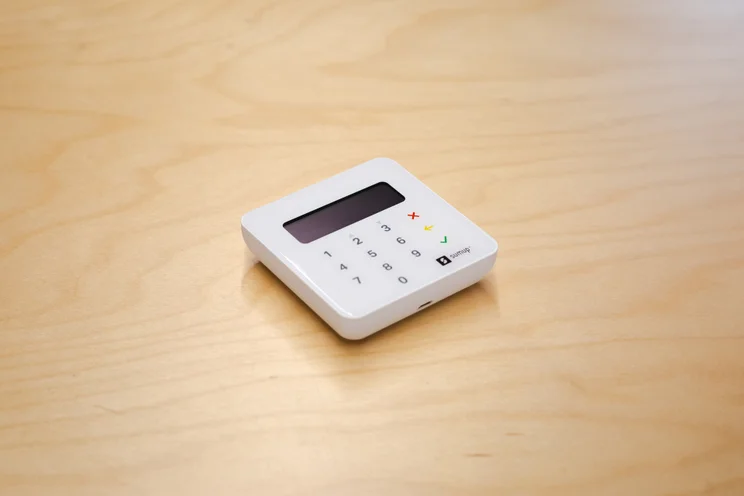
A card reader from SumUp, which takes payments via debit or credit card, mobile, or other forms of digital payment. Source: Tech.co original imagery
Cashless Society Statistics
To present a clearer picture of where society is heading, here are some statistics about cashless societies:
- Two-fifths of Americans used no cash in 2022 (Source: Pew Research)
- 13.4% of American consumers have stopped using cash completely in 2024, compared to 11% in 2022 (Source: Capital One Shopping)
- The average number of cash payments fell from 26% in 2019 to 20% in 2021 (Source: Federal Reserve)
- Between 2012 and 2022, cheque transactions declined by almost half (Source: Federal Reserve)
- The annual growth rate of digital payment is estimated at 9.25%, which could result in digital payments reaching $16.69 trillion by 2028 (Source: Statista)
- 70% of Americans believe that the US is becoming a cashless society (Source: Card Rates)
- More than 23 million people in the UK used virtually no cash in 2021 (Source: The Guardian)
- Cash only represents 1.3% of Sweden’s GDP (Source: International Monetary Fund)
- The number of cashless payments in the Asia-Pacific is forecasted to be higher than Europe and North America combined in 2026 (Source: Statista)
What Are the Benefits of a Cashless Society?
Not convinced of the advantages of going cashless? Here are some reasons dropping cash could benefit businesses and society at large.
Improves convenience
Digital systems can streamline practices by eliminating the need for bank runs and extra POS accessories like cash drawers. Therefore, one of the biggest reasons that businesses decide to go digital is convenience.
Saves costs
While the costs of digital payments can add up – with credit card processing fees averaging between 1.5% to 3.5% per card-based transaction – moving away from manual methods means that businesses will no longer need to cover banking costs associated with depositing and processing cash.
Helps to prevent fraud
Physical cash is much harder to track and trace, hence why it appeals to criminals and fraudsters. Switching to digital payment methods has been shown to reduce money laundering incidents and improve financial transparency in countries like Sweden and China, while also reducing cases of burglary.
Boosts consumer spending
Research shows consumers spend 160% more on credit card transactions than they would on cash transactions, likely because using tap payments and Venmo feels much more abstract. While this isn’t ideal for the bank balance of consumers, it can provide valuable opportunities for businesses looking to maintain healthy profits.
What Are the Disadvantages of a Cashless Society?
So, going cashless sounds great, right? Well, while phasing out physical tender can deliver clear benefits to businesses, it’s important to be aware of the potential drawbacks of a cashless society, too.
Increases financial exclusion
Around 5.6 million US households are currently unbanked, meaning that the occupants rely on cash to make daily purchases. By making digital methods mandatory, the most marginalized members of society will be affected, including members of the homeless population, who often rely on cash donations from the public in order to get back on their feet again.
Increased risk of cybercrime
While cashless businesses aren’t likely to encounter traditional burglaries, digital systems are much more vulnerable to cyber attacks, and these types of crimes tend to cost businesses a lot more.
Lack of privacy
Since digital payments leave a digital trail, the experts that we spoke to raised concerns around data privacy. Cyrus Vanover, founder of personal finance site FrugalBudgeter, told Tech.co: “A cashless society could make it easier for governments and financial institutions to track individuals’ financial transactions, raising concerns about privacy and surveillance.”
Mandatory negative interest charges
If we ditched cash for good, normal citizens wouldn’t be able to avoid paying negative interest rates imposed by central banks to curb the impact of inflation. Examples of this have already been seen in Japan, when the national bank introduced a policy that charged its users a negative interest rate of 0.1% back in 2016.
“Cashless payments can be a barrier for people who do not have access to technology or who are not familiar with digital payment systems.” – Doug Carey, a chartered financial analyst and CEO of WealthTrace
In the table below, you’ll find a quick at-a-glance overview of the pros and cons of a cashless society.
|
Pros
|
Cons
|
|
|---|---|---|
Cashless society |
||
|
||
|
When Will Society Become Cashless?
While it’s impossible to accurately predict when the US will move to a fully cashless society, a 2024 survey by Card Rates reveals that 70% of Americans believe that the nation is becoming a cashless society, with two in five respondents never usually carrying cash.
“Today you can actually conduct all aspects of your life without ever spending a single dollar bill.”– Mario Almonte, Managing Partner at Almonte PR
The popularity of cash payments has been dwindling for some time, but the method took a massive hit during the first year of the pandemic. In this period, cash comprised just 19% of all transactions, representing a fall of 7%. The trend toward digital currency has accelerated ever since, with the number of card and phone payments climbing higher each year.
Due to the accessibility of digital payment options, Mario Almonte, managing partner of the financial PR company Herman & Almonte, explains that for many US citizens, a cashless society is already here. “Every vendor offers cashless payment options,” Almonte tells Tech.co, adding: “Today you can actually conduct all aspects of your life without ever spending a single dollar bill.”
But the phasing out of paper and coins isn’t just taking place on home soil. While no such countries currently exist, experts predict that Sweden could become fully cashless soon.
Recent technological developments like the growing sophistication of digital wallets and the rise of blockchain-based systems like Bitcoin and central bank digital currencies (CBDCs) are accelerating the move away from physical tender, too.
But despite this global shift away from physical currency, the US isn’t likely to officially transition anytime soon. The government has no plans to make paper money worthless, and the majority of Americans are not ready to make cash a thing of the past – 56% of Gallup respondents revealed that they like to have cash with them at all times when they leave the house.
Which political party wants a cashless society?
While the debate around going cashless isn’t neatly split down partisan lines, Republicans have traditionally proven more favorable towards the idea of a cashless society.
On the other side of the coin, Democrats tend to be more supportive of protecting cash. With around 7% of the US population unbanked, they argue that the acceleration of cashless payments could leave certain segments of the population behind.
On occasion, both sides see eye to eye. Several US states, including Arizona, Illinois, New York, and Kentucky, have banned retail establishments from going fully cashless after the bills received cross-party support from legislators.
Steps Businesses Should Take Today
Going cashless won’t be right for every business. Here are some important considerations to make if you’re curious about ditching dollar bills for good.
Know your customer base
If you make a large portion of your income through cash payments or primarily serve demographics who still consider cash to be king – such as elderly consumers and those from lower socio-economic backgrounds – removing cash may cut off vital streams of revenue.
Check if your state is eligible
While most states don’t have any policies against going fully digital, certain states and cities prohibit cashless businesses. These states include Connecticut, New Jersey, Massachusetts, and Pennsylvania, making ditching cash in these locations impossible.
Invest in a good POS system
However, if you’re looking to streamline your checkout experience and tap into the ever-growing digital payments economy, embracing tech for cashless payments could prove to be a wise decision for your business.
For those serious about taking the next steps, POS systems offer streamlined ways for businesses to accept and manage digital transactions. Most POS systems let you accept a wide range of digital payment options, such as e-wallet, bank transfer, and contactless (including Apple Pay and Google Pay). Our top-rated provider, Square, even offers Buy Now Pay Later (BNPL) and split-payment options.
Summary: Are We Close to a Cashless Society?
In summary, while a cashless society offers a raft of great benefits, including a reduction in fraud, better convenience, and more, it doesn’t look like the US will go fully cashless in the near-future. This is because it still has its drawbacks, from potentially increasing financial exclusion to raising the possibility of cybercrime.
What we can say conclusively is that US society is slowly moving towards a future in which cash plays a very minor role, even if it is never totally cashless. And in this climate, it’s critical that your business is ready to cope with the demands of a largely digital economy.
If you click on, sign up to a service through, or make a purchase through the links on our site, or use our quotes tool to receive custom pricing for your business needs, we may earn a referral fee from the supplier(s) of the technology you’re interested in. This helps Tech.co to provide free information and reviews, and carries no additional cost to you. Most importantly, it doesn’t affect our editorial impartiality. Ratings and rankings on Tech.co cannot be bought. Our reviews are based on objective research analysis. Rare exceptions to this will be marked clearly as a ‘sponsored’ table column, or explained by a full advertising disclosure on the page, in place of this one. Click to return to top of page


