
We may receive a commission from our partners if you click on a link to review or purchase a product or service. Click to Learn More
If your business accepts card payments, credit card processing fees are obligatory. These fees can cost vendors anywhere between 1.5% to 3.5% per transaction, but the rate depends on a variety of factors, including the credit card your customer uses, your chosen point-of-sale (POS) provider, and the size of your monthly fees. For those seeking cost-effective solutions, the best free POS software for small businesses can help reduce expenses while maintaining efficiency.
As supply costs continue to rise, transaction fees can be a huge cash drain for merchants — especially if they don’t understand how they work. So, if you’re looking to keep on top of your finances in 2026, this guide breaks down everything you need to know about processing fees, including where they go, the average price you will pay, and tips to find the best deal possible.
Scroll down to learn more about the types of fees you’ll incur when taking card payments and what influences them. Alternatively, if you’re looking to cut costs further, you can also use our free POS comparison tool for tailored quotes from leading POS providers, such as Square and PayPal POS.
How Much are Credit Card Processing Fees?
Credit card processing fees cost vendors anywhere between 1.5% to 3.5% per transaction. However, the exact size of these fees depends on your chosen POS provider, what card your customer is using, and whether or not the card is present for the transaction.
Take a look at our comparison section below for a benchmark of how much you can expect to pay:
|
Type of fee
|
Price range
|
|
|---|---|---|
|
Card-Present Transaction Fees |
Card Not Present Transaction Fees |
Online Transaction Fees |
|
1.99% + 20¢ to 2.99% + 15¢ |
2.6% + 30 ¢ to 3.5% + 15 ¢ |
2.99% + 20¢ to 3.5% + 15¢ |
What Are Credit Card Processing Fees?
Credit card processing fees are the levy businesses need to pay every time they accept a card payment through a POS system. With typical charges ranging from 1.5% to 3.5% per transaction, transaction fees represent quite a small percentage of the overall sale. However, they add up quickly over time, especially if your business uses a free POS service.
But what does this look like on the ground? Well, based on these estimates, restaurants that take in $40,500 per month (Credibly) can expect to pay around $41 to $53 in credit card processing fees per day. Alternatively, retailers that make $20,000-$45,000 per month (Posnation) will end up paying around $13 to $32 a day.
It’s also important to note that while these fees are incurred while using point-of-sale systems, they’re separate from the cost of POS software and hardware. If you’re interested in learning more about the other costs, read our detailed guide to POS prices.
But why do businesses need to pay for credit card processing fees, and where do they actually go?
Why are these fees necessary?
Card processing fees cover the costs of handling card transactions securely. The fees cover the operational costs of verifying payment transactions, transferring money between banks, and ensuring transactions adhere to security standards.
Therefore, card processing fees are the price businesses have to pay for efficient and secure payments.
Where do your fees go?
Payment processing fees are determined by three parties: the card issuer, the payment processor, and the card network. We’ve summarized the different fees below:
- Interchange fee – Also known as a ‘swipe fee’, interchange fees are sent straight to the card issuer to cover the costs associated with accepting, authorizing, and processing card transactions. These fees represent the largest portion of the total charge. They are typically lower for in-person transactions and sales using debit cards.
- Payment processor fee – A payment processor fee is a predetermined levy that is sent directly to the vendor’s chosen payment processors, like Square, Shopify, or Stripe. In addition to charging per sale, payment processors can also require monthly payments.
- Assessment fee – These fees are paid directly to the credit card network and make up a much smaller percentage of the overall fee. Unlike interchange and payment charges, they’re based on monthly sales and not per transaction.
The Main Types of Credit Card Fees: Explained
To help you understand how much these payment options could cost your business, here’s a breakdown of the main types of business transactions:
- Card-present transaction – Card-present (CP) transactions take place when a customer pays for goods or services in person. These transactions can be carried out by swiping a card, using contactless, or the chip and pin. It is worth noting that they incur lower fees because they’re a low-risk form of payment.
- Keyed-in transaction – Keyed-in or ‘card-not-present’ (CNP) transactions occur when you enter credit card information manually into a POS system to make a sale. Since the payment type is inherently riskier than CP sales, they typically come at a higher cost.
- Online transaction – As the name suggests, online transactions are business transactions that take place on the internet. The cost of online sales will depend on your POS provider but they normally cost somewhere in between CP and CNP sales.
- Over-the-phone transactions – Over-the-phone transactions are a type of CNP sale that is made, well, over the phone. Since they’re more prone to fraud than other types of payment options, these forms of transactions typically cost businesses a premium.
- QR code transactions – QR code transactions are a contactless payment method that allows customers to pay for goods or services by scanning a code with their smartphones. Since this payment option is widely considered to be safe, they typically cost less than CP and online transactions.

If your business wants to service customers without making contact, QR payments are becoming an increasingly common transaction method.
Who pays credit card processing fees?
Card processing fees are paid for by the vendor, not the customer. However, since certain types of transactions will cost vendors more, businesses are allowed to add surcharges to select payment methods – unless it’s restricted by state law.
Can vendors pass the fees on to consumers?
Merchants can add a surcharge to customers making payments with credit cards in most US states (excluding Connecticut, Massachusetts, Maine and Puerto Rico), though surcharging debit and prepaid cards is prohibited under federal law. This means that vendors are responsible for covering the card processing fees themselves.
What Influences Transaction Fee Prices?
As we’ve already emphasized, the price of card processing fees depends on a wide variety of factors.
- The type of credit card – Certain credit cards can run up higher fees. Banks like American Express charge merchants around 3% to accept their cards, while its competitors, Visa and Mastercard, charge closer to 2%.
- The size of your business – Small vendors typically have higher fees than national retailers with high turnover rates as the size of the fee is largely determined by transaction volume. The type of transaction can also play a factor, with keyed-in and online transactions typically costing businesses more than card-present sales.
- Your chosen POS provider – Fees are dependent on POS providers too. Taking this into account, our in-house team of researchers has collected the transaction fees of the major POS providers and identified the average range you can expect to pay for the three main transaction types.
- Your chosen POS plan – POS packages that are designed for higher turnovers will incur the cheapest fees in this bracket, whereas smaller businesses with cheaper free plans will be subject to heftier fees. For instance, Square charges 2.6% + $0.15 per transaction on its Free plan, but this fee drops to 2.4% + $0.15 for businesses that pay monthly ($149/month) for its Premium plan.
Credit Card Processing Fees Compared
POS providers take different approaches when it comes to card transaction fees. For example, forever-free POS systems tend to charge higher processing fees in place of monthly payments, while other systems like SpotOn, remain committed to keeping transaction rates low.
Take a look at how card processing fees compare among the leading POS providers in our table below:
|
Transaction fee range
The range of fees that will be incurred with each transaction.
|
||||
|---|---|---|---|---|
 |
 |
 |
 |
 |
|
Square |
Clover |
Toast |
SpotOn |
Shopify POS |
|
2.6% + $0.5 to 3.3% + $0.30 |
2.3% + 10¢ to 3.5% + 10¢ per sale |
3.09% + 15¢ to 3.69% + 15¢ |
2.45% + $0.15 to 3.79% + $0.20 |
2.4% + 10¢ to 5.0% + 30¢ |
| Try Square | Compare Quotes | Visit Toast | Compare Quotes | Try Shopify |
Who has the lowest credit card processing fees?
Our SpotOn POS review highlights that it currently offers the cheapest credit card transaction fees on the market. Under its POS Essentials plan, it charges 2.45% + $0.15 (excluding Amex) for all card-present transactions, with its keyed-in rate costing slightly more at 3.45% + $0.15 per sale.
PayPal POS is another great value contender, too, especially if you’re looking to shirk monthly costs. The point-of-sale charges a flat rate of 2.29% + 9¢ for every card-present transaction, and it doesn’t impose any hidden or recurring fees either — making it one of the most cost-effective POS options for businesses that are watching their bottom line.
Unfortunately, the PayPal feature set isn’t as strong as rivals like Square and Clover, so if you’re after a POS that can do it all, you may need to get to grips with paying slightly higher processing fees.
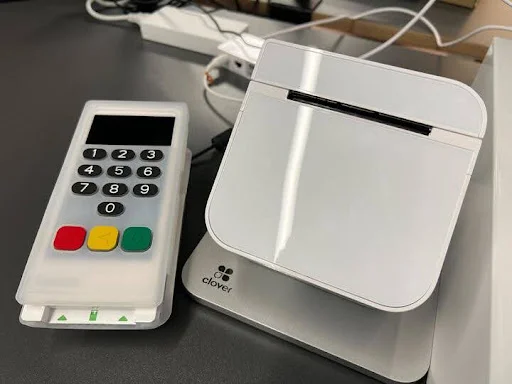
Clover POS card reader and receipt printer. Source: Tech.co
How Do Card Processing Fees Work?
If you’re on the lookout for a new processing option, you can expect to find three different pricing models: flat-rate, interchange plus, and tiered. Here’s a breakdown of the structures and suitability for different types of businesses:
Interchange plus pricing
Also known as “pass-through” and “cost-plus” pricing, interchange plus pricing is a payment structure that passes through the payment processor’s wholesale costs directly to the merchant. Since this pricing option is dependent on current interchange rates, it tends to fluctuate from month to month. This makes it one of the best pricing structures for small businesses because they’re able to benefit when interchange fees are lower.
Tiered pricing
Depending on variables, like card type and credit card, tiered pricing categorizes transaction rates into three tiers: qualified, mid-qualified, and non-qualified. When compared to interchange plus pricing, this is a relatively straightforward option because prices remain fairly consistent. However, since many transaction types land on higher price tiers, it’s less suitable for businesses with tighter budgets.
Flat-rate pricing
Flat-rate credit card processing is the primary model used by payment service providers, such as Square, PayPal, and Apple Pay. As the name suggests, this option imposes consistent charges and typically only distinguishes between CP, CNP, and online sales.
This makes this pricing structure ideal for budding and small businesses that are looking for a simple solution. However, since flat-rate processing doesn’t account for a processor’s wholesale costs, this option tends to be pricier than interchange plus pricing in the long run.
How to Save Money on Credit Card Processing Fees
Unfortunately, as we inch closer to a cashless society, if your business wants to diversify its payment options, paying credit card processing fees is inevitable. However, there are steps your business can take to limit the cost of these charges:
-
- Select the right pricing model – While the card processing structure will likely be determined by your business’s POS, if you’re open to new options it’s always worth considering which pricing model will incur the lowest costs. Interchange plus options tend to undercut tiered and flat-rate methods.
- Read the small print – Payment processors have a habit of hiding extra charges in their terms and conditions. To avoid getting caught out by add-ons like refunds and foreign card processing, sifting through the small print is essential.
- Negotiate with your card processor – If your business is experiencing higher transactions, you may be able to negotiate a better price with your card processor. The higher your transaction volume, the more leveraging power you’ll have.
- Choose your POS wisely – POS providers charge wildly different transaction rates. Keep an eye on these charges before you move with a solution to make sure you secure the best deal possible.
- Collect customer data – For B2B businesses that rely on an interchange pricing model, collecting client data, like invoice numbers and Tax IDs, can reduce interchange costs by 20%.
As businesses continue to be squeezed by rising costs of products and inflation rates, being mindful of secondary expenses like credit card fees has never been more important. Aside from factoring these fees into your budget, staying informed about the different pricing structures and the cost of different transactions are a few practical ways that vendors can soften the blow.
Selecting a cost-effective POS is another failsafe way to trim down on expenses, too. So, if you’re committed to finding a provider that suits your budget, our comparison tool can provide you with tailored quotes in minutes, and it’s completely free to use.
Credit Card Processing: FAQs
While the cost of credit card processing can vary heavily, businesses can expect to pay anywhere from 1.5% to 3.5% per transaction.
If you’re looking to cut down credit card processing fees, you can pass the fee onto consumers by imposing a surcharge. However, this option is very unpopular with customers and is legally restricted in certain states.
The most likely reason credit cards charge 3% fees is to cover the costs of foreign transactions. This type of fee typically ranges from 1% to 3% of the transaction and is imposed when account owners make purchases in foreign currencies.
The only way businesses can avoid credit card processing fees is by taking cash payments. However, businesses can limit the cost of credit card processing fees through a variety of methods, including selecting the right pricing model, reading the small print, and negotiating with card processors.
If you click on, sign up to a service through, or make a purchase through the links on our site, or use our quotes tool to receive custom pricing for your business needs, we may earn a referral fee from the supplier(s) of the technology you’re interested in. This helps Tech.co to provide free information and reviews, and carries no additional cost to you. Most importantly, it doesn’t affect our editorial impartiality. Ratings and rankings on Tech.co cannot be bought. Our reviews are based on objective research analysis. Rare exceptions to this will be marked clearly as a ‘sponsored’ table column, or explained by a full advertising disclosure on the page, in place of this one. Click to return to top of page


