


We may receive a commission from our partners if you click on a link to review or purchase a product or service. Click to Learn More
Most companies using a CRM track too much data, and as a consequence, are unable to turn it into actionable insights.
Built into platforms like monday CRM, CRM analytics surface the patterns buried in your data, turning raw numbers into decisions that move revenue, improve service, and scale your team’s output.
Thanks to AI, CRM platform can now automatically flag risks and opportunities without anyone having to pull a manual report.
- CRM analytics describes the organization and use of customer data to provide actionable insights for businesses to improve their sales, service, or marketing efforts.
- The benefits of CRM analytics include increasing conversion rates, reducing service times, and improving productivity for your business.
- CRM platforms automatically track customer data, which can be converted into reports and used to inform business decisions.
- CRM platforms should be used to analyze data like pipeline progress, customer acquisition cost, resolution times, and customer lifetime value.
- CRM analytics can improve ROI by as much as 138% and reduce service response times by up to 70%.
What Are CRM Analytics and Why Do They Matter?
CRM analytics is the reporting layer built into your platform that logs customer interactions to convert raw data into revenue-driving decisions.
Most teams have too much data, and don’t know how to turn it into something useful. CRM analytics connects activity to outcome, so you’re making calls based on what the data shows, not what someone assumes.
For example, monday CRM’s Deal Insights can help a sales team by showing where deals typically stall. A monday agent flags these trends automatically, so the team isn’t waiting for a quarterly review to course-correct.
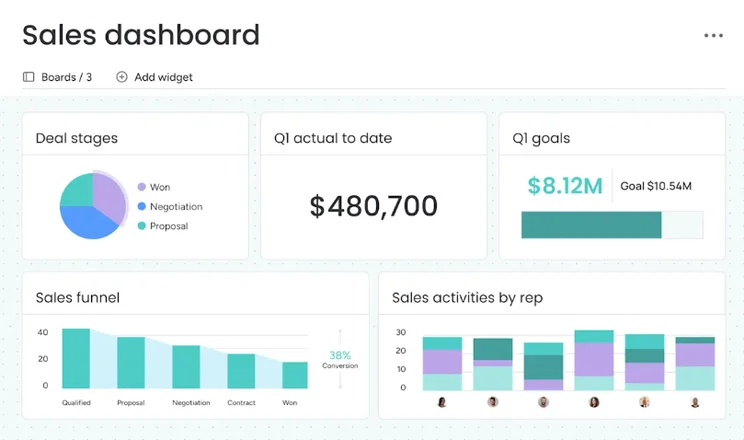
monday CRM provides users with customizable dashboards that shows critical data in real time. Source: monday.com
What Are the Key CRM Metrics To Track?
Some of the most important CRM metrics include win rate, conversion rate, and average deal value.
Win rate
- The percentage of closed deals
- Tracks overall sales effectiveness
- Clearest signal of whether your pipeline is converting
Conversion rate
- How many leads move from one pipeline stage to the next
- Shows where deals are progressing or stalling
Average deal value
- The average worth of a closed deal
- Helps forecast revenue
- Flags if your team is closing volume but not value
Sales velocity
- How fast deals move through the pipeline
- A slowdown here is usually the first sign of a problem upstream
Customer lifetime value (CLV)
- What a customer is worth over time
- Existing customers spend 67% more than new ones and are 14 times easier to convert, making this one of the most valuable metrics to track
Open and click-to-open rates
- How customers interact with your marketing emails
- Shows whether your subject lines and content are landing
Pipeline contribution by channel
- Look at which marketing channels are actually generating deals, not just traffic
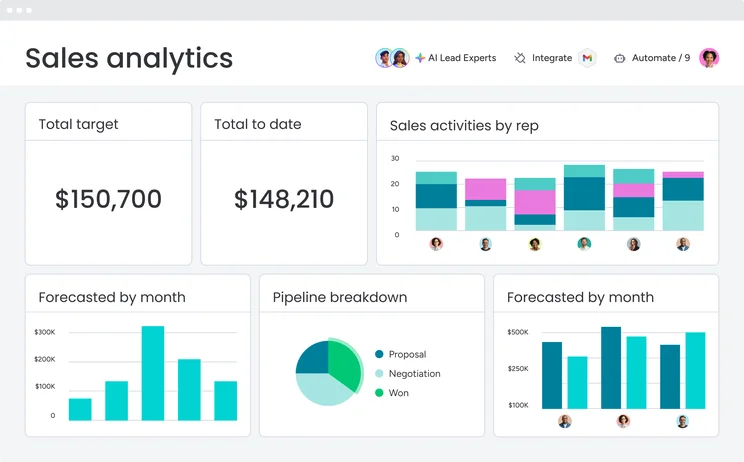
monday CRM provides users with an easy-to-understand analytics tool for their businesses. Source: monday.com
How To Use CRM Analytics Tools
Choose the right metrics, use data visualization tools, and practice good data hygiene if you want to use CRM analytics tools.
1. Choose metrics aligned to revenue goals
To get the most out of your CRM analytics platform, only choose metrics that are relevant to you.
More importantly, be as specific as possible. If your conversion rate is high but revenue is lagging, track win rate to see if conversions are leading to sales, and average deal value to see if they’re worth the time spent.
2. Implement real-time dashboards
CRM analytics take all your organized and analyzed customer data and put it into real-time visualizations that can help inform business decisions.
Use dashboards, tables, and graphs to communicate information more effectively. monday CRM’s built-in visualization tools let you build custom dashboards around the metrics that are relevant to your team.
monday CRM’s AI capabilities bring your data to life in concrete ways. monday sidekick generates on-demand dashboard summaries, collating deal performance, pipeline health, and team activity into a single briefing.
monday agents automatically build and update reports as data changes, so your team always has a current view without manual intervention.
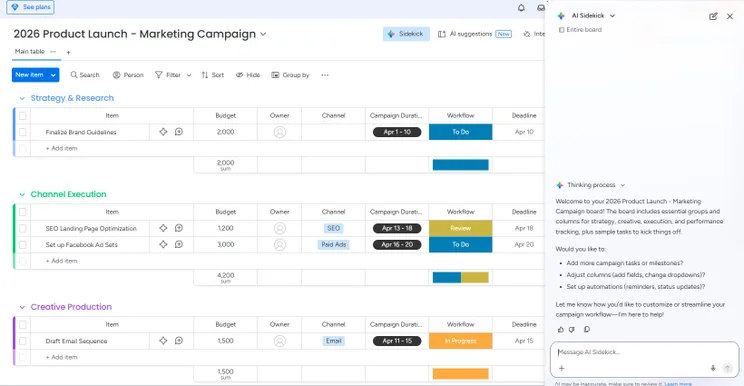
monday Sidekick can create boards for you from a natural language prompt. Source: Tech.co
3. Enforce automated data hygiene
Data hygiene means that your CRM analytics platform has a supply of good, accurate data that won’t interfere with your analytics.
Regularly check that your data is coming from the correct sources and isn’t leading you in the wrong direction.
monday CRM helps with this through built-in data management controls that flag duplicates and standardize records across your pipeline, keeping your analytics clean as your data scales.
4. Leverage different AI tools
Beyond standard analytics features, platforms such as monday CRM have advanced AI tools to help you to quickly make informed decisions. For example, predictive lead scoring automatically ranks new prospects based on their likelihood to close.
Elsewhere, integrations with leading workplace apps, such as Gmail, enable users to sync customer data between platforms and streamline key workflows, such as tracking email correspondence.
What Are the Benefits of Using CRM Analytics Tools?
Benefits of using CRM analytics tools include higher conversion rates, reduced service times, and improved productivity.
Increase conversion rates
CRM analytics improves conversion rates by giving your team the context to act at the right moment.
monday CRM’s predictive lead scoring ranks leads by their likelihood to close, so your team spends time on the deals most likely to move.
Implementing predictive lead scoring within a CRM can increase conversion ROI by up to 138%.
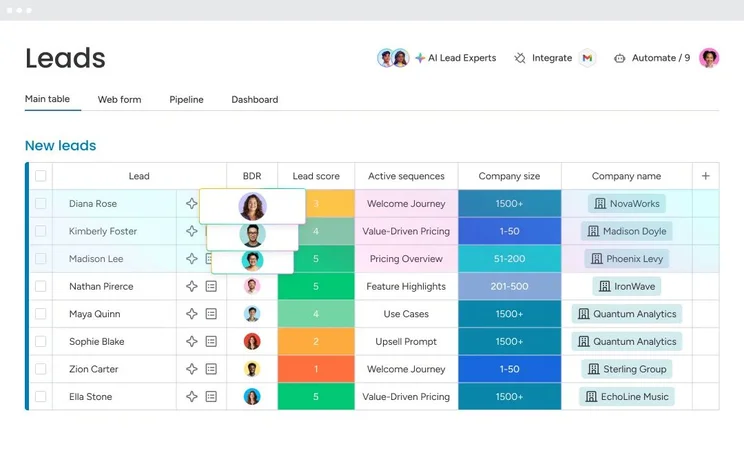
monday CRM can score leads for you, so you know which ones to focus on for a quick sale. Source: monday.com
Reduce service times
CRM analytics reduces service times by up to 70% by surfacing customer history and proposed solutions before agent interaction. When a customer contacts support, the time spent asking basic questions is wasted time.
CRM analytics surfaces interaction history and suggests resolutions, cutting out the back-and-forth.
Improve productivity
CRM analytics gives teams a clearer view of where time is actually going, and where it’s being wasted.
monday CRM AI handles lead scoring, flags at-risk deals, and automates routine tasks, so your team spends less time managing information and more time acting on it.
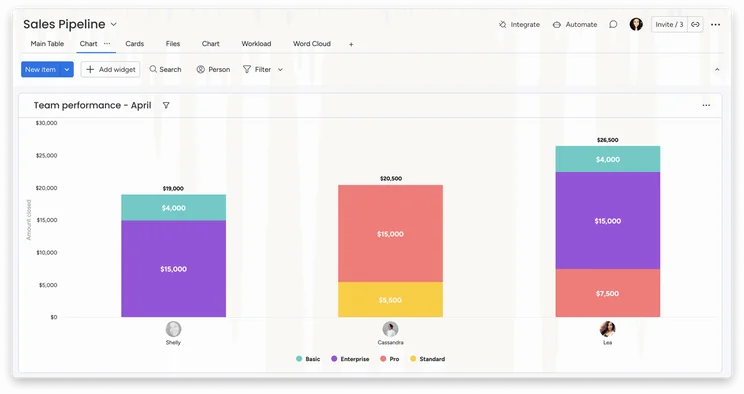
monday CRM provides a lot of tools to create visualizations of data that help you get the message across. Source: monday.com
How an Analytic CRM Processes Customer Data
An analytic CRM collects, organizes, and analyzes customer data, so that teams can make data-driven decisions.
Data collection
monday CRM automatically captures data through your existing workflows, including completed sales, closed tickets, email interactions, and pipeline activity, with no manual logging required.
Data organization
Data is segmented by factors like deal stage, lead source, or customer behavior, and surfaced through live dashboards that can trigger automated workflows based on what the data shows.
Data analysis
monday CRM’s AI-powered reporting identifies trends across your data, flagging things like deal stages with high drop-off rates or response times that are creeping up, so your team isn’t hunting for problems manually.
Data-driven decisions
The output is a clearer picture of where to focus, such as which leads to prioritize, which workflows to fix, and where the biggest revenue opportunities are sitting.
CRM analytics provide valuable customer data and actionable insights based on emerging trends.
For teams ready to put this into practice, monday CRM offers live dashboards, automated reporting, and AI-generated insights that surface what matters without manual input. Plans start with core analytics tools, with more advanced AI-powered reporting available on higher tiers.
Some platforms offer different reporting tools than others, so it’s worth investigating what’s available before committing to a system.
Frequently Asked Questions
Yes, CRM analytics tools can track offline touchpoints without manual logging through third-party integrations. By connecting other systems to your CRM, like point of sale (POS) systems or call monitoring software, you’ll be able to automate the data collection of metrics beyond the standard offering of your platform.
AI is the biggest shift happening in CRM analytics right now. Platforms like monday CRM are moving beyond static reports toward real-time, AI-generated insights that surface risks and opportunities automatically. The main challenge for most teams is data quality. AI-powered analytics are only as good as the data fed into them, which makes clean, well-governed CRM data increasingly important as these capabilities grow.
Yes. Sales velocity tracks how quickly deals move through your pipeline, and a slowdown is usually the earliest signal that something upstream needs attention. It factors in the number of opportunities, average deal value, win rate, and length of sales cycle, giving you a single metric that reflects overall pipeline health. monday CRM surfaces this alongside other deal metrics through Deal Insights.


