

We may receive a commission from our partners if you click on a link to review or purchase a product or service. Click to Learn More
Virtually any business will have assets, from physical ones like laptops to less tangible ones like software licenses and even rental agreements. As a result, your business will need an asset tracking system.
Just opting for a simple asset tracking spreadsheet is one low-effort solution to this problem. However, you’ll never be sure if it’s out of date or inaccurate. To really streamline your operation, you should build a custom system that combines asset tags and asset tracking software.
Asset tags can log an asset’s location, helping to confirm that everything is where it should be at all times. A powered asset tag can even log additional data, from engine status to out-of-hours use. Here, we’ll discuss what asset tagging actually is, as well as looking at which type of asset tag could benefit your business and why.
What Is Asset Tagging?
Asset tagging is a key element in asset monitoring and management, which are processes that in turn help you optimize asset lifecycles.
You should keep your assets in good operational condition by maintaining them regularly, whether that means dusting them off or rotating their tires. Asset tags will ensure that you don’t miss a single asset during this process. As long as you follow the correct schedule, your assets will stay in peak condition right up until they finally need to be replaced – and asset tags can help you track each asset’s age as well, so you don’t miss a replacement, either.
Basic asset tagging doesn’t need to come at a high cost. Barcode tags are particularly inexpensive, and small businesses in particular may be well-served with free asset tracking software. Operations with powered assets like bulldozers or delivery vans, however, will need to pay more for the right GPS tracking tags. Whatever the cost, the importance of asset tags lies in their ability to earn a business the most revenue as safely and efficiently as possible.
Types of Asset Tags
Businesses can use a variety of different asset tags, depending on their needs. Barcodes are one of the most common tags for fixed assets, while GPS tags are among the most common for powered, movable assets.
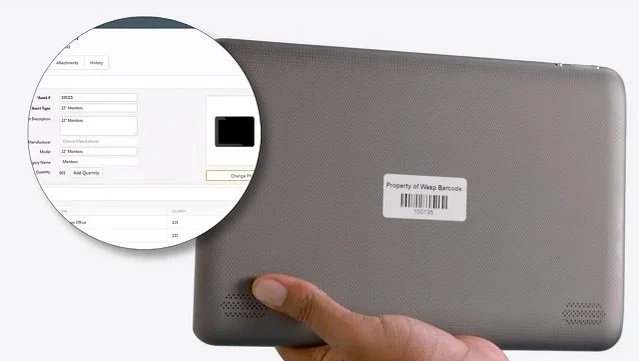
An example of a barcode tag on a laptop, along with a snapshot of the Wasp asset management software used to track it. Image source: Wasp
Barcodes
Best for: Small, inexpensive items
Barcodes are the most simple unpowered asset tag. Once attached to an asset, they’ll remain in place until they are manually scanned by an employee with a handheld scanner. Once scanned, your asset tracking software will have the location and time of the scan, allowing for basic asset tracking and preventative maintenance.

An example of a QR code being scanned by a mobile phone. Image source: Kampus Production
QR codes
Best for: Small, inexpensive items
QR codes function very similarly to barcodes: They must be found and manually scanned in order to track basic location information. However, a QR code uses a unique box-shaped pattern of black and white pixels, rather than a striped rectangular barcode.
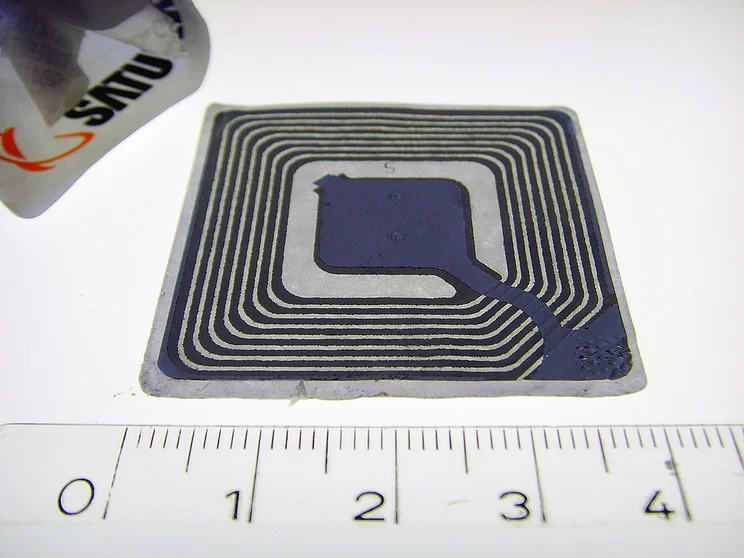
An example of an RFID tag, alongside a ruler for scale. Image source: Wikimedia
RFID
Best for: Small, but expensive items like medical equipment or laptops
An RFID, or “radio frequency identification,” tag stores more information than a barcode or QR code, as it can hold maintenance needs and history in addition to an asset’s electronic product code. All RFID tags use an antennae to transmit the information directly to a nearby receiver, so they won’t need to be manually scanned. This makes RFID tags the best solution for small, movable, and expensive assets, and perfect for industry-specific cases like hospital asset tracking.

An example of an NFC tag on the back of a mobile phone. Image source: Wikimedia
NFC
Best for: Swipable cards or tokens
The NFC, or “Near-Field Communication,” tag is an evolution of an RFID that uses an electromagnetic radio field, rather than a wave which travels to a receiver. NFCs typically have more storage and faster reading times than RFID, but come with much shorter transmission ranges of just four inches or less.
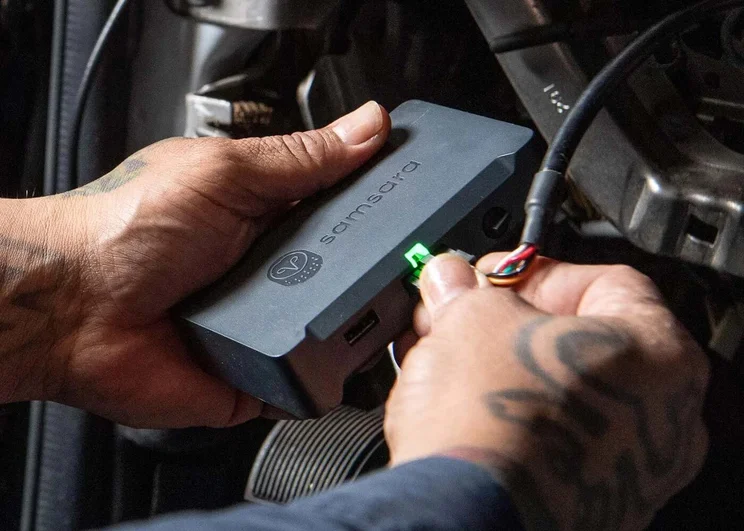
An example of a GPS asset tracking tag being installed on a vehicle. Image source: Samsara
GPS
Best for: Power tools, large equipment, or vehicles
A GPS, or global positioning system, tag is a battery-powered asset tracker that bounces its heavy-duty radio signal off of a satellite system in order to reach any receiver around the globe. This makes the GPS tag the most expensive type of asset tracker and the only one that can track an asset anywhere. GPS tags can also be hardwired into an asset’s engine, tracking and sending valuable up-to-the-minute data on the vehicle’s operations.
How Does Asset Tagging Work?
Once you’ve figured out which types of tags to use for which assets, you’ll need to know how to integrate the tags with a single asset tracking software interface. The different types of tags and assets will likely require different management plans and, depending on the size of your operation, you may need a single asset manager or an entire team to handle all the responsibilities.
Some assets may need to be checked in and out on a daily basis, while other fixed assets will simply need to be audited quarterly or annually to verify they are in working condition. You may need a software that supports employee tickets so that they can scan the specific barcode of the laptop they’re using, or you may need a software that automatically tracks GPS tags so that you’ll get an SMS alert when a piece of construction equipment moves outside a designated area.
Ultimately, the business requirements that determine how asset tagging works will vary widely between types of assets.
Best Practices
To use asset tags effectively, you’ll need to tailor them to your business needs.
- Choose the right tag: Use a barcode for a large powered asset and you’ll lose out on valuable data that a GPS could provide. Use a GPS tag for a small, inexpensive asset, however, and you’ll be increasing costs without a clear benefit.
- Audit your assets regularly: Hands-on audits will confirm that assets are in the right locations and conditions that your system claims they are in.
- Maintain and replace assets when needed: Any good asset management system needs to use corrective maintenance and preventative maintenance together in order to best optimize asset value.
- Train employees on asset tag use: Even a perfect system won’t work if employees don’t follow it. Encourage managers to follow up in the moment with any employee questions, or establish an quick annual explainer that can refresh everyone’s understanding at once.
- Consider security roles: Asset tracking data can be dangerous in wrong hands. With too many cooks in the kitchen, you’ll open yourself up to potential data breaches from malicious or inattentive employees.
Learn more about how to increase the lifecycle of your assets in our guide to asset maintenence.
Advantages of Asset Tags
All businesses have assets, but not all of them build their asset management system on top of tags. Instead, they might rely on manual identification to track down their asset locations when they need each individual asset. For a tiny business, these inefficiencies may be easy to overlook, but they still exist. Any business, small or large, will be better off with asset tags. Here’s why.
- Real-time management: You’ll be able to respond to unexpected changes immediately, not after the fact.
- Lower costs: Your asset tracking costs may appear to increase your budget, but they’ll ultimately help you stretch out your asset use by ensuring you can locate and maintain them at all times.
- Loss prevention: Misplaced, stolen, or misused assets can be flagged and located using their tags.
- Visibility and safety: Knowing the location and condition of all your assets boosts safety protocols, since you’ll track when assets are in a dangerous condition to be used and must be replaced.
- Faster scaling: Business growth demands more assets, but once established, a system of asset tags and management software will be able to handle all the assets you need.
In the end, asset tags contribute to better visibility and efficency, which all goes towards a stronger bottom line, and more than pays for itself.
Choosing the Right Asset Tags for Your Business
This quick cheat sheet offers the most common asset-and-tag combinations:
- Small, inexpensive, and fixed or rarely moved assets: Barcodes or QR codes
- Expensive or movable but unpowered assets: RFID
- Swipable assets like cards, tokens, or mobile devices: NFC
- Powered, movable assets: GPS
In the end, though, you’ll choose which tags are right for your needs. Some businesses might choose to use barcodes for their laptops, while those that need higher asset visibility will opt for RFID. You’ll also need to look at the distinct requirements of software asset management if that’s relevant to your business.


