

We may receive a commission from our partners if you click on a link to review or purchase a product or service. Click to Learn More
There are few things more satisfying than creating your own successful online business from scratch — and there are plenty of user-friendly ecommerce platforms to help you do just that.
However, it can be just as rewarding, financially and personally, to sell your business when it’s time to move on to a new challenge.
If you’ve put a lot of time and care into your company, you’ll want to make sure that you’re well rewarded when it comes time to sell. We asked Ben Fletcher, CEO of ecommerce aggregator The Mothership, for his recommendations on how to ensure your sale goes smoothly.Here’s Ben’s advice, as told to Tech.co Editor, Jennifer McIlveen.
Why Do People Sell Their Ecommerce Business?
The main reason why people usually sell their ecommerce business is to do with financial freedom.
Many business owners have most of their financial value tied up in their business and its stock, in an apt illustration of putting “all your eggs in one basket.” Selling offers business owners the opportunity to unlock funds and de-risk their net worth.
Besides, let’s face it: Running an ecommerce business is hard work. Whether you’re selling directly to consumers (DTC) or using a model such as fulfillment by Amazon (FBA), there are plenty of challenges to overcome.
Amazon ranking positions change, Google SEO algorithms update, competitors change their prices, listings get hi-jacked, shipping prices fluctuate madly, manufacturers ship late, stocks can run out and sales tax rules are too much. It can be long and painful.
Selling your ecommerce business not only offers financial freedom but gives you the freedom to escape the rat race and all its stresses – or start over. Often, sellers of ecommerce businesses go on to create an even better new business.
Off the back of getting a cash lump sum for your business, you might choose to invest in:
- Buy-to-let properties
- Stocks and ETFs
- New and exciting startups
- Paying off your mortgage
- Educating your kids
- Life experiences and bucket list holidays
- Gold or cryptocurrency
- Health insurance
- Buying or expanding your home
- A dream project such as a boat or holiday property
By spreading your wealth across many of these different options and expanding your portfolio, you can significantly increase the defensibility of your net worth.

Who Will Buy My Ecommerce Business?
Strategic buyers, aggregators, and private equity buyers are some of the individuals or businesses that could be interested in your ecommerce business. Read more about each below.
Strategic Buyers
Strategic buyers tend to be large competitors in your current market, who are looking to take a greater market share. They tend to be called “strategic buyers” in the US and “trade buyers” in the UK.
Aggregators
Aggregators are businesses with the primary aim of acquiring and growing multiple high-quality ecommerce businesses. This newly created group of potential buyers has only been in the game since 2018.
Full transparency here: My business, The Mothership, is an ecommerce aggregator. Other key players looking to acquire great ecommerce brands include Thrasio, Perch, and Berlin Brands Group.
Private Equity
Private equity buyers tend to look at businesses that start at $1m EBITDA (Earnings Before Interest, Taxes, Depreciation, and Amortization) and up, and have a very fast growth curve.
Private equity buyers look for ecommerce performance consistency and often look to keep the senior management in place, so are more likely to do a partial sale (i.e. less than 100%) unless they already have a similar business to yours in their portfolio.
When Should I Sell My Ecommerce Business?
Your choice to sell should be driven by when you personally need the cash, when your business is prepared for sale, and when there are lots of active buyers in the market.
Our recommendation would be to sell only when you have your business ready for sale, and either you need the cash or there are lots of active buyers in the market.
Ideally, you don’t want to sell your business during a crash or a recession, as there tend to be fewer buyers (due to there being less freely flowing cash) and therefore the multiples in the market tend to get depressed, meaning you may have to settle for less.
It may seem obvious, but don’t sell your business during a crash or recession.
Now is a good time to sell, as despite the challenges presented by the pandemic and an ongoing global conflict, there isn’t a recession and there are a lot of well-funded buyers in the market.

Possible Deal Structures
When selling your business, you are likely to be offered not just immediate cash but something else called deferred consideration. Deferred consideration is money that is paid in the future, and usually comes with strings attached that are to do with how well the business performs.
Typically, in ecommerce deals, around 25-50% of the money is paid upfront and then you can receive the rest at a later time, depending on how the business does.
The most obvious metrics that deferred consideration payments are attached to are revenues; gross profit, EBITDA (Earnings Before Interest, Taxes, Depreciation, and Amortization) or SDE (Seller Discretionary Earnings).
Sometimes deferred payment structures can be called “stabilization payments” or “earn out payments.”
- A “stabilization payment” is usually paid out pretty soon after the business is acquired, and is conditional on the business performing no worse than it did before it was acquired.
- An “earn out payment” is usually paid out over a longer period of time after the acquisition is made, and is usually attached to improvements in business performance.
Buyers like deferred consideration deals, because they’re a shield against the risk of your business not performing as well as expected and can incentivize you to help out during the transition.
If you are keen to wash your hands of a business completely, and more quickly, try to negotiate for all your cash upfront without any deferred consideration. Buyers may be willing to offer you this provided you can assure them that you will help them take on the business, but you may also have to accept a lower overall offer.
Valuing Your Ecommerce Business
There are a variety of factors that will impact the valuation of your ecommerce business by a potential buyer, and some are more important than others.
1) Profit and Loss
The profit of your ecommerce business will be the main factor that drives your valuation, and your valuation will usually be calculated as a multiple of the profit you make. It may be measured in Seller Discretionary Earnings (SDE) or Earnings Before Tax and Depreciation (EBITDA).
The larger your profits, the more buyers there will likely be for your business, and the larger your valuation multiple will be.
For example, say your business makes $200,000 of profit. You might get three times profit multiple and a $600,000 valuation, but at $500,000 of profit, you might get four times multiple and a $2,000,000 valuation.
According to Flippa, ecommerce multiples have fluctuated over the past few years. By 2024 H2, multiples stabilized at 3.98x, suggesting a shift toward sustainable profitability, rather than rapid growth.Your percentage profit margin can have a big influence on the valuation of your business, too. Taking your profit then dividing it by your revenue will give you a margin. If your business has a margin lower than 10%, you are likely to attract fewer buyers. Ideally, you will want a margin of over 20% to attract a higher valuation.
2) Growth Rate
Growth rate is usually determined based on the difference between your last two financial years’ revenue or profit and will likely impact the multiple of the valuation you get paid.
If you think about it, anyone buying a business growing at 50% per annum should see that business double in size in under two years. Therefore, a buyer should be paying a lot more for this than for a business that’s not growing at all.
3) Growth Opportunities
If you can clearly explain what the growth opportunities are to the potential buyer of your ecommerce business, and those opportunities are genuine and believable, then your buyer will likely be able to pay more for your ecommerce business, on the understanding that they could execute these growth opportunities.
The most common growth opportunities are:
- International expansion via Amazon or Direct to Consumer (DTC) sales. Growth may be possible by targeting the US, EU, AUS, CA or UK, where you aren’t selling there yet.
- New channel expansion. Growth could be unlocked by selling on channels such as Facebook, Google, YouTube and TikTok, in addition to the other channels you might be running on already.
- Increasing advertising spend. Putting more capital behind advertising could accelerate your ecommerce business growth.
- New product releases. Launching related products could add revenue streams to your business.

4) Product Quality & Uniqueness
How well your main products are reviewed on Amazon, social media sites and trusted review websites will have a big impact on how highly buyers will value your business. The volume of reviews for your products is also important, as this will add weight to the ratings given and support that your products really are of high quality.
In addition to quality, the uniqueness of your product designs and their ability to be protected through copyright, patents, design patents, trademarks, and registration on Amazon Brand Registry (1.0 and 2.0) will all increase the value of the business. If you are mainly reselling third-party products, this tends to lower your ecommerce business valuation.
5) Product Sector
Product sector can have a big impact on your business valuation, as it can be an indicator of expected performance and growth opportunity.
- Products that can be sold all around the world and are less regulated tend to command a higher business value than those that are more challenging to sell globally. For example, certain health products are regulated around the world, therefore they are harder to sell globally, and have less obvious growth levers.
- Sectors that are highly seasonal aren’t valued as well as more evergreen sectors, as they require greater working capital to run.
- Sectors that have physically smaller products, which can be sold easily through FBA (Fulfilled by Amazon), tend to command more money than sectors with larger products that need their own fulfillment via FBM (Fulfilled by Merchant).
- Product sectors that work on Amazon and can also be sold on a Shopify/WooCommerce-style website with Facebook, Google, TikTok and YouTube marketing tend to command a higher value.
- Product sectors with repeat purchase habits tend to command a higher value.
- Products that sit within a growing sector tend to command higher multiples. For example, products that fit into the vegan sector tend to do well, as this is a hugely growing consumer area across many major ecommerce markets.
The sectors that are most in demand and thus have the highest valuations tend to be those in substantial growth: house and garden, pets, babies, outdoors, and health and beauty.
6) Number of High-Selling Product Lines
Having several high-selling product lines is great for boosting your ecommerce valuation, as a buyer will be willing to pay more for a business that is well established in particular areas. Having too many product lines that sell in lower volumes is not as good for valuations, because this indicates your buyer will require a lot more cash to grow your business.
7) Number of Offers
One critical factor affecting the valuation of your business is how many offers you get for it. The more offers you get, the more competitive tension there will be. Valuations have been growing recently, driven by lots of buyers in the market.
The graph below shows the average numbers of Letters of Intent (an official offer) received across 28 Amazon (FBA) businesses that sold.
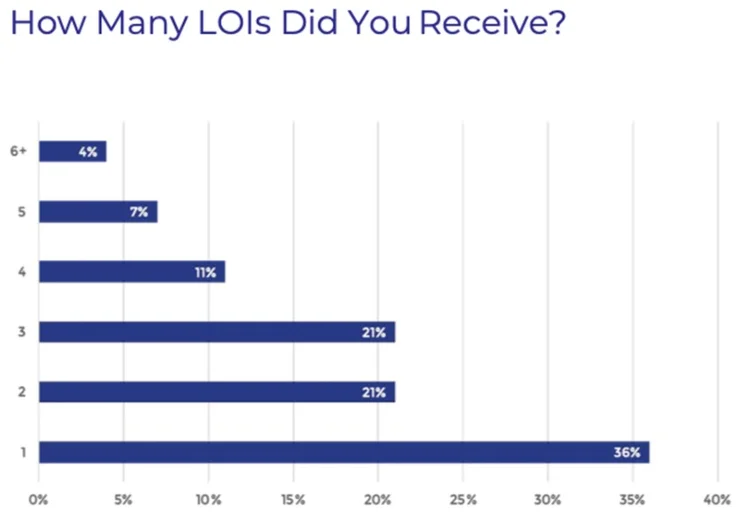
The better your business is prepared for exit, the more offers you are likely to receive – and thus the higher the price, as buyers bid up for your business.
How Do I Calculate a Weighted Returns Valuation?
This is simple to do – just multiply each element of the potential deal by the probability that you believe it will become cash in your bank.
To compare like for like with regards to any offers you might have on the table when selling your ecommerce business, it is worth calculating a weighted return.
See the two deals listed below to get an idea of what this might look like:
|
Upfront Cash
|
Stabilization Payment
|
Probability of securing cash
|
Weighted return
|
|
|---|---|---|---|---|
|
Deal A |
Deal B |
|||
|
$1,000,000 |
$900,000 |
|||
|
None |
$320,000 |
|||
|
100% |
80% |
|||
|
$1,000,000 |
$1,220,000 |
In this example, Deal B probably makes more sense than Deal A, even though Deal A gets more guaranteed cash upfront.
Step by Step: The Sales Process
Selling your ecommerce business involves seven logical steps:
1) Identifying Potential Buyers
The first step to selling your ecommerce business is working out who the potential buyers might be, including strategic or trade buyers, aggregators and private equity options.
2) Reaching Out to Potential Buyers
Once you’ve identified who might be suitable to purchase your ecommerce business, you’ll need to submit your details to the potential buyer’s website or contact the buyer personally.
Specifically, you’ll want to speak to someone in the Mergers and Acquisitions or Corporate Development department. Alternatively, if it is a smaller company without these departments, aim for the CEO.LinkedIn works well as a point of connection, as does email or a personalized letter. We recommend using all three approaches, so you cover all your bases.
3) Receiving Offers
To receive legitimate offers for your ecommerce business, you’ll need to have provided enough detail to get buyers interested. We recommend sharing the following initially:
- A two-page overview of your business
- An excel file containing your profit and loss accounts for the last three years, along with a balance sheet
This should be sufficient to start getting indications from buyers as to whether you might be a good fit for them or not.
Buyers will likely need more details once they’ve indicated their interest, such as:
- A list of all your products (SKUs) and a breakdown of their landed costs
- A profit breakdown by marketing channel and marketplace
- Your current stock valuation
If potential buyers remain interested after receiving their requested details, they will likely move onto providing a formal Letter of Intent (LOI). This is a document that outlines the main terms by which they want to buy your ecommerce business.
A Letter of Intent should include an overview of how much a buyer is offering and the conditions attached to that offer, as well as a timeline regarding the closing of the deal, an overview of restrictive covenants (more on these later) and a high-level overview of the contract.
You can set a reasonable deadline for interested buyers to submit their letters of intent by. In order to get to this stage as quickly as possible, and start weighing up your options, prepare all of the above information before reaching out to your potential buyers.
4) Negotiating Letters of Intent (LOIs)
Once you have a letter of intent or two, it’s time to negotiate the best deal you can. Obviously, the more letters you have, the more negotiating power you have, too.
The sale price is usually the most important piece of the negotiation, but there are also conditions around stabilization payments or earn outs that may need to be negotiated, as we explained above.
Other important matters include restrictive covenants and details of how the new owner plans to use the business you’ve built up.
This phase can be a bit of an emotional rollercoaster. One day you might think it’s crazy to sell your business, the next you might think it makes the most sense.
Choosing the right buyer can be tricky. It is really important that you discuss in detail all the things you care about regarding your business, and are open and honest about where it stands. It’s not a time to hold back – give your buyers a warts-and-all look, so that they are not surprised or shocked by anything they might find.
You should also ask lots of questions about any areas of concern in the potential deal and seek full transparency for what will happen once it is closed. Very often sellers want to know what the plans are for staff of the business.

5) Doing Your Due Diligence
Once a letter of intent is signed, a deal is provisionally agreed upon. Then, the due diligence phase begins to secure exclusivity and the closing of a deal with one successful buyer.
There are usually four factors in securing exclusivity:
- Data Requests: These are requests from the buyer around a specific topic. You will need to supply answers or data to the buyer via a shared Dropbox-style folder.
- Financial Diligence: This is something the buyer will do, but often they will need access to your Amazon account and/or ecommerce backend to allow them to ensure the financials are correct.
- Legal Diligence: This is something the buyer will do to ensure they can get all the relevant rights to things like domain names, trademarks and software as part of the sale.
- APA or SPA Drafting and Finalization: Finally, the buyer’s lawyer will draft an asset purchase agreement (APA) or share purchase agreement (SPA) for you to review. You will need to get a lawyer of your own to review the document’s small print and provide markup on the document for any areas you are not happy with. Eventually, you will arrive at a complete document that both sides are happy with, at which point the sale will be ready to complete.
6) Completing the Deal
First, the buyer’s lawyer will need to receive the agreed upon amount in cash from the buyer. The signing of the agreement can commence when this is in place.
Once the agreement has been signed by all relevant parties, the funds can be transferred from the buyer’s lawyer over to your lawyer and then on to you, for the purchase of your ecommerce business. Pop the champagne!
7) Transitioning and Integrating
Once you’ve sold your ecommerce business, there will be a transition period as you transfer all necessary parts to the buyer over the agreed time period. This often involves integrating technology, staff, logistics and suppliers into the buyer’s organization.
Restrictive Covenants
It’s important to note what restrictive covenants are, as your ecommerce business buyer will likely want you to sign up to some as part of the deal agreement. Restrictive covenants are basically restrictions that are placed on you as a condition of the sale, that mean you can’t do certain things such as:
- Compete against your old business
- Hire staff from your old business
- Use the suppliers from your old business
This is part of the deal negotiation that needs to happen.
Restrictive covenants tend to last between six months and three years, so if you’re looking to start a new ecommerce business after selling up, you’ll want them to be as short as possible, without spooking your buyer.
Restrictive covenants tend to last between six months and three years.
If you want to take certain staff with you into your new business, you should work this out before you enter your sale process, so you can negotiate exact details in the restrictive covenant about which staff are out of bounds to you during the restrictive period and which are not.
Try to negotiate the definition of “competition” to be as narrow as possible and highly specific – for example, “not allowed to sell vegan vitamin supplements via Amazon in the US” would be a better agreement than “not allowed to sell any product on Amazon, worldwide” for the restrictive period.

10 Tips to Maximize Your Business Valuation
The key to getting a high valuation is getting as many buyers as you can excited about your business, and removing as many stumbling blocks from your sale process as possible.
Tip 1: Get Your Financials Correct from the Get-Go
Ensure that your Profit & Loss records truly reflect the status of your business. Any errors can lead to disappointment on both sides, including significant drops in the price of your business. Hiring a good external accountant and/or using top-notch accounting software will help you to sort this out.
Tip 2: Get Your Tax Sorted
A company with tax issues is less attractive to buyers. You must ensure your corporation tax and sales tax/VAT are all in order before you try to sell your business.
Sales tax in the US is a complex business, particularly for Direct to Consumer (DTC) ecommerce revenues, with variation across all states – but it’s also a non-negotiable factor for buyers.
Popular software like QuickBooks have become staples of the business world for providing tax assistance, and can really help you get everything sorted out.
Tip 3: Maximize Profits in the 12 Months Before You Sell
Sounds obvious, right? But think carefully about your investments and profits in the year you plan to sell, and perhaps prioritize short-term gains more than you normally would.
Consider new hires really carefully – if they can have an immediate profit impact then bring them on board, but if their addition is more of a slow burn in terms of profit, think about postponing your hiring until after the sale has gone through.
Consider new country or channel launches carefully, too, since they could be costly on the profit line. But also be careful not to “window dress” for sale and fail to invest at all in the future growth of the business, as you may not sell immediately – and if growth starts to drop, then it will impact your valuation.
Tip 4: Don’t Run Out of Stock
This isn’t always in your control, but you should do everything possible to ensure your main items are well stocked in your sale year. Any out-of-stock issues could have a huge impact on profitability, and therefore the amount you’re able to sell for.
Tip 5: Consolidate SKUs
Buyers tend to want to buy businesses with fewer products that all sell at high volumes, rather than a lot of low-volume SKUs. It may be worth getting rid of low volume, low profit contributing SKUs, and SKUs with poor ratings, so as not to put off potential buyers.
Tip 6: Consider Your Warehousing and Logistics Strategy
Buyers want easy lives, so to give them confidence and attract a higher offer for your ecommerce business, simplify your logistics where possible.
Having your own warehouse and warehouse staff is a headache for any buyer, as they then have to take over its management. If there will be minimal impact on your profit line by moving to a reasonably priced third-party logistics provider, then do it before you sell, as you will attract more buyers that way.
Tip 7: If You Have a Bulky Goods Business (e.g. Furniture), Sell in a Year of Low and Stable Shipping
2021 was a nightmare for bulky goods businesses, due to the massive impact shipping cost rises had on them. Timing is everything if you’re looking for a strong sale.
Tip 8: Source and Test a Backup Supplier
Buyers will often spend time researching your main supplier and checking that they are a stable, decent and reputable outfit. It gives the buyer more comfort if you have a backup supplier you have sourced from already.
Tip 9: Spend Time Outlining Growth Opportunities
The more data you have to prove your growth opportunities, the better it will be for the sale of your ecommerce business. Use data to demonstrate to buyers how much growth there is to be had in a new territory, new channel, or new product launch you have planned.
Tip 10: Make Sure You Trade Well During the Sale Process
Dips in performance during the sale process can either cause the buyer to drop their price or drop out completely.
Make sure you focus on the business and don’t drop the ball on performance even if the process is going swimmingly. Using the right technology can be crucial to ensuring that this is the case.
Best Ecommerce Software
Below are some of Tech.co’s top recommendations for ecommerce software that can keep you on the straight and narrow both before and during the sales process.
Best Ecommerce Website Builder
Our top-rated ecommerce website builder is Wix thanks to its plentiful features, general ease of use, and stunningly beautiful templates.
Even better, first time users need not fret about getting their online store up and running, as Wix provides a comprehensive ADI that allows you to answer a few simple questions and will create a website for you based on your responses.
Wix is also great about updating its platform, so you can be sure that if it’s missing a key feature, you’ll see it on the platform sooner rather than later. Take a look at a few website builders below if you’re in need of a way to revamp your online store.
|
Cheapest price
The most affordable plan that offers ecommerce functionality
|
Special deal
|
Staff accounts
|
Products
|
Multi-currency display
|
App market
|
POS compatibility
|
Checkout customization
|
Multi-location inventory
|
||
|---|---|---|---|---|---|---|---|---|---|---|
|
BEST OVERALL
 |
 |
 |
 |
 |
||||||
|
Wix |
Squarespace |
Shopify |
Hostinger |
GoDaddy |
||||||
|
$26.10/month with code TAKE10 |
$17.10/month with code TC10 |
$1/month for first 3 months |
$3.59/month with code TECH |
Save 53% with annual contract |
||||||
|
Up to 15 |
Unlimited |
Up to unlimited |
1 |
1 |
||||||
|
50,000 |
Unlimited |
Unlimited |
1,000 |
Unlimited |
||||||
|
35+ |
100+ |
130+ |
75+ |
50+ |
||||||
|
|
|
|
|
|
||||||
|
Add-on |
Square integration |
|
|
|
||||||
|
|
|
|
|
|
||||||
|
|
Add-on |
|
|
|
Best POS Systems for Ecommerce
Square is a great option for companies looking to sell online, due in large part to its affordable offering and ease of use. In fact, the platform is so affordable that it offers a free plan to get your store active at no cost to your budget. The free plan does have transaction fees though, so it might be better to opt for a paid plan if you’re selling a lot of products.
Simply put, Square is ideal for small businesses, as it provides the essential features you need at a good price, while not overwhelming new users with a lot of features they probably won’t need. Check out our collection of POS systems to see if any are a good fit for your business.
|
Price
The typical lowest starting price. The lowest price available for your business will depend on your needs
|
Tech.co retail rating
Score out of 5 for general retail suitability based on Tech.co's independent market research
|
Best for
Tech.co's verdict to help you identify the most suitable choice for your retail business
|
Hardware
|
iPad app
Is there a version of the software made specifically for iPad use?
|
Android app
Is there a version of the software made specifically for Android tablet use?
|
24/7 support
|
Get started
|
||
|---|---|---|---|---|---|---|---|---|---|
|
BEST OVERALL
 |
 |
 |
|
 |
|||||
|
Square POS |
Clover |
SumUp |
Shopify POS |
Lightspeed |
|||||
|
Free |
From $16/month for 36 months (depending on plan) |
$0/month |
From $0/month |
From $89/month |
|||||
|
4.8
|
4.5
|
4.5
|
4.3
|
4.1
|
|||||
|
Ease of use |
Managing rapid retail expansion |
Data-driven sales insights |
Managing in-store and online sales in one platform |
Managing multiple stores |
|||||
|
Sold by Square, separately or bundled. Works with most leading brands and has a great free trial. |
Sells a broad range of hardware, including full cash stations and mobile card readers |
Sells a range of in-house hardware, including iPad stands, card readers, and KDS |
Sold by Shopify, but also works with iPads and Android tablets |
Specialized hardware available. Not compatible with weighing scales |
|||||
|
|
|
|
|
|
|||||
|
|
|
|
|
|
|||||
|
|
|
|
|
|
|||||
| Try Square | Compare Prices | Try SumUp | Try Shopify | Compare Quotes |
Best Accounting Software
Our research shows that Zoho Books is the best choice for accounting software for small businesses. During our testing process, our users thought the platform was user-friendly with an intuitive, modern interface. They also felt the dashboard was perfect for a small business, because of its insights into cash flow and payments.
Here are a few other options for accounting software that could help you sort out your financials.
|
Starting price
|
Free trial
|
Best for
|
Pros
|
Cons
|
Try now
|
||
|---|---|---|---|---|---|---|---|
 |
 |
 |
 |
 |
|||
|
FreshBooks |
Xero |
Zoho Books |
FreeAgent |
QuickBooks |
|||
|
|
|
Free |
|
|
|||
|
30 days |
30 days |
14 days |
30 days |
30 days |
|||
|
New businesses |
Experienced accountants and established businesses with complex financial needs |
Integrations |
Budget-conscious businesses |
Businesses needing advanced financial insights and customization |
|||
|
|
|
|
|
|||
|
|
|
|
|
|||
| Try FreshBooks | Try Xero now | Try Zoho Books | Get Quotes | Try QuickBooks |
Many thanks to Ben, Founder and CEO of The Mothership, for sharing his wisdom and advice for ecommerce businesses looking to sell. You can find Ben at ben.fletcher@themothership.ai.
If you click on, sign up to a service through, or make a purchase through the links on our site, or use our quotes tool to receive custom pricing for your business needs, we may earn a referral fee from the supplier(s) of the technology you’re interested in. This helps Tech.co to provide free information and reviews, and carries no additional cost to you. Most importantly, it doesn’t affect our editorial impartiality. Ratings and rankings on Tech.co cannot be bought. Our reviews are based on objective research analysis. Rare exceptions to this will be marked clearly as a ‘sponsored’ table column, or explained by a full advertising disclosure on the page, in place of this one. Click to return to top of page


