
We may receive a commission from our partners if you click on a link to review or purchase a product or service. Click to Learn More
The way companies manage their fleets has come a long way since the days of manual logging and two-way radios. Thanks to the recent artificial intelligence (AI) boom, fleet management systems and telematics systems are embracing the technology, helping businesses maximize their operational efficiency without breaking the bank.
From optimizing route efficiency to improving the safety of drivers and vehicles, the applications of AI in fleet management go far and wide. Yet, in order for businesses to make the most of the technology, gaining a clear understanding of its applications, strengths, and potential risks is key.
In this guide, we explore how companies can leverage this rapidly advancing technology to position themselves ahead of the competition, outline some practical advice for getting it right, and explain why harnessing AI is no longer a non-negotiable in today’s world.
How to Utilize AI in Fleet Management
Artificial intelligence has ushered in a new era of efficiency in fleet management, making it easier than ever for businesses to unlock useful insights, automate processes, and ensure the safety of their vehicles and employees. Here are just some ways AI can be used to optimize the fleet management process.
Access real-time data
AI systems continuously monitor fleet management data collected from telematics devices, GPS systems, and IoT sensors (Internet of Things – such as driver location), offering businesses real-time insights into vehicle performance, vehicle location, driver behavior, and total cost of ownership (TCO).
AI can also provide fleet managers with actionable insights based on this data, and make automated decisions on behalf of the company. This makes it easier for managers to make strategic decisions about their fleet quickly and address potential challenges before they get out of hand.
Example use case: By gaining AI-powered instant insights, fleet managers can reassign tasks in real time, minimizing driver downtime as a result.
Optimize fleet routes
Route optimization enables companies to save time and costs by shortening driver distance and reducing unnecessary stops. Artificial intelligence takes the process to the next level by continually retrieving data from GPS satellites, traffic management systems, and weather forecasts, among other sources, and using it to ensure drivers are assigned the most efficient route possible.
AI-enabled systems are also able to adjust routes automatically, by responding to real-time events like unpredictable weather patterns and unexpected road closures. If fuel costs are one of your top concerns, AI fleet management systems can also help to minimize fuel consumption by choosing routes with less start-and-stop traffic and recommending fuel-efficient speeds to drivers.
If you want your fleet to remain as productive and efficient as possible, check out our guide to the best route planning software.
Example use case: If a highway is closed unexpectedly, AI fleet management systems can automatically re-route your driver’s journey to minimize the disruption.
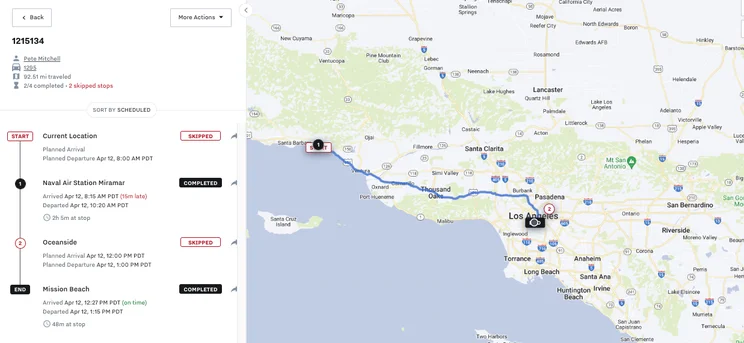
Fleet management provider Samsara uses AI to help optimize fleet routes as well as maintenance. Source: Samsara
Carry out predictive maintenance
Predictive maintenance is an approach in fleet management that allows companies to monitor the real-time performance and conditions of vehicles, helping them to identify potential issues before they turn costly.
AI significantly improves the process by using advanced analytics to combine current telematics data with historical data, providing businesses with more targeted insights as a result. In addition to notifying companies when abnormalities occur, AI also uses predictive analysis to identify patterns that could lead to vehicle or equipment failures in the future. Aside from being a major cost saver, AI-powered predictive maintenance also helps to protect the safety of drivers by minimizing unexpected errors and breakdowns.
Example use case: If a truck is becoming contaminated with water internally, AI predictive maintenance can identify and warn the driver about the issue before it causes any long-term damage to the vehicle.
Analyse and improve driver behavior
Inappropriate driving behavior can have drastic consequences on the safety of the driver and those around them, the condition of the vehicle, and the company’s reputation. All the best driver monitoring systems observe metrics like driver speed, acceleration, braking and idling time and use AI-powered algorithms to analyze the safety of this behavior.
AI can also suggest targeted interventions for inappropriate behavior, and develop strategies to reduce the likelihood of incidents taking place in the future. This immediate feedback helps the driver by fostering a safer environment, and benefits fleet managers by affording them greater oversight.
Example use case: If one of your drivers is rapidly accelerating down a highway, immediate feedback can be provided to them, allowing them to amend their behavior on the spot.
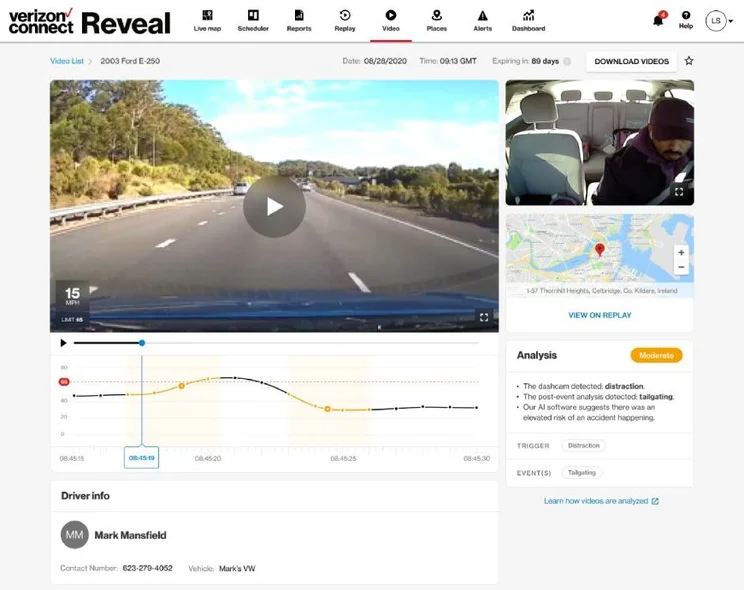
Verizon Connects AI Dashcam feature helps to detect potentially dangerous driving events to increase driver safety. Source: Verizon
Streamline your inventory management
If your fleet is responsible for transporting inventory, AI is able to streamline the stock management process in a variety of ways. Firstly, by utilizing historical and current data, AI-enabled stock management systems give managers real-time stock insights, and are capable of forecasting future demand, reducing the risk of overstocking and stockouts.
AI can also automate parts of the stock tracking process, reducing risks associated with human error. Finally, AI-powered algorithms are able to optimize the stock ordering process by figuring out the best times for companies to order from suppliers. As a result, companies are more likely to overcome potential supply chain issues and ensure they have enough stock to meet their demand.
Example use case: If your company stock is running low, your AI-enabled fleet management system can send you real-time notifications to purchase more, or even take care of the task automatically, to reduce stockouts from taking place.
Address staffing challenges
Labor shortages remain one of the biggest challenges faced by fleet companies today. While AI will never be able to fully replace the role of the driver, the rapidly evolving technology could in future lower the barrier to entry for becoming a driver by facilitating autonomous options. Some fleet companies have rolled out temporary self-driving features, as well as AI capabilities that make the truck automatically pull over when a problem is detected.
AI can also assist with the recruitment and hiring process by analyzing resumes in bulk and performing automated screenings. It has the potential to help with unconscious bias by doing ‘blind’ screenings of candidates, removing data related to things like gender, ethnicity, and age. But it’s worth being aware that there are some concerns that AI algorithms can add bias to recruitment.
By handling a big chunk of the process, AI can help employers scale back on costs, and maximize their chance of finding a successful candidate.
Example use case: If you’re struggling to find qualified drivers, you can streamline the hiring process by using AI to automatically reject ineligible applicants and assign assessments to qualified candidates.
Best Practices For Using AI in Fleet Management
Embracing AI could be one of the best strategic decisions your company makes this year. However, this doesn’t mean you shouldn’t approach the technology with caution. To ensure your deployment of AI is as safe, secure, and seamless as possible, you should be mindful of the considerations below.
- Make sure your data is reliable – AI recommendations are only as accurate as the data they depend upon. Therefore, to make sure your AI software provides you with the most reliable recommendations possible, the information fed into the system needs to be validated, detailed, and of a high quality.
- Comply with privacy regulations – When handling personal employee information, make sure that the data is handled in compliance with the data protection regulations in your specific region. For example, if your company is based in California you have to comply with the California Consumer Privacy Act (CCPA). We also recommend collecting no more data that is necessary for a given purpose and anonymizing the data to protect employee identities where possible.
- Ensure data is encrypted – To keep important data safe when using AI, encrypt data with safeguards like Transport Layer Security (TLS) and end-to-end encryption (E2EE) when it’s being transmitted between systems, and when it’s stored in data centers.
- Develop clear policies around the use of AI – To ensure AI is only being used in the most safe and secure way possible, employers should develop clear policies for the use and oversight of the technology in their company. These policies should be clear, achievable, and communicated thoroughly with all levels of the company.
- Train employees on how to use AI correctly – AI technology is evolving by the day. So, to make sure your team is able to use it to its full potential, companies should offer AI training sessions so employees can become comfortable and proficient with the technology. Rolling out structured training sessions will also lower the likelihood of risks occurring.
- Don’t implement AI at the cost of jobs – While AI can provide businesses with useful ways to overcome staffing shortcomings, the job security of your employees should always be a top priority. Not only will AI never be able to replicate human-centric skills like problem-solving and adaptability, but employers also have a moral obligation to protect jobs when possible.
Best AI Fleet Management Providers
While lots of fleet management systems have started rolling out AI capabilities, some providers go above and beyond when it comes to integrating the smart technology into their software.
For example, Samsara offers a raft of AI features, including real-time analytics, and AI-powered predictive maintenance. The provider also has an AI-enhanced dashcam that monitors driver behavior to help detect incidents in real time. According to Samsara, the tool is an effective safety mechanism too, helping to prevent crashes and flagging safety warnings.
Learn more about the feature-rich fleet management provider in our Samsara review and pricing guide.
Our best-rated fleet management software Verizon Connect is also leading the charge when it comes to AI integration. Verizon uses AI to optimize routes so companies can reduce travel time and fuel costs, analyze driver behavior and offer them useful feedback, and carry out predictive maintenance to help keep fleets in optimal condition.
There’s no shortage of fleet management providers that are embracing AI to make your life easier. Take a look at our favorites in our guide to the best fleet management software provider.
|
Price from
The typical lowest starting price. The lowest price available for your business will depend on your needs
|
Best for
Who is this provider most suitable for?
|
Contract length
|
Free trial or demo
|
Fuel card integration
|
GPS integration
|
||||
|---|---|---|---|---|---|---|---|---|---|
 |
Best Verizon Alternative
 |
 |
 |
 |
 |
 |
 |
 |
 |
|
Verizon Connect Reveal |
Samsara |
Teletrac Navman TN360 |
US Fleet Tracking |
Fleetio |
GPS Insight |
GPS Trackit |
Omnitracs |
Quartix |
IntelliShift |
|
Custom (typically from $23.50/vehicle/month) |
Custom (typically from $27/vehicle/month) |
Custom (typically from $25/vehicle/month) |
$24.95/vehicle/month |
$4/vehicle/month |
$14.95/vehicle/month |
$24.99/vehicle/month |
Custom |
$14.90/vehicle/month |
$19.99/vehicle/month |
|
Best overall |
Established, large businesses |
Construction fleets |
Location tracking only |
Cutting costs |
Ease of use, thanks a great interface and support team |
Cargo transport |
GPS tracking and route optimization |
|
Best mid-range option |
|
3-year minimum (initial) |
3-year minimum |
1 year |
Monthly |
Monthly |
No contracts |
No contracts |
1 year |
12 months |
3 year minimum |
|
Free demo |
30-day free trial — hardware and software |
Free online demo |
Free live demo |
14-day free trial |
Free demo |
Free demo |
Free online demo |
4-week trial |
Free demo |
|
|
|
|
|
|
|
|
|
|
|
|
|
|
|
|
|
|
|
|
|
|
About Our Research
We take our impartial research and analysis seriously, so you can have complete confidence that we’re giving you the clearest, most useful recommendations.
After conducting an initial exploration to identify the most relevant, popular, and established tools in the market, we put them through their paces with a research framework designed in-house to see their real strengths and weaknesses. In this case, we analyzed 20 fleet management products across 51 different areas of investigation.
Based on years of market and user needs research, we’ve established a fleet management testing methodology that scores each product in six core assessment areas and six additional subcategories, covering everything, from the driver management features to value for money, customer support, and much more.
Our main testing categories for fleet management systems are:
- Price: The cost associated with using the fleet management software, including upfront costs, subscription fees, hardware costs (if applicable), and any additional charges for advanced features or add-ons.
- Tracking: The core functionality of the fleet management software, which involves monitoring and tracking the location and movements of vehicles in real-time, including features such as GPS tracking, route optimization, and geofencing.
- Driver management: The features and tools provided by the fleet management software to manage and monitor driver activities. This can include driver behavior monitoring, driver performance reports, and driver identification.
- Vehicle management: The functionalities that allow for the efficient management and maintenance of vehicles, such as vehicle health monitoring and maintenance scheduling.
- Product features: The additional functionalities and capabilities offered by the fleet management software, beyond basic tracking and management, such as real-time alerts and notifications, or driver routing and dispatching.
- Support: The resources, assistance, and guidance provided by the fleet management software company to users, including phone support, email or chat support, and online forums.
When it comes to calculating a product’s final score, not all testing and research categories are weighted evenly, as we know some aspects matter more to our readers than others, which are merely “nice to have”. After hundreds of hours, our process is complete, and the results should ensure you can find the best solution for your needs.
At Tech.co, we have a number of full-time in-house researchers, who re-run testing and research processes regularly to ensure our results remain reflective of the present day.
AI is leveling up the way companies are able to manage their fleets, making it easier than ever for managers to continually monitor vehicles, make informed decisions, maximize the efficiency of processes, and ensure the safety of vehicles and drivers. While fully autonomous fleets may still be a distant reality, as AI embeds itself further into the industry’s core practices, now is the time to leverage the technology to your advantage, or risk falling behind the pack.
This isn’t to say AI doesn’t come without its risks, however. To ensure that your company embarks on its AI journey in the safest way possible, safeguarding personal data, only relying on reliable data, and developing a clear AI framework is imperative.
If you’re looking to get started with or switch to a new fleet management system today, you can get quotes from the leading providers quickly and easily by filling out our free online form.
If you click on, sign up to a service through, or make a purchase through the links on our site, or use our quotes tool to receive custom pricing for your business needs, we may earn a referral fee from the supplier(s) of the technology you’re interested in. This helps Tech.co to provide free information and reviews, and carries no additional cost to you. Most importantly, it doesn’t affect our editorial impartiality. Ratings and rankings on Tech.co cannot be bought. Our reviews are based on objective research analysis. Rare exceptions to this will be marked clearly as a ‘sponsored’ table column, or explained by a full advertising disclosure on the page, in place of this one. Click to return to top of page


