

We may receive a commission from our partners if you click on a link to review or purchase a product or service. Click to Learn More
The best way to maximize return on investment (ROI) when it comes to telematics and fleet management systems is by reducing fuel costs through route optimization, cutting repair costs by employing predictive maintenance, and eliminating accidents with safety features like AI dash cams.
More importantly, businesses that use these tools can save as much as $639,859 per year, according to our in-depth analysis of telematics ROI.
As for how to measure telematics ROI, fleet owners need to track all the costs and subtract them from all the savings, then divide it all by total costs and multiply by 100 to get the percentage of ROI.
Learn more about Motive’s AI-powered fleet management platform.
- Timeline for return: It takes two to 12 months for telematics and fleet management software to see meaningful ROI.
- Core savings drivers: ROI is mostly achieved by reducing fuel costs through route optimization, cutting repair expenses with predictive maintenance, and improving safety to lower accident rates.
- ROI calculation: To measure ROI, establish your total costs and subtract from your total savings, then divide by your total costs, and multiply by 100.
- Maximization strategies: To maximize ROI, make sure that you are integrating telematics with other systems in your fleet, fine tune analytics for your specific operations, and make sure that drivers are on board for the new platform.

Motive can maximize telematics ROI
Discover how to get measurable cost reductions across your fleet operations.
When Does Telematics Deliver ROI?
It takes telematics two to 12 months to deliver measurable return-on-investment, depending on the size of your business, the cost of the system, and how long it takes to install the technology across your fleet.
How Does Telematics Save Fleets Time and Money?
Telematics platforms and fleet management software can be used to automate manual processes and provide real-time visibility to save your business time and money.
In fact, our data found that telematics saves users on average $639,859 per year. Here’s how they do it.
Our independent research came to one very clear conclusion: Telematics is clearly a good investment for fleet management businesses.
Between route optimization, predictive maintenance, and AI dash cams, logistics businesses are able to save more than $600,000 per year.
With 11% of logistics professionals stating that they aren’t sure about the ROI of business software, this kind of data is invaluable in helping owners to pull the trigger on these platforms.

James is the lead researcher for Tech.co, providing in-depth analysis of business software like telematics.
How does predictive maintenance increase ROI?
Predictive maintenance allows fleet managers to reduce costs by addressing repairs before they become a significant problem. This is done by constantly monitoring vehicle health to identify and address issues and optimize vehicle uptime.
According to our data, predictive maintenance saves seven and a half hours weekly by avoiding unplanned servicing of vehicles. This means that predictive maintenance can save your business $8,285 per year.
Motive provides maintenance reminders, scheduling and fault code alerts to help organizations stay ahead of issues and minimize vehicle downtime.
With the vehicle gateway they can:
- Catch vehicle defects early with real-time fault code alerts.
- Ensure vehicles and assets get serviced with a mechanic workflow to sign off and resolve defects.
- Track and view upcoming, overdue, and completed service with detailed reports.
- Get timely notifications for scheduled maintenance aids in proactively addressing potential defects.
- Track upcoming, overdue, and completed maintenance tasks, supported by detailed reports.
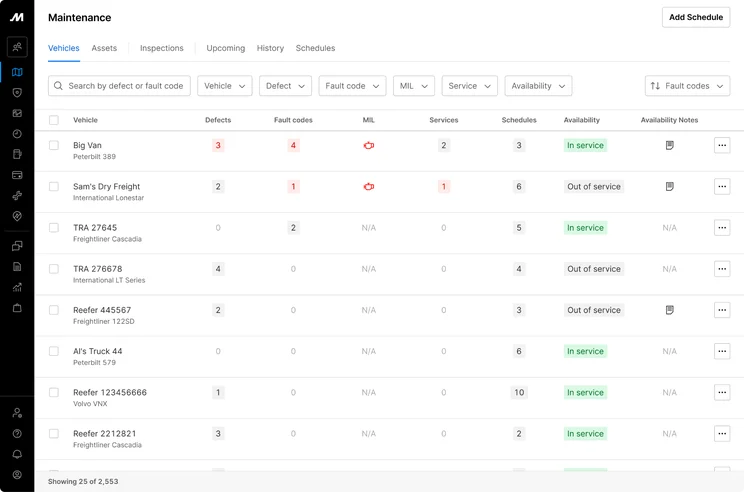
The maintenance interface in Motive allows you to create a schedule for repairs. Source: Motive
How does route optimization increase ROI?
Fuel costs account for one quarter of logistics business budgets in 2026 and one of the easiest ways to reduce them is through route optimization. Our data found that AI route optimization cuts down on fuel budgets by 19.3%.
Additionally, AI route optimization saves businesses on average $9,474 per year in labor costs, with dispatchers noting that the technology saves them between two-to-three hours a day on route planning.
With Motive, Fleet View provides real-time visibility and historical context about your vehicles and equipment. Live traffic and weather conditions layered directly onto maps allow for precise route planning and navigation. Real-time geofence notifications enhance operational control with immediate updates on fleet movement, scheduling, and security.
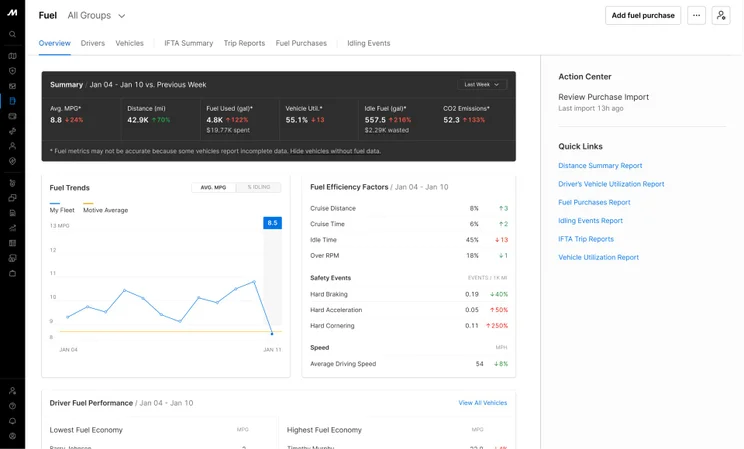
Route optimization saves fleet managers significant amounts of fuel, and Motive helps keep track of these savings. Source: Motive
How do AI dash cams increase ROI?
Our data found that safety improvements like AI dash cams can prevent as many as 10 accidents per year, which can result in $588,577 in yearly savings.
The AI Dashcam Plus from Motive can improve fleet safety and prevent accidents by providing:
- Real-time in-cab alerts
- Automated coaching
- Driving scoring
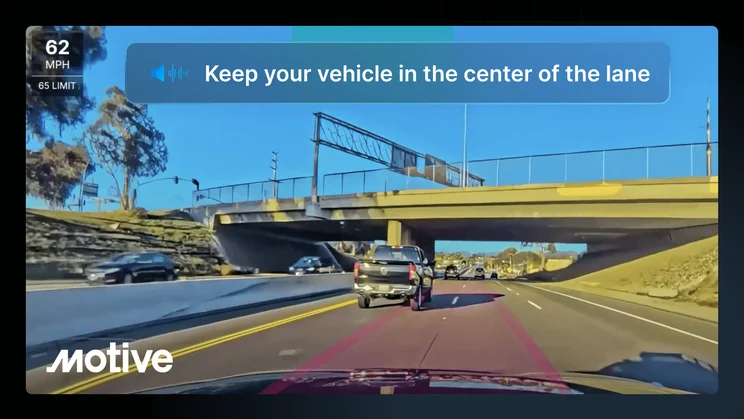
Motive’s AI dash cam can recognize improper lane usage and suggest changes to improve safety. Source: Motive
The return-on-investment numbers above are a part of our in-depth logistics research aimed at understanding how the industry is operating in 2026.
We conducted a survey of 265 logistics professionals who work at shipping or transport companies in April 2026 to learn about what businesses are doing when it comes to logistics.
On top of that, we analyzed existing public industry data from the Bureau of Labor Statistics, Indeed, and the ROI calculator from Motive to get a clear picture of how return-on-investment is manifesting for logistics businesses in 2026.
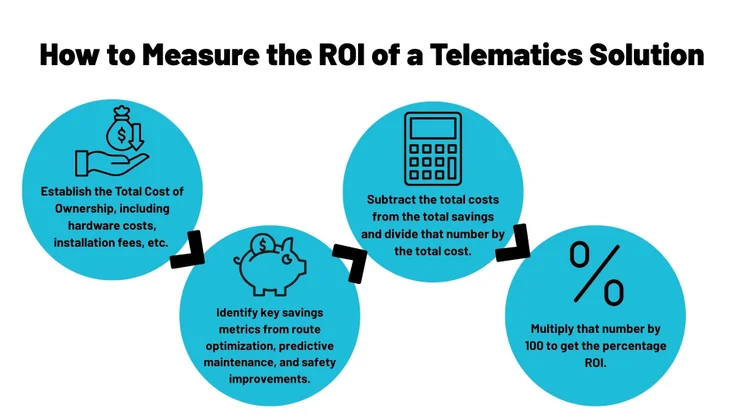
How To Measure the ROI of a Telematics Solution
- Establish the total cost of ownership (TCO) of the telematics, including hardware costs, installation fees, subscription charges, etc.
- Identify key savings metrics from route optimization, predictive maintenance, and safety improvements.
- Subtract the total costs from the total savings and divide that number by the total cost.
- Multiply that number by 100 to get the percentage ROI.
The only way to be sure that your telematics system is getting ROI is to actually calculate it. Luckily, the above process is quick and simple, as long as you’ve been tracking your fleet management costs and savings along the way.
Discover how to get measurable cost reduction across your fleet operations.
How To Maximize Telematics ROI
Here are a few things you can do to ensure that you’re getting the most out of your telematics:
- Driver buy-in: The value of a telematics system is lost if your drivers aren’t actually using it. If your system is overly punitive or simply too hard to use, the investment in a telematics system will be all for nothing.
- Fine tune analytics: Telematics systems track a lot of data, and if you haven’t customized your system to track exactly what you need to improve your business, you won’t be able to use it correctly to make necessary changes.
- Integrate your system: Telematics systems integrate with other platforms, which can provide you with a clearer picture of your fleet. Fuel cards, for example, can integrate to some systems, allowing you to optimize your fill-ups.
While telematics and fleet management systems can save your business a lot of time and money, the reality is that you need to optimize the platform to make sure it’s working for your business. Failing to do so would be a huge disservice to you and your fleet.
Telematics and fleet management software uses features like route optimization, predictive maintenance alerts, and AI dash cams for improved driver safety, all leading to reduced costs and improved margins for fleet owners.
Maximizing your telematics ROI requires time, approximately two to 12 months, but it also requires driver buy-in, finely tuned analytics, and system integrations to full ensure the best return on your investment.
To measure your ROI, take the total savings and subtract the total cost of ownership. Then divide by the total cost of ownership and multiply by 100 to get your percentage ROI.
To get started with telematics and fleet management, learn more at Motive.
Frequently Asked Questions
Fleet management systems can integrate with fuel cards, providing users with geofencing features that can track when a card is used for a vehicle that isn’t the licensed truck, preventing fraud.
Many insurers offer telematics-based pricing or usage-based insurance (UBI) that can provide discounts of up to 40% on premiums. AI dash cams are generally part of these kind of packages, as they can monitor driver behavior and exonerate users in case of accidents.
Fleet telematics can reduce total costs by as much as 30% in the first year by streamlining business’ maintenance, routing, and compliance operations.


