
We may receive a commission from our partners if you click on a link to review or purchase a product or service. Click to Learn More
Research from Tech.co shows artificial intelligence (AI) within fleet management boosts efficiency up to 19.3%, saves managers 7.25 hours a week, and prevents 10 accidents annually.
AI route optimization software helps logistics businesses find the most efficient delivery route and save fuel costs. Likewise, AI preventative maintenance software provides real-time insight into asset health, helping managers correctly schedule maintenance, and AI dash cams provide automatic feedback on driver behavior to improve safety.
Logistics leaders are already aware of AI’s potential impact: according to the latest Tech.co data, 69% of fleet professionals view AI as a competitive industry advantage. Our data is derived from a survey including 265 fleet professionals in the US.
- Research from Tech.co has found that logistics professionals are already seeing significant productivity gains from implementing AI, and 69% of professionals view AI as a competitive advantage within the industry.
- Route optimization software is the most used AI tool for logistics professionals and can help companies cut down fuel budgets by 19.3%, our research reveals.
- Preventative maintenance is used by 22% of logistics professionals in our research and saves businesses 7.5 hours per week, on average.
- Dash cams with AI features are able to automatically alert drivers to unsafe driving practices and can prevent up to 10 accidents per year, according to our research.
- As AI develops, it will continue to make a big impact on logistics professionals, particularly as it improves its ability to provide real-time insights and alerts for managers.

The Top Use Cases of AI in Fleet Management
Fleet managers can take advantage of AI across route optimization, predictive maintenance, and dash cams.
95% of US logistics professionals surveyed by Tech.co save 1-20 hours weekly using AI tools, suggesting there are significant productivity gains to be made when implementing the technology.
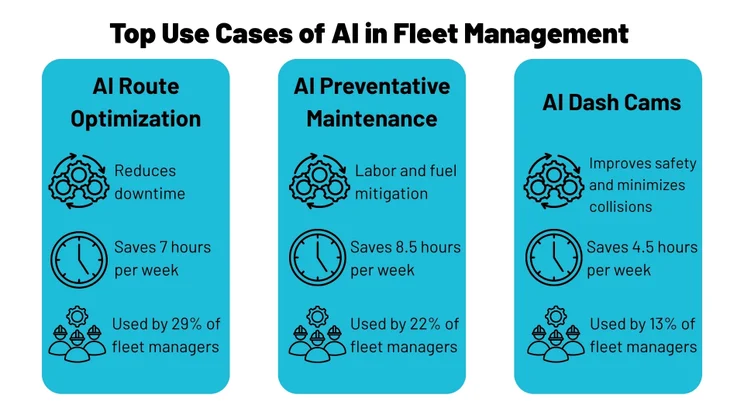
| AI tool | Function | Average time saved per week |
| Route optimization | Reduces downtime by finding the most efficient route for drivers | 7 hours |
| Predictive maintenance | Labor and fuel mitigation through the monitoring of equipment health in real-time | 8.5 hours |
| Dash cams | Provide real-time risk analysis to drivers to improve safety and minimize collisions | 4.5 hours |
Our data is based on the responses of 265 fleet professionals, collected in our monthly logistics survey. We combined these responses with publicly available industry data to make further predictions and conclusions.
This research was conducted exclusively for Motive.
AI Route optimization
AI route optimization software identifies and provides drivers with the most efficient driving route, based on elements such as distance, traffic conditions, delivery schedules, and weather patterns.
In our research, 29% of fleet managers reported using route optimization software in their logistics business, and 58% of fleet managers said route optimization was what they primarily used AI for.
Similarly, 27% of fleet managers reported a need for AI route optimization software within their business, making it the most desired AI tool in our research.
How route optimization works with AI
Route optimization software uses AI to provide real-time and historic insights into road conditions and delivery times for drivers about their routes.
For example, Motive’s AI route optimization solution offers GPS, traffic updates, and weather overlays based on real-time GPS data, historic delivery data, and live traffic data.
All of this data can be used by fleet managers to assign and coordinate delivery routes efficiently, and allows drivers to avoid congestion or road accidents that could slow them down.
How to implement AI route optimization software
AI route optimization is embedded into many modern fleet management solutions, such as Motive’s, therefore setting it up will be part of the wider system set up. To start using the tool:
- Import necessary fleet data, including driver and vehicle information, fuel types, and driver working hours into the system.
- Set up start and end locations for your routes, and upload stop addresses with the exact locations.
- Set up constraints such as the maximum route duration and vehicle capacity.
- Allocate routes on a testing basis to drivers and monitor progress, adjusting where necessary.
What are the benefits of AI route optimization software?
- Time savings: Our research found that route optimization can save companies a whole day per week on average, which improves productivity and reduces time wasted.
- Fuel cost savings: AI route optimization cuts fuel budgets by 19.3%, according to our research. By finding the quickest route to their destination, trucks use less fuel than on lengthier journeys, reducing costs.
- Improves efficiency: Using route optimization software, drivers take the most efficient route, meaning deliveries can be made quicker and with fewer delays.
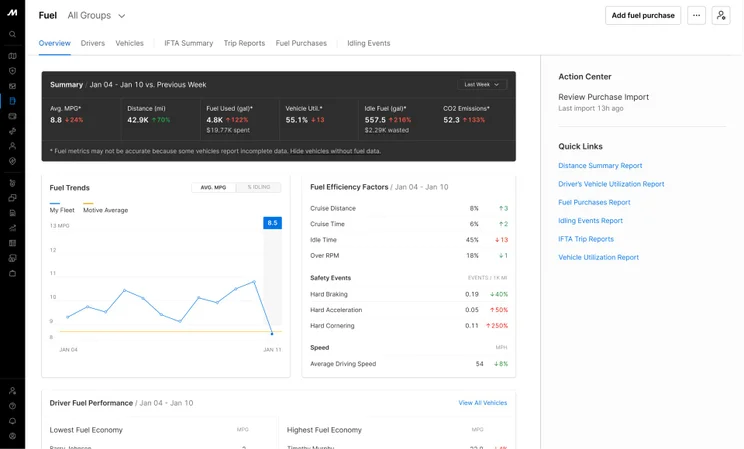
AI route optimization helps fleet managers save fuel by finding the most efficient route. Motive helps managers keep track of these savings with a dedicated fuel overview. Source: Motive
AI Predictive maintenance
AI predictive maintenance software monitors equipment and asset health, alerting managers to potential repairs and failures ahead of time. Systems run diagnostics based on previous and current data.
AI predictive maintenance software was the second most used AI tool in our research. 22% of fleet managers reported using predictive maintenance software, and 23% reported primarily using AI for this purpose.
Likewise, AI predictive maintenance saves logistics businesses the most amount of time compared with other AI technologies, with average time savings adding up to more than a day per week.
How predictive maintenance works with AI
Predictive maintenance software uses AI and machine learning to collect real-time and historical data, helping to inform equipment repair schedules and reduce the need for emergency repairs.
Furthermore, AI predictive maintenance software predicts failures before they happen. Systems are able to analyze engine performance, sensor data, and fault codes, which they then use to suggest optimal times for service and give managers full context around faults.
How to implement AI predictive maintenance software
To set up AI predictive maintenance software:
- Identify and organize your inventory and assets into categorical data, including details such as manufacturer, model, serial number, and its physical location in your warehouse.
- Input manufacturer-recommended maintenance cycles and define what maintenance tasks are needed for each asset.
- Set up tasks in the system, including scheduling frequencies, and assign to specific employees with the tools and parts needed for each maintenance task.
- Implement and test the software, creating regular reports and dashboards to monitor key performance indicators (KPIs). Adjust frequencies as you go to avoid over or under-maintaining each asset.
What are the benefits of AI predictive maintenance software?
- Save maintenance costs: AI predictive maintenance software reduces the need for emergency repairs and saves businesses as much as $8,268 a year in technician costs, our research shows.
- Boost efficiency: Using AI predictive maintenance, businesses can prepare for and correctly schedule in maintenance for each of their assets, which boosts operational efficiency by ensuring all vehicles are cared for.
AI Dash cams
AI dash cams are small, in-car cameras used to record driver and road activity while driving. They are able to provide impartial video evidence to support insurance claims and help train drivers on safe road practices.
In our research, 13% of fleet professionals reported primarily using AI for safety coaching features within dash cams, which suggests proper driver training and safety remain top concerns.
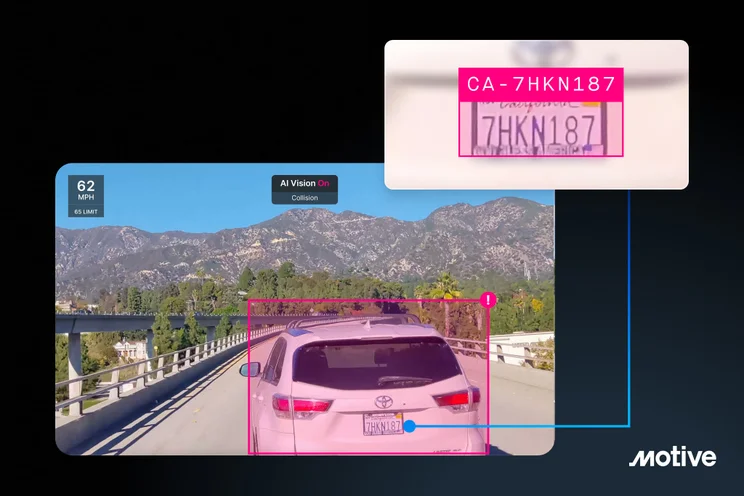
Motive’s AI dash cam enables the easy identification of number plates. Source: Motive.
How dash cams work with AI
Modern-day dash cams use AI to provide real-time insights into driver and road activity. For example, with Motive’s AI dash cams, unsafe behaviors such as distraction, drowsiness, or close following are detected automatically as they happen, and the system delivers an alert to the driver. This is done through a combination of visual and audio feedback.
Similarly, Motive’s dash cams provide automated coaching and driver scoring, so safety can be assessed by managers. For enterprise-level fleets, Motive’s AI dash cams provide a highly scalable and personalized method of training drivers and preventing collisions. In our US survey of 265 fleet professionals, we found that AI dash cams prevent 10 accidents per year, on average.
How to implement AI dash cams
AI dash cams are set up directly into commercial vehicles. Professional installation is recommended because you’ll need to connect the cameras to your vehicle’s electrical system. Here’s what can be expected:
- Before installing, clean your vehicle’s windshield so the adhesive of the camera can be properly secured.
- Position cameras so the front camera is behind the rearview mirror for maximum road coverage. Always ensure the camera does not obstruct the driver’s view of the road. Mount any additional cameras using this same method.
- Connect your dash cam to the vehicle’s battery using a hardwire kit. Again, make sure no wires obstruct the driver’s view when doing this.
- Use a mobile app like Motive’s to configure your dash cams. The app allows managers to collect insights directly from your mobile phone.
What are the benefits of AI dash cams?
- Time saving: Tech.co’s logistics research found that AI dash cams can save fleet professionals 4.5 hours per week, greatly improving operational efficiency.
- Enhanced safety: AI dash cams provide automatic, real-time safety alerts for drivers to allow automatic behavior adjustment. This helps prevent collisions and encourages drivers to adopt safer driving habits.
Our research shows that AI within logistics lead to significant time savings, with businesses being able to save as much as 8.5 hours per week using predictive maintenance software. These time savings enable managers to focus more on providing high-quality customer service and leadership skills.
Likewise, through AI-powered route optimization software, businesses can cut fuel costs significantly and carry out deliveries more effectively. AI dash cams can also greatly improve driver safety and prevent collisions, which in turn helps lower insurance costs.

The Future of AI in Fleet Management
Our data shows that, on average, logistics professionals are saving 7.25 hours per week by using AI tools. As the technology develops, this number is likely to increase, as AI becomes more effective at providing real-time insights, automating alerts to managers about what areas of the business they should focus on, and crafting high-quality outputs.
Additionally, Motive’s 2026 AI Road Safety report found that for every collision on the road, organizations now see seven near-collisions. As a result, Motive predicts AI-powered, real-time intervention and AI safety programs will provide essential safety for drivers on the road.
Notably, humans play a crucial role in advancing AI by improving the quality of outputs and securing data. While AI has led to the automation of many processes, creativity and relationship-building remain critical human elements of the industry.
Logistics tools increasingly leverage the power of AI to improve fleet management processes and increase efficiency for today’s logistics businesses. Fleet managers are looking to AI within route optimization, predictive maintenance, and dash cams to gain a competitive edge and improve overall return-on-investment for their business.
Tech.co’s own research shows that logistics businesses are seeing significant productivity gains when adopting AI, and that many professionals see a great future for the technology.
To get started, consider adopting an all-in-one fleet solution, like Motive, and taking advantage of a vast set of AI tools, including AI dash cams and preventative maintenance.
FAQs
AI tools such as AI dash cams continually monitor driver performance and alert drivers when unsafe driving behavior is detected, such as speeding or using a cell phone while driving. This data provides feedback for drivers and fleet managers, and informs future coaching programs, helping to minimize road accidents and lower insurance costs.
Over time, AI systems are able to detect patterns in fleet data to make tools such as route optimization and predictive maintenance more efficient. As the AI collects data continuously and in real-time, it is constantly learning and adapting based on the needs of fleet businesses, overall improving operational efficiency, cutting costs, and increasing customer satisfaction.
Many powerful fleet management systems come with AI features integrated into its software, and can be used immediately after purchase. Fleet managers should prioritize feeding the AI high-quality, relevant data to provide the correct insights and better operations. Once systems have been set up, take a staggered approach and test out tools before going live. Managers should also carry out regular audits of their data and monitor the behavior of AI tools, to make sure outputs are always up-to-date and relevant.


