

We may receive a commission from our partners if you click on a link to review or purchase a product or service. Click to Learn More
Shopify stands out for robust ecommerce tools, a huge selection of third party integrations, and advanced enterprise-level features like a built-in fulfillment network.
It’s one of the best website builders for building an online store, according to our in-depth, hands-on research of 12 different ecommerce website builder platforms.
Shopify is an ecommerce-exclusive website builder, with an unmatched online store building experience. However, it’s a bit expensive, starting at $29 per month.
- Sales features: Shopify’s wide range of advanced sales features includes Shopify Markets for tracking international selling across different currencies and countries.
- Pricing: Shopify pricing starts at $29 per month, which is above the industry average of about $16 per month.
- Third-party integrations: Shopify’s huge app store has more than 8,000 integrations.
- Support: Shopify offers 24/7 customer support via email and live chatbot for all plans.
- Ease of use: Shopify interface is a little clunkier and not as intuitive as rivals Wix and Squarespace, making it less ideal for beginners or teams with limited tech skills.
After conducting an initial exploration to identify the most relevant, popular, and established ecommerce website builders in the market, we put 12 website builder services to the test across 283 areas of investigation.
Based on years of market and user needs research, we’ve established an ecommerce website builder testing methodology with seven main categories of investigation — including sales features (30%), design features (15%), pricing (10%), and reputation (5%) — and 33 subcategories; this covers everything from customer feedback to design, ease of use, and more.
This data is then used by our human writers to research and write these in-depth reviews of ecommerce website builders like Shopify.
What Makes Shopify a Good Ecommerce Website Builder?
Shopify prioritizes building online stores, providing native international selling hubs, a marketplace ecosystem of over 8,000 apps, and compatibility with point-of-sale hardware.
- International selling – Shopify is the best website builder for selling internationally thanks to the Shopify Markets features, which allowed us to manage sales across different countries with different currencies from a single hub.
- Third party integrations – Shopify offers the largest third party app store across our research, with more than 8,000 compatible integrations for additional functionality.
- Fulfillment Network – Shopify has its own logistics and warehousing service to pack and ship your items for you, lowering your overhead.
- POS compatibility – Shopify POS is a point-of-sale system that integrates Shopify websites for a complete overview of in-store and online business, including inventory, sales, and customer data.
- B2B sales – Shopify’s dedicated B2B sales platform has custom features for the industry, like custom pricing and payment terms.
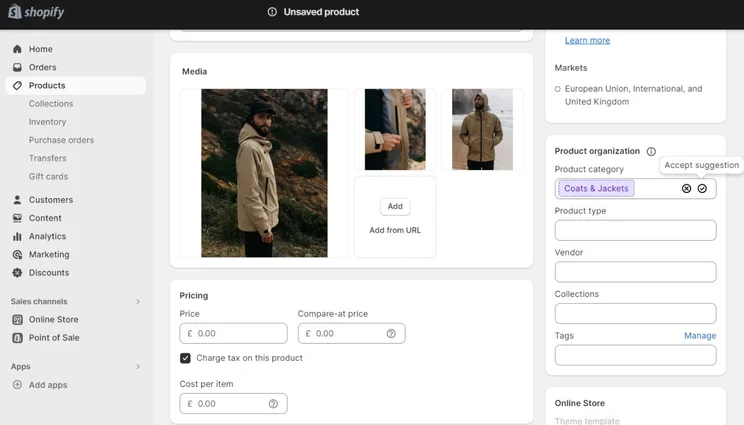
We were able to effectively track our inventory with Shopify’s more advanced sales features. Source: Tech.co testing
Can I build an online store with AI on Shopify?
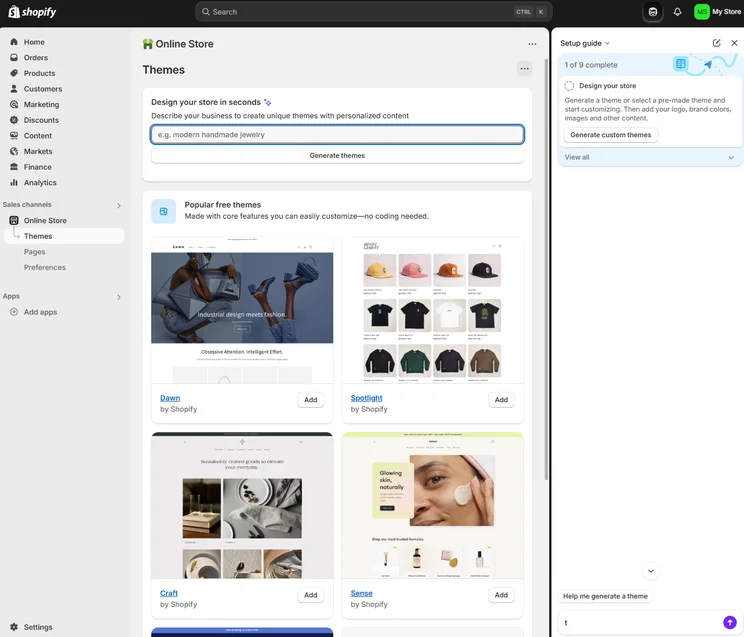
Yes, Shopify provides an AI store builder that can generate an online store for you.
We tested it with a simple natural language prompt, “build me a store that sells bananas,” and we were provided with different template options to get started. Even better, we didn’t need to be a paying customer or even logged in to Shopify to get a full preview of our potential site.
Shopify also offers AI features within the platform once your site is built. Shopify Magic generated content, edited images, and generally improved our online store with AI-powered suggestions.
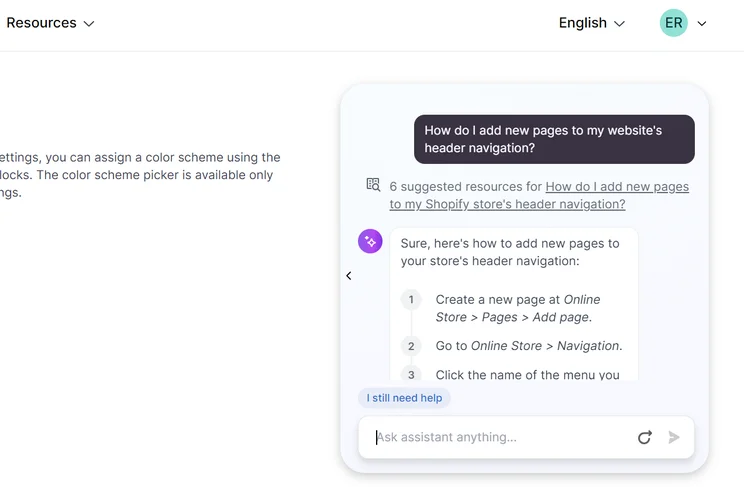
There’s also Shopify Sidekick, a 24/7 chatbot expert that helped us navigate the ecommerce website builder and necessary accomplish tasks, like setting up inventory and payment options.
Our guide to the best AI website builders has more.

The Shopify AI store builder took a natural language prompt and created an online store for us in seconds. Source: Tech.co testing
Is it easy to switch to Shopify?
You can switch from a different website builder to Shopify, but it’s not that easy, particularly if you’re a larger store with a lot of inventory.
Shopify let our testers migrate data like customer profiles and product pages through CSV file transfers. Specialized apps like Matrixify can further streamline the process.
After this process, users must manually configure backend elements including category assignment, theme choices, and SEO tools.
Shopify

In Short
-
Pros
- Add unlimited products with your own CSV
- Customizable member areas
- Intuitive product-adding experience for beginners
- AI site builder can have you live in seconds
-
Cons
- Monthly fees for POS system integration
- Scheduling and booking requires add-on
- No tutorials for setup, so tough for beginners
- Limited SEO settings available
Pricing
- Starter plan: $5/month
- Basic plan: $29/month
- Grow plan: $79/month
- Advanced plan: $299/month
- Plus plan: $2,300/month
Images
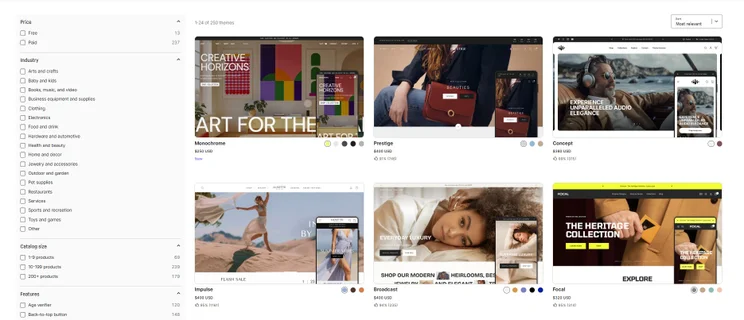

What Are the Limitations of Shopify?
Shopify is excellent for ecommerce businesses that need to build a website, but some downsides that could get in the way, depending on your particular needs.
- Design – Shopify templates are rigid, and prevented us from adding and moving elements everwhere we wanted. For more design flexibility, Squarespace is an excellent choice.
- Non-ecommerce tools – Shopify’s non-ecommerce website elements are lacking. With blogging tools, for example, we weren’t able to make as many layout changes. For more features outside of your online store, Wix is our top pick.
- Ease of use – Shopify provides robust ecommerce functionality, which made the platform harder to use, especially for beginners. For an easy-to-use website builder, we found Squarespace to be a good option.
- Price – Shopify is more expensive than the industry average, with a starting price of $29 per month and an enterprise solution for $360 per month. For a more affordable website builder, we’d recommend Hostinger.
Check out our Shopify vs Wix guide to learn more
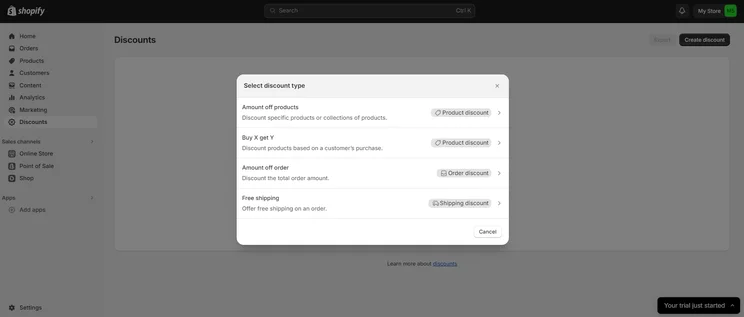
The more granular website building features on Shopify, like customizable discount codes, can make it a bit harder to use for beginners that other more simple solutions. Source: Tech.co testing
How Much Does Shopify Cost?
Shopify’s pricing starts with three standard pricing options for those trying to build an online store: Basic, Grow, and Advanced.
|
Plan
|
Price (1-year contract)
The price per month you'll pay if you choose to be billed annually
|
Price (1-month contract)
The price per month you'll pay if you choose to be billed monthly
|
Ecommerce
|
|---|---|---|---|
|
Basic |
Grow |
Advanced |
|
|
$29/month |
$79/month |
$299/month |
|
|
$39/month |
$105/month |
$399/month |
|
|
|
|
|
Shopify also offers an enterprise-level solution called the Plus plan for large online stores. It costs $2,300 per month, with a minimum contract of three years.
Is Shopify a good value?
Compared to other website builders, Shopify is on the more expensive end of the spectrum, with a starting price of $29 per month, which is well above the industry average of about $16 per month. However, Shopify provides ecommerce features on all of its pricing plans, while providers like Wix tend not to.
Shopify also provides robust sales features, like first-party hardware compatibility and international selling dashboards. It’s more expensive, but has the functionality to match.
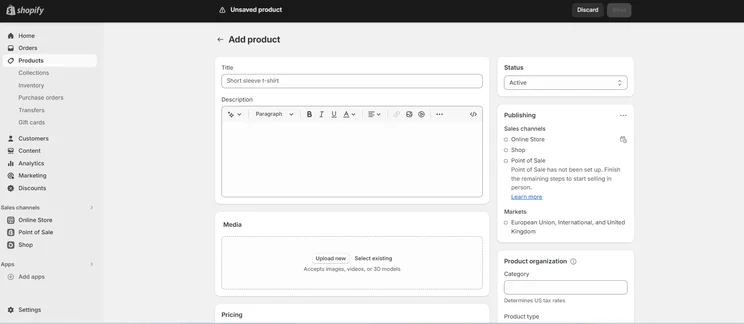
Shopify allowed us to build an online store on its Basic plan, which many website builders only allow on mid-tier plans. Source: Tech.co testing
Does Shopify have a free plan?
Shopify doesn’t offer a free website builder plan, but does have a limited 3-day free trial. After that, you can pay just $1 per month for the first three months, so you can still get a feel for the platform without a big financial commitment.
What are the transaction fees with Shopify?
Shopify’s transaction fees vary depending on what pricing plan you’ve signed up for and what kind of transactions you’re taking. Below, we’ve included a breakdown of how much transaction fees will cost your business:
| Plan | Online | In Person | Third party Payment provider |
|---|---|---|---|
| Basic | 2.9% + 30¢ | 2.6% + 10¢ | 2% |
| Grow | 2.7% + 30¢ | 2.5% + 10¢ | 1% |
| Advanced | 2.5% + 30¢ | 2.4% + 10¢ | 0.6% |
Shopify Basic transaction fees are right in line with the rest of the industry, with Wix, Squarespace, and most other website builders sporting fees that range between 2% and 3% and between 10¢ and 30¢ for online and in-person sales.
However, Shopify is one of the few ecommerce website builders that charges extra for third-party payment processing. Wix and Squarespace both provide this at 0%.
If you opt to use Shopify Payments — the native payment gateway for all Shopify users — instead of a third-party payment provider, you will be able to completely avoid additional transaction fees.
Our Methodology
Tech.co’s hands-on evaluation of 12 major ecommerce platforms tests 283 specific areas of investigation within seven weighted categories.
- What kind of website features are available? (15%) Includes blog functionality, SEO capability, and marketing capacity.
- What kind of sales features are available? (30%) Includes payment features, POS integrations, AR & VR integrations, check-out options, and more.
- How flexible is the design editor? (15%) Includes page templates, customizable themes, and the aesthetic appeal and visual layout of the websites created.
- What is the reputation of the provider? (5%) The feedback and ratings given by customers who have used a particular website builder determine its market position and reputation.
- How easy is it to use? (15%) How user-friendly and intuitive a website builder is for people with varying levels of technical expertise.
- Is it a good value? (10%) The balance between the cost of a website builder and the benefits it provides, factoring in pricing plans, subscription models, and available features.
- How many support options are there? (15%) The assistance and resources available to users when they encounter issues or need guidance.
If you’re building an online store, Shopify will be a solid website builder for your business. It provides robust sales tools — like a built-in fulfillment network and international selling dashboard — for online stores of all sizes, as well as a massive app library to integrate services into your platform.
Shopify can be harder to use for beginners because of this functionality, though, and its exclusive focus on building online stores means that non-ecommerce elements are not as impressive and its layouts are more rigid.
Still, we found Shopify to be one of the best ecommerce website builders available for building an online store, even if the starting price of $29 per month is a bit higher than average.
Shopify Review FAQs
Shopify is consistently ranked among the top ecommerce web builders because it builds well-performing sites, offers an exceptional sales toolkit, and charges affordable transaction fees. Shopify isn’t perfect, as it has limited design features and its costs are above average.
Judge.me is the best app for product reviews on Shopify, as it offers a number of useful features like Google rich snippets and review importing, as well as a generous free plan.
Shopify’s Product Reviews app is a great way to boost online traffic and sales. Using structured data, the app automatically adds an aggregate review score to your site’s search results on Google. This organically drives more traffic to your page.
All Shopify stores now have a storefront within ‘Shop app’, the provider’s marketplace for Shopify stores. Previously, this was a service that merchants could opt in or out of. This app streamlines the checkout process for your customers by offering a “one-click” option for purchases.
Provide high-quality and detailed content that answers specific user queries, rather than simply describing the features of a product. Write your content in the style of natural language prompts, mimicking the way users interact with AI services like ChatGPT, and update regularly so that pricing and product information remains accurate.
If you click on, sign up to a service through, or make a purchase through the links on our site, or use our quotes tool to receive custom pricing for your business needs, we may earn a referral fee from the supplier(s) of the technology you’re interested in. This helps Tech.co to provide free information and reviews, and carries no additional cost to you. Most importantly, it doesn’t affect our editorial impartiality. Ratings and rankings on Tech.co cannot be bought. Our reviews are based on objective research analysis. Rare exceptions to this will be marked clearly as a ‘sponsored’ table column, or explained by a full advertising disclosure on the page, in place of this one. Click to return to top of page
.


