
We may receive a commission from our partners if you click on a link to review or purchase a product or service. Click to Learn More
The US trucking industry spends an estimated $105 billion on diesel fuel annually, representing the second biggest expense motor carriers face, after labor costs. In fact, Tech.co’s survey data has found 52% of logistics professionals spend more than 20% of their monthly budget on fuel! Saving on fuel is essential for every fleet manager looking to cut costs.
The best ways to improve fuel economy in a truck are to reduce speeding, idling and aggressive driving, while staying tuned up and keeping tires inflated. In our recent logistics report, we found that 43% of the professionals we surveyed are prioritizing reducing idling time, and 40% are optimizing routes, both which contribute to improving fuel economy.
Here, we’ve combined industry insider tips and scientific research to offer the most comprehensive investigation of which habits burn the most fuel. And these tips work. Research shows that managers who follow these tips can save up to 30% on fuel costs and increase from an average 6MPG to ~8.5MPG per vehicle.
Read on to learn more – and if you’re serious about improving your fleet management business, consider getting a quote for fleet management software with built-in fuel-saving features.
In fact, here are three of our top-rated fleet management software products if you want to take a look at their site and learn more:
- Factors that can significantly increase fuel use include driver behavior, speeding, idling, and aggressive acceleration
- The key technologies involved in modern-day fuel management are telematics, GPS route optimization, and AI-powered analytics, which is used to monitor driver habits, reduce mileage, and predict maintenance needs
- Fleet management systems such as Webfleet, Motive, and Samsara can also be great tools for tracking and reducing fuel consumption in real-time
- Other than software, regular vehicle maintenance (monitoring tire pressure, using the recommended oil, and engine tune-ups), can improve gas mileage
- Fuel cards are a simple way to track fuel expenses
- Investing in onsite fuel storage can improve costs by allowing for wholesale fuel purchases

Want to increase fuel economy across your company fleet?
Grab a customized quote for fleet management software and join the thousands of businesses we've helped.
10 Ways to Improve Your Truck’s Fuel Economy
Below, we’ve listed all the ways you can improve the fuel economy of your truck/s. Some changes offer a far greater impact than others, so we’ve ranked these changes in order of importance, putting the biggest difference-makers first.
1. Stop Speeding
More than any other driving habit, excessive speeding burns the most fuel.
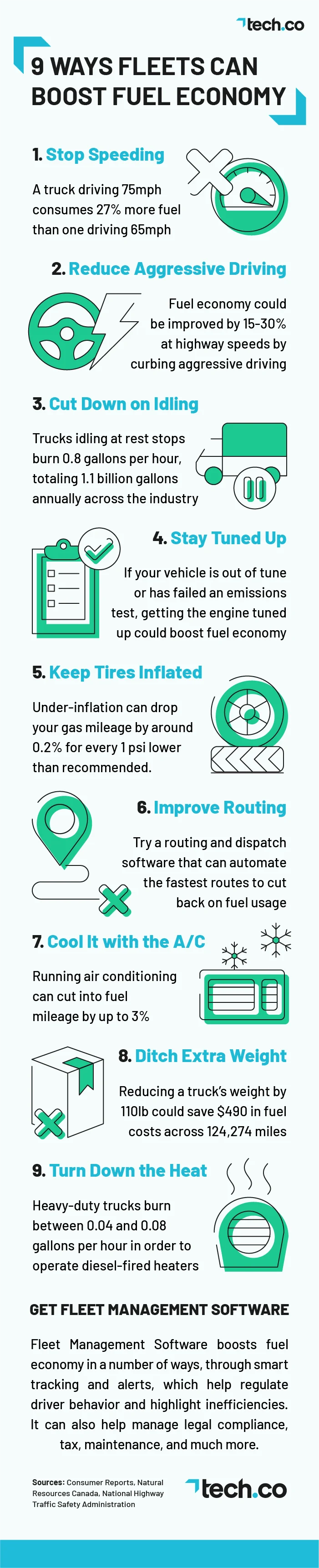
A truck driving 75 mph consumes 27% more fuel than one driving 65 mph, the ATA has found. According to their estimate, capping truck speed at 65 mph would net the trucking industry another 2.8 billion gallons of diesel fuel saved, over the course of a decade.
Speeding can be easily avoided, too, by simply paying attention to the speedometer. If you’re concerned that drivers won’t follow the set speed limits while driving, you can monitor vehicle speeds with a GPS-equipped fleet management system.
For those that speed to save time, you may be shocked to learn how little difference it makes. Over a distance of 100 miles, a vehicle will only save a maximum of 12 minutes by going at 75 mph instead of 65 mph. It’s simply not worth the extra cost, or risk.
2. Reduce Aggressive Driving
The next biggest area to focus on after speeding? Harsh and frequent braking and accelerating. Think about the stop-start driving that vehicles suffer through when an overeager trucker speeds up, only to slow back down immediately, on busy roads.
The Oak Ridge National Laboratory has one of the best sources of data for this issue, although it comes with a few caveats. Its researchers published a 2017 study that found fuel economy in light-duty gasoline vehicles could be improved by between 15% and 30% when at highway speeds, simply by curbing aggressive driving. The US Department of Energy used that same study as a jumping-off point to estimate that dollar savings could be between $0.26 and $1.06 per gallon of gasoline used.
However, a heavy-duty truck won’t see the exact results that a light-duty vehicle would, and it’s unrealistic to assume all harsh driving habits can be stopped. A 2012 study that factored in what it called “real-world driving conditions” landed on a more conservative estimate of 5–10% reduced fuel use through ceasing to brake and accelerate harshly, or 20% less fuel use for particularly aggressive cases. One takeaway is clear: aggressive driving is one of the biggest fuel burning practices out there.
3. Cut Down on Idling
Idling a heavy-duty truck burns around 0.8 gallons of fuel each hour. That’s higher than the 0.25 to 0.5 gallons that a consumer car burns, since the larger engine size consumes more. Idling adds up fast, particularly when truckers idle at rest stops for hours on end — indeed, according to one estimate, rest stop idling burns 1.1 billion gallons of fuel every year.
Idling also increases total emissions, as well as engine wear — leading to extra maintenance costs down the line.
Aside from converting to an electric vehicle, cutting down on fleet idling is perhaps best implemented through a company-wide policy change. This can be enforced through an FMS that logs idle times, which can notify fleet managers when idling exceeds a set limit.
Another option is an Automatic Engine Start/Stop (AESS) system, which automatically starts and stops the engine in an effort to keep the cab temperatures reasonable while reducing idle times. These systems are fairly inexpensive to install, but also only “offer minimal savings in extreme weather,” according to one 2015 report from the AFDC — so may not be worth the trouble.
4. Stay Tuned Up
If your vehicle is out of tune or has failed an emissions test, getting the engine tuned up might boost your fuel economy. However, this fuel-saving measure doesn’t have the most recent data to back it up. According to the best study out there, from Energy and Environmental Analysis, Inc., engine repairs could lead to a “net expected value” improvement of 4.1% better fuel economy.
The catch? That study is from way back in 2001, so it may not apply to trucks on the road nearly two decades later – many of which have a higher overall fuel economy. That didn’t stop the US Department of Energy from re-using this statistic without citation in one 2019 guide, but hey, I’m not here to point fingers.
This tip is largely just common sense, however: a vehicle that’s in bad condition needs to be better maintained if you want it to keep running at an optimal level. The fact that it’ll result in better fuel economy is just one of the benefits. Change your oil frequently, and don’t forget about changing the fuel filters — one task that’s commonly overlooked when it comes to diesel trucks.
5. Keep Tires Inflated
When a truck’s tires are under-inflated, they don’t do their job as well, and the vehicle burns more gas to compensate. How much more? According to a 2006 report from the National Highway Traffic Safety Administration, you can expect a drop of 0.2% in gas mileage for every 1 psi lower than the recommended pressure.
If your tires averaged 10 psi too low before you topped them off, you’ll tighten your fuel use by 2% when your tires are properly inflated. That might not sound like a lot, but keeping your tires inflated is an easy fix, and it’ll add up over time. Another 2001 survey from the National Highway Traffic Safety Administration of one fleet found that one third of all vehicles had at least one tire “severely under-inflated,” so poor tire inflation might be a bigger problem than you’d think.
If under-inflated tires will lose you gas, do over-inflated tires save even more gas? Not according to one myth-busting experiment by Popular Mechanics, which found virtually no difference in MPG even over a 400-mile trip. Granted, Pop Mech used a Honda Fit rather than any type of truck, but you’re unlikely to see better results with your own rig.
6. Get More Efficient Routes
Dan Lewis, CEO of digital freight matching company Convoy, thinks inefficiency is the biggest problem facing truckers today.
“Trucks are running down the highway empty, then they’re sitting for hours at facilities,” he said in a 2018 CNBC interview. “You can generate 20–30% more capacity just by running the whole system more efficiently.”
This is a particularly useful tip for the many local delivery trucks with multiple stops to reach before they return to their base of operations. What’s the most efficient path to take? Which route will have the least traffic at which time of day? That can be a lot of moving parts to keep tabs on, which is why inefficiencies tend to creep in.
I’d strongly recommend looking into a routing and dispatch software that can automate key decisions based on real driving data, and plot out the best route in seconds. Most FMSs offer this service, and it’s a simple way to save on daily fuel costs.
7. Cool It With the A/C
The fuel used by blasting a vehicle’s air conditioning has been well studied in cars, though the literature is sparse for trucks. Consumer Reports has the definitive test for Honda Accords: they drove one at 65 mph while running the A/C, and determined that the air conditioner cut into fuel mileage by 3%. Interestingly, they also tried running the Honda at 65 mph with the windows rolled down, and found the effect on fuel usage was “not measurable.”
Past estimates for the impact of A/C on fuel use have ranged wildly, reaching as much as 30%, according to the SAE. While the exact fuel impact for trucks isn’t quite clear, it definitely exists, and 3% is likely the floor for a truck’s air conditioner’s impact on fuel economy. Limiting it will save fuel.
Granted, this measure may simply not be worth the driver suffering through sweltering heat, even if they can open the windows or opt for a portable 12V-battery-powered air conditioning unit. Drivers will do a lot for improved fuel savings, but ditching their A/C might be a bridge too far. In fact, UPS is under scrutiny for not even offering A/C in their delivery trucks, despite 110 degree heat in some regions.
8. Ditch Extra Weight
A full truckload burns more fuel than an empty truck. One Canadian report estimates that a truck that reduces its weight by 110 pounds would save $490 in fuel across 124,274 miles.
Perhaps more importantly, you’ll also want to avoid strapping anything to a truck bed that could add wind resistance. According to Consumer Reports, even an empty rack will drop a car’s mileage by 5 mph when driving at 65 mph.
Now, I’m not suggesting you start shipping empty trailers. Naturally, you’ll still want to get your trucks as full of their actual freight as possible. US trucks moved 10.8 billion tons of freight in 2017 alone, and all of that weight was necessary. But everything else that isn’t needed is technically costing you fuel. If you can trim another 20 pounds off your total weight here and there, it’ll (slowly) add up.
9. Turn Down the Heat
Will running a fuel-powered heating system for a truck burn enough fuel to put a dent in your bottom line? Not really. But you can try, if you must.
A 2015 study by the AFDC found that heavy-duty trucks burned between 0.04 and 0.08 gallons per hour in order to operate a diesel-fired heater. That’s not nothing, but keeping your truck cab toasty during a cold winter night isn’t nothing, either. It’s a small fuel expenditure, but it has a big impact on a trucker’s quality of life.
Limiting drivers’ heat is likely to be pretty far down on a fleet manager’s list of priorities for how to get better gas mileage in a truck. And after all, it is at the bottom of this list.

Need to save money on fuel costs?
Get a tailored price for fleet management software to start saving today
10. Get Fleet Management Software
One of the best ways to implement all these changes is with fleet management software. This robust business tool is designed to cut down on costs, improve productivity, and generally make your business more efficient from top to bottom.
Fleet Management software can help you implement all of the tips above. It can automate alerts which reduce bad habits such as speeding and idling. It can optimize routes accounting for multiple destinations, traffic and the weather, in real time. It can let you know when there’s an engine issue or need for maintenance. Plus, it can offer your business additional benefits, including managing dispatch, ELD compliance, IFTA tax, and much more.
For a glance at what kind of providers are out there, take a look at this table to see all the fuel-saving features and prices of some of the best.
|
Price from
The typical lowest starting price. The lowest price available for your business will depend on your needs
|
Best for
Who is this provider most suitable for?
|
Contract length
|
Free trial or demo
|
Fuel card integration
|
GPS integration
|
||||
|---|---|---|---|---|---|---|---|---|---|
 |
Best Verizon Alternative
 |
 |
 |
 |
 |
 |
 |
 |
 |
|
Verizon Connect Reveal |
Samsara |
Teletrac Navman TN360 |
US Fleet Tracking |
Fleetio |
GPS Insight |
GPS Trackit |
Omnitracs |
Quartix |
IntelliShift |
|
Custom (typically from $23.50/vehicle/month) |
Custom (typically from $27/vehicle/month) |
Custom (typically from $25/vehicle/month) |
$24.95/vehicle/month |
$4/vehicle/month |
$14.95/vehicle/month |
$24.99/vehicle/month |
Custom |
$14.90/vehicle/month |
$19.99/vehicle/month |
|
Best overall |
Established, large businesses |
Construction fleets |
Location tracking only |
Cutting costs |
Ease of use, thanks a great interface and support team |
Cargo transport |
GPS tracking and route optimization |
|
Best mid-range option |
|
3-year minimum (initial) |
3-year minimum |
1 year |
Monthly |
Monthly |
No contracts |
No contracts |
1 year |
12 months |
3 year minimum |
|
Free demo |
30-day free trial — hardware and software |
Free online demo |
Free live demo |
14-day free trial |
Free demo |
Free demo |
Free online demo |
4-week trial |
Free demo |
|
|
|
|
|
|
|
|
|
|
|
|
|
|
|
|
|
|
|
|
|
|
Total Gas Costs Saved With Fleet Management
If you want to start implementing all these fuel-saving measures today, a fleet management system is your fastest path to that goal. An FMS will be able to address the three biggest fuel-wasting practices: speeding, harsh braking or accelerating, and excessive idle times. Fleet managers can set automatic notifications to be sent by email or SMS to let them know of any incidents, and can read weekly or monthly reports that let them know whether drivers’ habits are improving over time. Many fleet management systems make it easy to see and reward the best drivers, through driver scorecards.
Need your fleet to be ELD compliant? Check out our ELD devices guide
Granted, an FMS won’t solve every problem on the list — it won’t directly impact A/C use, or get rid of unneeded weight — but it’s certainly the most simple way to address the biggest concerns.
In the end, an FMS will let you go much further on each gallon of fuel purchased.
But just how much can an FMS help you reduce fuel use and costs? According to major vendor Verizon Connect Reveal, you can reduce fuel costs by up to 20–25% with their vehicle tracking solution. Another top vendor, Samsara, estimates their FMS offers fuel savings of $1,193 per vehicle per year. Finally, Teletrac Navman conducted a customer survey that indicates their FMS reduces average fuel use by up to 30%.
According to Automotive Fleet, the US has 20,000 fleets of 15 or more vehicles. Assuming the average fleet of class 8 trucks clocks in at 20 vehicles, saving 30% on each vehicle’s fuel economy gives that fleet a total annual savings of just under $165,000. A 50-vehicle fleet can save around $412,400 per year with an FMS — which is also how much the fleet will waste for every year that it doesn’t upgrade.
Granted, most fleets aren’t entirely class 8 trucks. Thanks to a little government data on the average fuel use of eight different vehicle types in 2018, combined with a national average gas price of $2.56 per gallon, I was able to put together this table showing just how much a 30% saving in fuel economy would mean for each vehicle type.
|
Transit Bus
|
Class 8 Truck
|
Refuse Truck
|
Para. Shuttle
|
Delivery Truck
|
School Bus
|
Light Truck
|
Light-Duty Vehicle
|
|
|---|---|---|---|---|---|---|---|---|
|
Annual average fuel cost |
Estimated annual fuel waste |
New cost (with 30% FMS savings) |
||||||
|
$28,779.52 |
$8,633.86 |
$20,145.66 |
||||||
|
$27,491.84 |
$8,247.55 |
$19,244.29 |
||||||
|
$25,285.12 |
$7,585.54 |
$17,699.58 |
||||||
|
$7,424 |
$2,227.20 |
$5,196.80 |
||||||
|
$4,490.24 |
$1,347.07 |
$3,143.17 |
||||||
|
$4,387.84 |
$1,316.35 |
$3,071.49 |
||||||
|
$1,748.48 |
$524.54 |
$1,223.94 |
||||||
|
$1,336.32 |
$400.90 |
$935.42 |
Total Increase in MPG for a Truck
All those dollar numbers on the table above are pretty big when you’re looking at an entire year of savings. But how much exactly will you be saving on the more practical miles-per-gallon metric?
To figure that out, we’ll need to know how many miles to the gallon the average truck makes. According to data on class 7 and class 8 trucks collected by Geotab, the average MPG varies varies from state to state, but tends to fall pretty close to 6 MPG across the continental US. Assuming gasoline averages $2.56/gallon, that means fuel savings of 30% would turn a $2.56 6-mile trip into a $1.792 6-mile trip. That’s $0.299 per mile at the reduced price.
$2.56, divided by $0.299, comes out to 8.562. In other words, if a fleet fully benefits from an FMS, it could jump up from 6 miles per gallon to 8.56 miles per gallon. (If you didn’t follow that math, you’ll just have to trust us!)
If you operate a class 8 truck, follow the advice in this article, and get a fleet management system, you’ll save fuel costs by up to 30%, and go as far as 2.56 miles more per gallon — an uplift of 42.67%.
What Role Can Electric Vehicles (EVs) Play?
Through the professionals we surveyed in our sustainability-focused logistics report, we found that large-scale adoption of EVs appears to be mostly on hold, and trials have paused. This is because logistics businesses face other pressures such as rising costs and the impact of tariffs.
Our data revealed that only 16% of logistics professionals were giving the most attention to trialing EVs. In comparison, 40% are focused on route optimization, which directly tackles pressure from rising fuel costs.
It’s thought that EVs will remain in the backseat until these pressures ease and a clearer regulatory landscape comes into focus, with new regulations from individual states or the Environmental Protection Agency (EPA).
How to Improve Fuel Economy Today
The trucking industry spends billions on fuel every year, and it represents a huge opportunity for even the smallest fleets to save money. With fleet management software, you’ll be able to notably cut into your fuel costs, as well as improve routing, comply with safety regulations, and follow all the legal guidelines for trucking.
If you’re ready to commit to saving fuel today, fleet management software is the best way to increase your miles per gallon. To get started, take a look at our quick price comparison form. It just takes a minute to fill out, and will get you personalized quotes from all the top fleet management software providers in the industry.

You've made it this far!
Why not grab a quick quote for fleet management software before you go?
If you click on, sign up to a service through, or make a purchase through the links on our site, or use our quotes tool to receive custom pricing for your business needs, we may earn a referral fee from the supplier(s) of the technology you’re interested in. This helps Tech.co to provide free information and reviews, and carries no additional cost to you. Most importantly, it doesn’t affect our editorial impartiality. Ratings and rankings on Tech.co cannot be bought. Our reviews are based on objective research analysis. Rare exceptions to this will be marked clearly as a ‘sponsored’ table column, or explained by a full advertising disclosure on the page, in place of this one. Click to return to top of page


