
We may receive a commission from our partners if you click on a link to review or purchase a product or service. Click to Learn More
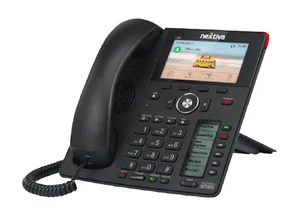
The best multi-line phone system is the 12-line Nextiva X-885, offering helpful features for small and medium-sized businesses, like HD call quality, a large LCD color display, and serious price value, costing only $190.
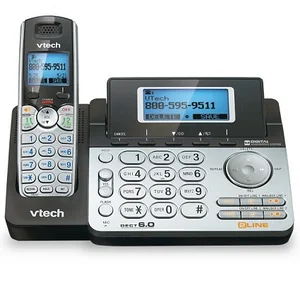
There are plenty of multi-line phone systems out there, though, and you should be able to find something that fits your specific needs. For example, if you really need to stick to a strict budget, the VTech DS6151 provides up to two lines for the low price of only $88.95.
In this guide, we’ll walk you through some of the best phone systems on the market today, including what kind of features they offer, how many lines they provide, and how much they cost, so you’ll be able to find the right device for your business.
- The Nextiva X-885 is the best phone system for small to medium-sized businesses, and costs around $190 upfront for 12 lines.
- The simpler two-line system, the VTech DS6151 is the best budget phone system. It costs around $90 and is expandable up to 12 handsets.
- Make sure to evaluate how many lines you actually need at your particular business before making your decision.
- Two-line phone systems cost between $80 and $170, while four-line phones are typically between $170 and $250.
- Cloud versus landline: Cloud-based VoIP multi-line phone systems offer more features and are more cost effective than traditional landlines.
To find these top-performing options, we combed through hundreds of product specs and customer reviews, so you don’t have to. We then ranked the most frequently mentioned pros and cons of every popular option on the market, measuring them against seven different criteria that are important for multi-line phone systems.
While we looked across four regions in total — the US, Canada, the UK, and Australia — we’ve focused this article on the US systems worth considering.
Check out our in-depth research guide to learn more.
(Pricing updated 23rd July 2026)
What’s the Best Multi-Line Phone System for Small Businesses?
The best small business multi-line phone system is the 12-line Nextiva X-885 because of its HD call quality and VoIP integrations. However, there are tons of other quality products available.
- Nextiva X-885 – Best overall multi-line phone system
- VTech DS6151 — Best two-line phone system
- AT&T ML17939 — Best for speakerphone conversations
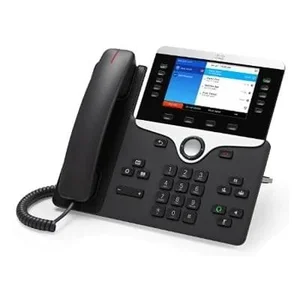
- Cisco CP-8861 — Best for larger businesses
- Panasonic KX-TG9582B — Best for cell-to-landline communication
Check out how our best multi-line phone systems compare side-by-side, below:
|
Pros
|
Cons
|
||||
|---|---|---|---|---|---|
 |
 |
 |
 |
 |
|
 |
 |
 |
 |
 |
|
|
Nextiva X-885 |
VTech DS6151 |
AT&T ML17939 |
Cisco CP-8861 |
Panasonic KX-TG9582B |
|
|
|
|
|
|
|
|
|
|
|
|
|
| Compare Prices | Compare Prices | Compare Prices | Compare Prices | Compare Prices |
1. Nextiva X-885: Best Overall Multi-Line Phone
- Price: $190
- Lines: 12
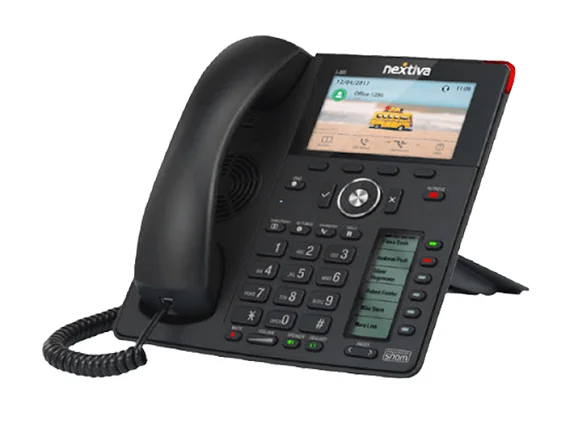
The Nextiva X-885 is the best multi-line phone in our in-depth research because of its modern design and its native integration with Nextiva, providing advanced VoIP features built in. Plus, with 12 lines, it’s the most flexible option on this list, making it perfect for front desk staffers.
The Nextiva X-885 is a bit more expensive than other options on this list, which makes it less accessible for smaller businesses. On top of that, the device doesn’t have Wi-Fi functionality built in, so you’ll have to pay for a USB dongle that can do that for you.
- Key feature: The 4.3-inch color display provides a modern feel while being easy to use.
- Pro: The phone system natively integrates with the Nextiva VoIP service, providing access to advanced features like visual voicemail.
- Con: Connecting to Wi-Fi requires an additional dongle, which you’ll have to pay for. It does connect via Ethernet for no additional charge.
- Pricing: At $190, the Nextiva X-885 is a bit more expensive, but the added features and premium design are worth it.
2. VTech DS6151: Best Two-Line Phone System
- Price: $88.95
- Lines: 2
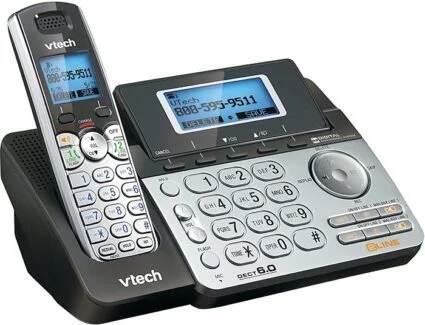
If you need a lower cost phone system with fewer lines and a bit more flexibility, the VTech DS6151 is the right fit for you. It offers only two lines and costs just $88.95, which is less than half the cost of the Nextiva X-885. It’s also a cordless option, so you aren’t tethered to a base when you make calls.
Most notably, the phone system uses DECT 6.0 digital technology to ensure there is no interference with any other wireless networks or electronic devices in the building, improving quality and security.
The VTech DS6151 is a traditional phone system, though, which means you won’t get all the VoIP features like AI summaries and visual voicemail.
- Key feature: With DECT 6.0 digital technology, the VTech DS6151 exclusively makes calls that are secure end-to-end encrypted and have crystal clear audio quality.
- Pro: The VTech DS6151 can add up to 12 cordless handsets to the system on a single phone line, so it can scale with you as your business grows.
- Con: Because the VTech DS6151 is a traditional phone system, the design and functionality are a bit less modern than other options on the list.
- Pricing: The VTech DS6151 is the most affordable phone system on this list, costing only $88.95.
3. AT&T ML17939: Best for Speakerphone Conversations
- Price: $104.95
- Lines: 2

The AT&T ML17939 is a two-line phone system that is a bit more expensive than the VTech DS6151, despite being a corded option. However, it offers more advanced features, like Clearspeak technology, for seamless speakerphone conversations, and a built-in digital answering system, with 12 minutes of recording time per line.
Like the VTech DS6151, the AT&T ML17939 is a traditional phone system, which means you won’t get access to any advanced VoIP features. But with a 50-name and number phonebook directory and streamlined dialing tools, you can still get a lot out of this phone for your team.
- Key feature: Clearspeak technology allows users to have high quality speakerphone conversations directly from the base without using the handset.
- Pro: The system is easy to use, providing speed dialing tools that allow you to simply push a single button to speak with one of 50 contacts.
- Con: The traditional, corded phone system is a bit outdated in 2026, providing limited flexibility for professionals working anywhere but their desk.
- Pricing: The AT&T ML17939 is a bit more expensive than other traditional, two-line phones at $104.95, but provides some advanced functionality to make up for it.
4. Cisco CP-8861: Best for Larger Businesses
- Price: $172.95
- Lines: 5
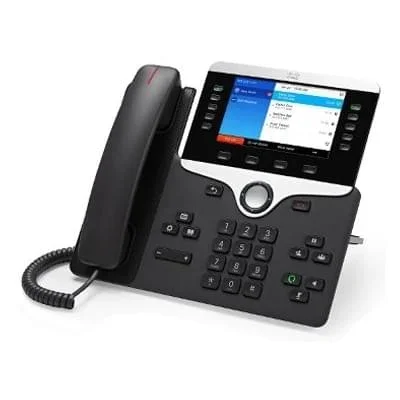
The Cisco CP-8861 is a robust, versatile, and expensive phone system. It’s ideal for larger businesses, because it can scale with your growth, allowing for up to three Key Expansion Modules (KEMs), which will turn your phone system into an all-in-one command center for your front desk staff.
Beyond that, it comes with a large, 5-inch display, built-in Wi-Fi and Bluetooth for quicker connections with headsets, and compatibility with VoIP services for advanced features, like AI summaries.
There are some downsides, other than the high price tag, though. It’s a larger device than most phone systems at 10 inches wide, so you’ll need a big desk to house it. The Cisco CP-8861 also has some hefty power requirements, because it’s designed to be powered via Power over Ethernet (PoE).
- Key feature: The Cisco Intelligent Proximity feature allows users to connect their smartphone to the device to transfer contacts and call history.
- Pros: The massive 5-inch display and integrated Wi-Fi and Bluetooth make it very easy to use for employees.
- Cons: The phone system has high power requirements with Class 4 PoE needed, which means you might have to upgrade your office infrastructure.
- Pricing: The Cisco CP-8861 is notably more expensive than competitors at $172.95, plus you may want a monthly charge for Cisco Unified Communications, for full functionality.
5. Panasonic KX-TG9582B: Best for Cell-to-Landline Communication
- Price: $240
- Lines: 2
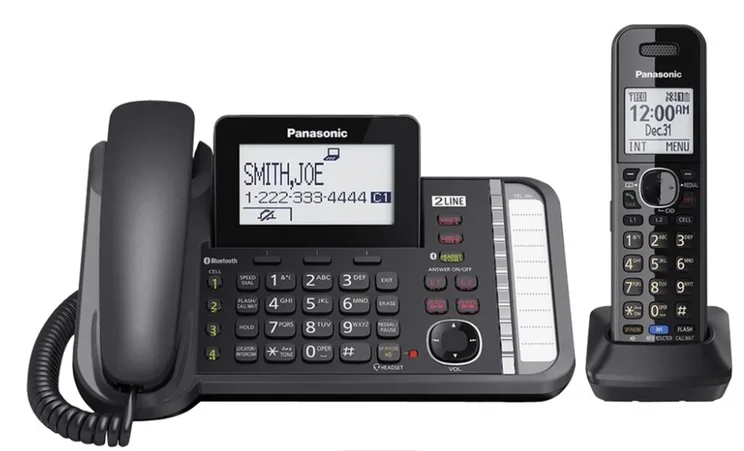
The Panasonic KX-TG9582B is a two-line traditional phone system that, despite lacking VoIP compatibility, can connect up to four smartphones to accept calls with its Link2Cell technology. This makes it a perfect solution for smaller businesses that do business on the go.
The Panasonic KX-TG9582B is expensive, but it does come with an additional handset included in the price. More notably, that handset has a 75-minute backup battery, so if the power goes out, you’ll still be able to make calls.
- Key feature: The Link2Cell feature allows users to connect four smartphones to one phone system.
- Pros: The battery backup on the Panasonic KX-TG9582B means you still get 75 minutes of call time, even in a power outage.
- Cons: Despite the mobile connection options, it is a traditional phone system, which means it is not compatible with VoIP services.
- Pricing: The Panasonic KX-TG9582B is the only phone system on the list to break the $200 barrier, at $240, but it does come with one additional handset included, so does still represent good value.
How Much Does a Multi-Line Phone Cost?
The cost of a multi-line phone varies depending on the number of lines it offers, as well as the quality and features.
- Two-line phone systems: Two-line phones typically cost $60–$165.
- Four-line phone systems: Four-line phones generally cost $110–$175.
- Add-on features: Advanced calling tools like echo cancellation, widescreen color displays, and CRM integrations typically cost extra.
- Extra devices: Additional wired or wireless phone stations typically cost $45–$70 for a two-line system and $70–$120 for a four-line system, though you’ll need to get in touch with vendors to get a custom quote.
Alternatively, if you’re able to do without physical hardphones and are interested in saving money, learn how much VoIP phones cost in our VoIP cost price breakdown guide.
What’s the Difference Between Traditional and VoIP Phone Systems?
Traditional phone systems connect to analog infrastructure like landlines and require specific hardware to make and receive calls. These systems do not require the internet to make calls and don’t typically come with advanced features, like AI summaries or visual voicemail.
Voice over Internet Protocol (VoIP) phone systems use the internet to make calls and can be used on mobile devices and desktop computers.
Check out the breakdown below comparing some of the key differences between traditional phone systems and VoIP phone systems.
| Traditional | VoIP |
|---|---|
| Large upfront cost | No upfront cost |
| High maintenance fees | Low monthly fees |
| Reliable infrastructure | Modern technology |
| Specific hardware requirements | Works on desktop and mobile devices |
| On-site installation | Cloud-based platform |
To learn more about how VoIP systems compare with traditional phone systems, check out our VoIP versus landlines guide.
Who Are the Best VoIP Providers?
If you want to prioritize VoIP functionality over a traditional phone system, there are some top VoIP providers that can get you connected with a communication platform for your business.
In our hands-on research of the best VoIP providers, we found that RingCentral is the best option for most businesses offering a massive library of compatible third-party apps that allows businesses to integrate its other systems into the communication platform.
There are a lot of VoIP providers out there, though, each offering different perks depending on your business need. Check out the table below to see some of our top platforms compared on everything, from price to features.
|
Starting price
The typical lowest starting price. The lowest price available for your business will depend on your needs
|
Best for
|
Core benefit
|
||||||
|---|---|---|---|---|---|---|---|---|
|
BEST OVERALL
 |
 |
 |
 |
 |
 |
 |
|
 |
|
RingCentral |
Vonage |
magicJack for Business |
8×8 |
Zoom Phone |
GoTo Connect |
Ooma |
Nextiva |
Net2Phone |
|
$20/user/month |
$13.99/user/month |
$15.99/user/month |
Custom |
$10.50/user/month |
Custom |
$19.95/user/month |
$20/user/month |
$19.99/user/month |
|
Integrations |
Training features |
Smaller businesses |
24/7 customer support |
Call management features |
Unifying internal communications |
Customer experience |
Professional services |
Great for international businesses |
|
Large variety of helpdesk and CRM integrations |
Staff improve on the job, due to top training and management tools |
Basic, affordable option for smallest businesses |
Integrates with various other communication tools |
Affordable pricing |
Provides call management features at low cost |
Crystal-clear call quality |
Unlimited calls in US and Canada |
Integrates with Microsoft Office, Google, and others |
Methodology: How We Pick Multi-Line Phone Systems
Our team tested products and studied online reviews in order to rank each phone system on a five-star scale based on seven different criteria important to multi-line phone systems. Systems that delivered the most functionality while remaining cost-effective and easy to use rose to the top.
Here’s a breakdown of the metrics by which we evaluated the top multi-line phone systems:
- Cost factors: Does the phone system offer a good value relative to its price?
- Features: Can the system support typical business needs?
- External connections and integrations: Will it work easily with existing systems?
- Customer support options: Will you get the support you need?
- Security options: Is the system safe and private?
- Scalability: Can the system easily keep up as a business grows?
- Customer review scores: Does the system satisfy its current customers?
Check out our in-depth research guide to learn more about how we test and evaluate software for small businesses.
Our top pick is the 12-line $190 Nextiva X-885 system, which offers a 4.3-inch LCD color display, HQ call quality and a suite of versatile, useful features — certainly enough to justify the high cost.
But if you’re looking for a simple two-line system, we recommend the $88.95 VTech DS6151 for its features, ease of use, and expandability of up to 12 stations.
Whatever model you settle on, you’ll more than make up the cost in savings by avoiding hours of phone tag and hunting for the right client number, particularly if you opt for a cloud-based VoIP option.
Frequently Asked Questions
Yes. In 2026, most multi-line phone systems are VoIP-based, which means there is a mobile app that goes along with it and can be used on your cell phone.
When it comes to desk phones, lines refer to the number of calls the system can handle simultaneously. So, a two-line phone system can handle two calls at the same time, while a four-line phone system can handle four calls at the same time.
Yes, most multi-line phone systems and their VoIP counterparts offer something called “porting,” which allows you to bring over your previous number to the new system.
If you click on, sign up to a service through, or make a purchase through the links on our site, or use our quotes tool to receive custom pricing for your business needs, we may earn a referral fee from the supplier(s) of the technology you’re interested in. This helps Tech.co to provide free information and reviews, and carries no additional cost to you. Most importantly, it doesn’t affect our editorial impartiality. Ratings and rankings on Tech.co cannot be bought. Our reviews are based on objective research analysis. Rare exceptions to this will be marked clearly as a ‘sponsored’ table column, or explained by a full advertising disclosure on the page, in place of this one. Click to return to top of page


