
We may receive a commission from our partners if you click on a link to review or purchase a product or service. Click to Learn More
When it comes to VoIP vs landline systems, VoIP systems have some clear advantages and will be able to meet the needs of a bigger selection of businesses. Not only do VoIP systems offer more calling features, but they’re also much more flexible and cost-effective.
VoIP (voice over Internet Protocol) is a type of phone system that lets you make telephone calls via the internet using smartphones, laptops, or traditional desk phones. Landlines, on the other hand, are a traditional, established telephone system that transmits communications via physical wires and cables.
Landlines may still be the right choice for some, even if VoIP systems offer clear benefits. If you’re unsure about which phone system will be a good match for your business, we break down their differences on a granular level: covering cost, scalability, calling features, and more. Read on to learn more, or use our free comparison tool to get free quotes from the leading VoIP systems.
How Do VoIP vs Landline Phones Compare: At a Glance
Not sure which phone system your business should rely on? Before we go through the details, here are the main ways that VoIP systems and traditional phone lines differ:
- VoIP systems are cheaper to install than landline phones, as they rely on the internet, not copper wires
- Domestic and international calls are cheaper with VoIP systems than landlines, making them a better choice for businesses making lots of outbound calls
- VoIP calls can be made from a range of devices like laptops, smartphones, and desk phones, making them better for flexible, remote, and hybrid workers
- Landlines are slightly more reliable overall, as they can have a slight edge on call quality, and don’t have latency (delay) issues which VoIP calls can experience
- Landline phones are immune to power outages, as they don’t rely on the internet to function like VoIP systems
- Landline phones have a lower learning curve than VoIP, as workers will already be familiar with landline technology
Jump to our in-depth review, or read on to learn more about how the two phone lines compare when it comes to costs, security, flexibility, and more.
What Is VoIP?
VoIP is a way of making a telephone call over the internet, rather than through a traditional landline setup. Many VoIP vendors will provide your company with the hardware to host the online system locally, using an IP-PBX. Alternatively, providers can host the entire setup in the cloud, which is becoming increasingly common.
Either way, VoIP removes a business’s reliance on physical lines (or much additional hardware), making it easier and cheaper to increase the number of phones for your expanding workforce than with a landline.
The core benefits of VoIP vastly outweigh the few minor drawbacks you may encounter while using a VoIP system – but still, it’s good to be aware of them.
Pros:
- Inexpensive – Typical VoIP setup for 12 staff costs about $800, compared to $2,500 for a comparable landline system.
- Flexible – VoIP software lets your agents place work calls from laptops and mobile devices rather than desk handsets.
- Low maintenance – You’ll need to opt for cloud hosting rather than on-premises VoIP installation for this benefit, which saves you time and money.
Cons:
- Internet-dependent – You won’t be able to make calls if there’s a power outage, which won’t affect landlines.
- Latency – VoIP products can suffer from latency (delays on the line), and opting for a poor provider could mean significant lag.
- Call location can’t be tracked – Having an internet number that’s not tied to a specific physical location can slow down emergency services.
What Is a Landline Phone?
A landline phone is another term for the traditional phone system – it works through copper wires running from a local or national telecommunications company to the premises. It’s a tried and tested technology, but an old one with very little advancement in recent years.
Given its dependence on hardware, it is also considerably more expensive than a VoIP setup. This is due to the fact you have to install a private branch exchange (PBX) to serve an office environment where multiple phone lines are required, as well as upkeep and maintain the physical components of the system.
Pros:
- Superior audio quality – Landlines convert your sound waves directly into electricity and back again, while VoIP converts the waves into packets of data, limiting the quality.
- Immune to power outages – Landlines do use a tiny amount of electricity, but it’s so little that phone companies can easily keep them running on generators.
- Zero learning curve – You won’t have to teach your employees how to operate a new system, so there’s no learning curve.
Cons:
- Costly installation – If you aren’t already using landline phone, the system is a lot more expensive and technically challenging to install than VoIP technology.
- Lack of features – Landline phones lack advanced features you’d get with VoIP systems like call forwarding, instant messaging, and AI virtual assistants.
- Poor scalability – Adding an extra line or expanding your package is much more costly with landlines than with VoIP systems.
How Do VoIP Vs Landline Phones Compare: In-Depth
VoIP offers a number of advantages over landline phones, including lower costs, greater flexibility, and the ability to make calls from anywhere with an internet connection. However, upgrading to the technology won’t be worth it for every business, especially if they’re familiar with using landline phones.
Next, we explore how both phone system compare on the things that matter, including:

Looking for the best phone service for a small business?
Our top choice is Ooma- get a quote in moments to see how you could benefit.
VoIP vs landline: pricing and costs
VoIP costs are considerably cheaper than a traditional landline setup, which is a big reason why businesses are so open to switching from landlines to VoIP for their communication needs. Smaller setup fees, smaller maintenance and hardware costs, lower call charges – almost every facet of your traditional landline bill can be slashed considerably with a VoIP setup. So, whether you need VoIP for hotel businesses or VoIP for call centers, there’s a solution that will work for you.
On average, VoIP users spend between $10 and $30 per user, per month on their VoIP systems. Not only that, but as your business grows, it’s easier and more cost-effective to add more VoIP lines for new staff than it ever would be for a landline system. Plus, you’ll get lots of useful features such as video calling that aren’t generally available from a landline system straight out of the box.
As we’ve covered, the typical VoIP setup for 12 employees costs around $800, compared to around $2,500 for a comparable landline system, so it’s around half the cost, all things considered. What’s more, VoIP services generally provide significantly cheaper international call rates than landlines – VoIP call rates to other countries can be as cheap as $0.01 per minute.
|
Starting price
The typical lowest starting price. The lowest price available for your business will depend on your needs
|
Best for
|
Core benefit
|
||||||
|---|---|---|---|---|---|---|---|---|
|
BEST OVERALL
 |
 |
 |
 |
 |
 |
 |
 |
 |
|
RingCentral |
Vonage |
magicJack for Business |
8×8 |
Zoom Phone |
GoTo Connect |
Ooma |
Nextiva |
Net2Phone |
|
$20/user/month |
$13.99/user/month |
$15.99/user/month |
Custom |
$10.50/user/month |
Custom |
$19.95/user/month |
$20/user/month |
$19.99/user/month |
|
Integrations |
Training features |
Smaller businesses |
24/7 customer support |
Call management features |
Unifying internal communications |
Customer experience |
Professional services |
Great for international businesses |
|
Large variety of helpdesk and CRM integrations |
Staff improve on the job, due to top training and management tools |
Basic, affordable option for smallest businesses |
Integrates with various other communication tools |
Affordable pricing |
Provides call management features at low cost |
Crystal-clear call quality |
Unlimited calls in US and Canada |
Integrates with Microsoft Office, Google, and others |

Want to Switch from Landline Phones to VoIP?
Try our custom VoIP quotes form to get information for your business today.
VoIP vs landline: equipment
The big advantage of VoIP is that pretty much any device can be used as a VoIP phone, whether it’s your laptop or mobile device. Hardware is effectively optional. For a VoIP system, additional hardware you might want to consider includes desk phones and conference phones designed for group meetings and calls.
However, the key piece of hardware you’re likely to need if you purchase a VoIP system is headsets. VoIP headsets plug into the devices your staff members use to make calls – which will result in better audio quality and smoother conversations. Prices for these headsets can range from $25 to $150.
But importantly, with VoIP, it’s all optional – employees can still use mobile devices as softphones. If you have good quality mobile devices and your internet connection is strong, then you might not even need headsets.
Desk handsets, which you may opt for if you’ve purchased a VoIP system but you’ll definitely need if you’re using a traditional landline system, also vary greatly in price. They’re available from as little as $50 for basic models, to around $100 for mid-range business IP phones, to over $500 for more advanced units with video-calling capabilities and other features that already come packaged within VoIP software.
If you’re using a landline, you’ll also need an on-site line switching Private Branch Exchange (PBX) system, which will let you switch calls between users on local lines and allow calls to be distributed to different devices within an office. There may also be additional costs relating to phone cables you’ll need to connect all your phones up to the PBX system.
VoIP vs landline: sound quality
Traditional landlines hold the ace when it comes to sound quality, but VoIP systems are getting better by the day. While landlines may not offer the large suite of features available with VoIP, the technology has been honed over decades to ensure that voice calls are as clear as possible, rarely suffering from interference, dropped calls, or poor quality.
Unlike landlines, the internet isn’t a system that was designed solely with vocal communication in mind. Instead, it was intended to carry data. The road to getting voice calls to be a viable means of connecting hasn’t always been smooth, as anyone who used VoIP in the early days will be able to attest to.
The aim has always been that the caller shouldn’t even be aware that the call is taking place over VoIP, and nowadays, in the vast majority of cases, this is true. While there may be the occasional blip here and there, VoIP sound quality has been highly polished, and if you opt for a reliable VoIP provider, it should be indistinguishable from an actual landline.
Just remember, the quality and speed of your internet connection will have a large impact on VoIP call quality, and it is therefore essential that you have faith in your provider’s ability to deliver a robust and speedy connection.
VoIP vs landline: features
It’s easy to be dazzled by the range and novelty value of some of the features available when first appraising your phone system options. You likely don’t need every bell and whistle, but a few core features to expect from VoIP are:
- Mobile device accessibility
- Automatic redirection
- Auto attendants
- Video calling
- Voicemail-to-text
- Ring groups
- Spam prevention
- Conferencing
Many of these features can also be attained through a landline system, but some of them require specialized equipment, compared to the VoIP system’s one-stop shop. Another thing to consider in the VoIP vs landline match-up is that modern VoIP systems now offer a range of management features, such as call recording, monitoring, and transcripts, which are useful for training staff.
A lot of top VoIP providers such as RingCentral also offer collaboration tools like a task manager and a team chat feature that you won’t find in landline packages. As we’ve mentioned above, if you want these sorts of tools, you’ll probably have to pay hefty fees for add-ons.
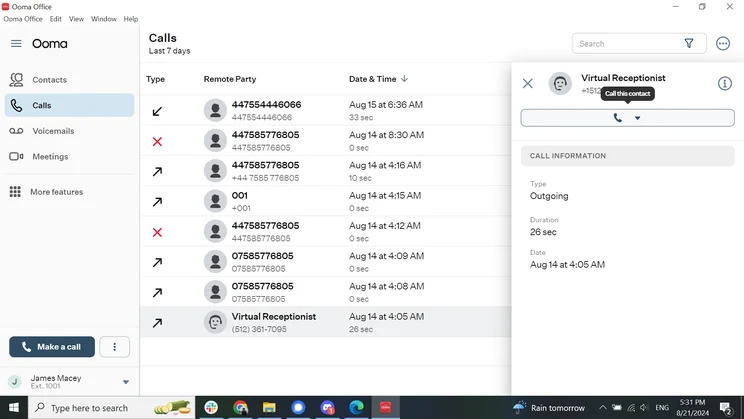
Ooma virtual assistant feature let me direct incoming calls and share information easily. Source: Tech.co user testing
Knowing which features will add massive value to your business, and which are appealing but not absolutely essential, is crucial. If a key feature on your wants list is not included as standard, see if the provider can add it. If there are features included that you know are of limited value to you, see if they can be removed to reduce the overall cost. Modern VoIP phone solutions have never been so flexible and customizable, so take advantage of this.
VoIP vs landline: security
Security is also an issue when it comes to internet-based services. While VoIP is more prone to certain security risks than landlines because it’s connected to the internet, landlines are connected to the Public Switched Telephone Network (PSTN) – which isn’t encrypted like VoIP is. All the typical security protocols are adhered to by top VoIP providers. Commonly found features include:
- Strong passwords
- Two-factor authentication
- Updated firmware on all mobile devices
- Review call logs regularly, flagging any unusual activity
- Disable international calling if your business doesn’t use it
- Get a firewall for your router
Safety is a related concern. 911 responders can find landlines, but for an internet number, responders must rely on the shaky location data recorded from wireless carriers: In one study, only 187 out of 1,000 emergency call centers reported a “great deal” of confidence in this data.
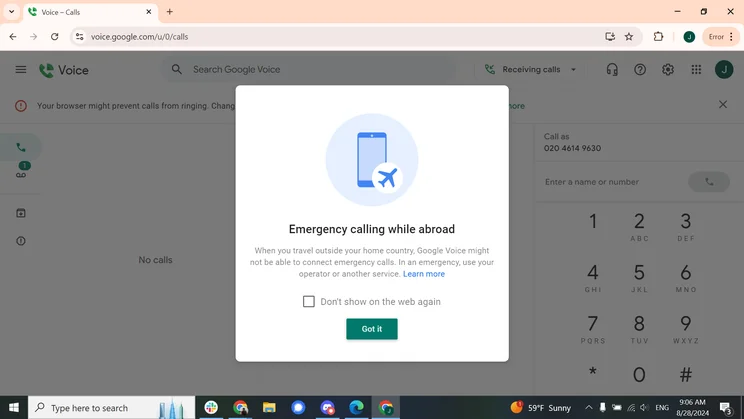
Google Voice advises you against making emergency calls with the service when you’re abroad. Source: Tech.co user testing
Check to see if the VoIP provider you’re interested in offers a guarantee that emergency services will know your location — Ooma, one of our top picks, offers a “911 Emergency Services” feature which does just that.
Check out our VoIP security guide for more information
VoIP vs landline: reliability
Traditional landlines have proven to be dependable over the years and can continue to operate in situations such as power outages. While they are not infallible, they are notoriously stable most of the time. Modern VoIP connections are also very reliable, with some providers boasting a 99% uptime, but they don’t quite match up.
VoIP’s key weakness is also its main strength – the internet. Every facet of VoIP is entirely dependent on being able to get online. If your internet goes down, so does VoIP. The same applies to your power connection. This shouldn’t be a major cause for concern, but if you are looking at a VoIP network, it’s essential that you have an excellent and dependable internet provider, as this will form the backbone of the service.
If you’re interested in VoIP but worried your office internet connection might let you down, look for a provider who offers automatic rerouting to mobile devices as a backup in case of poor connection or power cuts. As mentioned earlier, all leading providers, such as 8×8 and Vonage, now offer this service.
VoIP vs landline: scalability
Scalability is another aspect to consider, as you’ll want to invest in a phone system that can grow with your business. All in all, scaling a VoIP system – which will just require you to upgrade your plan and add more users – is much easier than upscaling a landline system. Software updates can quickly be downloaded and maintenance completed within seconds.
Scaling up a landline system comes with significant challenges because you’ll need more hardware like desk phones and probably more phone cables and wiring, although this will depend on the state of your office’s landline infrastructure.
When it comes to voice over IP vs landline, for scalability, there’s a clear winner.
VoIP vs landline: installation
If you opt for either a landline or an on-premises VoIP system, you’ll need to factor in the cost and time required for installation. A VoIP hosted over the cloud is far more simple to set up, with just a software installation and a training session on how the features work.
In any case, you’ll want to check with your prospective service providers whether training for your employees and phone system users is included, if this training is also applicable for new employees who join the business after the phone system is set up, and in what form the training comes – a video series or in-person live workshops are the most common forms.
Budget for ongoing maintenance
Keeping everything running smoothly is an ongoing process, so you’ll want to budget for unexpected maintenance. It can be difficult to account for all the possible costs and overheads associated with a new phone system installation, so just keep a contingency fund available if possible, for those unexpected fixes and bumps in the first few months of getting the system up and running.
If you’re tired of your landline phone setup costing too much without providing the features you need, switching to VoIP can be a hugely helpful strategy. However, there are some steps you need to take before you get started to ensure you don’t run into problems with your business communication system overall.
For one, don’t cancel your landline service before you’ve got a VoIP provider in mind. After all, you don’t want your number to be unreachable for any period of time as a business. In that vein, you’ll want to port over your old landline number to your VoIP software, a service offered by the majority of providers. This will allow you to keep your old number on the new service, so you won’t lose out on loyal customers.
Finally, once your VoIP provider is all set up and ready to go, you can cancel your landline service with a clear end-of-service date. If you want to start the switch right now, check out our free custom VoIP quote tool for a price that works for you.
Check out our VoIP statistics guide for data on why you should switch
Which Phone System Is Best For My Business?
Still unsure about whether to switch to a traditional landline or VoIP system? With so many variables to consider, we understand that making a decision isn’t always easy. To help you decide, here are some recommendations for different types of businesses:

You should use a VoIP system if…
- Your business is interested in reducing costs, as VoIP systems are cheaper than landline phones to install and maintain
- Your business is a call center, sales company, or any business that manages high call volumes, as VoIP systems offer much more advanced calling features than traditional landlines
- Your business is remote or hybrid, as VoIP systems allow you to make calls from a range of devices, anywhere with an internet connection, unlike landlines
You should use a landline phone if…
- Your business is small and doesn’t plan on expanding anytime soon, as extra lines are much more costly to install with landlines than with VoIP systems
- Your business doesn’t have access to reliable internet, as landline phones are able to work consistently without relying on an internet connection
- Your business needs consistent call quality, as landlines offer slightly superior call quality than VoIP systems, and don’t suffer any latency issues
As we’ve learned, the difference between VoIP and landline systems is that VoIP is a flexible internet communications system that delivers a cheap, effective way for businesses to communicate with customers. The landline is the traditional telecom solution that is tried and tested yet limited in features, struggling to keep up with the demands of modern business.
VoIP is an excellent and inexpensive way to grow your business and ensure that you are responding to your customers’ needs effectively. The benefits over a traditional landline are many, as the thousands of companies that have already made the switch to VoIP will attest.
Ready to modernize your business and make the move to VoIP? Our online VoIP comparison tool will get you there, generating custom quotes for your company.
If you click on, sign up to a service through, or make a purchase through the links on our site, or use our quotes tool to receive custom pricing for your business needs, we may earn a referral fee from the supplier(s) of the technology you’re interested in. This helps Tech.co to provide free information and reviews, and carries no additional cost to you. Most importantly, it doesn’t affect our editorial impartiality. Ratings and rankings on Tech.co cannot be bought. Our reviews are based on objective research analysis. Rare exceptions to this will be marked clearly as a ‘sponsored’ table column, or explained by a full advertising disclosure on the page, in place of this one. Click to return to top of page


