

- Despite only being penned in 2025, vibe coding has been named word of the year by Collins English Dictionary.
- Vibe coding describes the practice of producing code using natural language.
- Many vibe coding platforms allow users to create apps for free.
Despite not even being a year old, the term vibe coding has been named word of the year by Collins English Dictionary, beating other contenders such as ‘bio hacking’ and ‘glaze’.
The term was coined by a founding engineer at OpenAI, and an entire industry has sprung up around it almost overnight, with AI removing the traditional barriers of coding and allowing anyone to give it a go.
The tech is credited with speeding up the coding process and democratizing it.
Vibe Coding Named Word of 2025
Collins English Dictionary, a British publication first printed in 1979, has named vibe coding the word of the year. It narrowly beat other contenders on a final shortlist, including ‘clanker’ – an unsympathetic Star Wars-inspired term to describe robots and AI, ‘bio hacking’, which describes efforts made to extend life by manipulating the body, and ‘glaze’, which describes heaping cringe-worthy praise on someone.
It’s no surprise that the list was tech-heavy, but even less surprising that it was vibe coding that topped the poll. Google Trends shows that the term has had a meteoric rise since it was first coined at the start of the year:
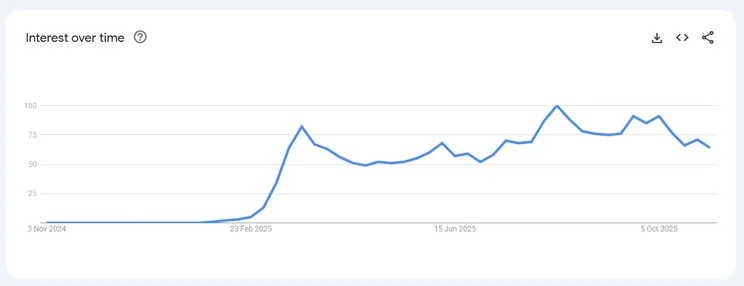
Interest in 2025 for vibe coding on Google Trends

This just in! View the top business tech deals for 2026 👨💻
The term was invented in early 2025 by Andrej Karpathy, a founding engineer at open AI, and former director of AI at Telsa. It’s origin can be traced back to an X message Karpathy posted in February this year. However, he does state that vibe coding, isn’t coding exactly:
it’s not really coding – I just see stuff, say stuff, run stuff, and copy paste stuff, and it mostly works. – Andrej Karpathy
What is Vibe Coding?
At its heart, vibe coding is the practice of turning natural language into code, without the need for hundreds of hours to learn Python, SQL or other languages. This has been enabled thanks to the recent advances in AI, which is essentially playing the middle man here and interpreting what the user is asking, and spitting out usable, working code.
Its biggest success, and likely the chance why it has suddenly skyrocketed in popularity, is that entirely demystifies the process of coding, and makes it available to all. This is especially true now that there are many dedicated vibe coding platforms that can make accessing the tech even easier, with many available for free.
With these tools, the sky is the limit. Users are able to create apps, websites, programs…essentially anything that requires code, but without needing to know a lick of the language.

Turn ideas into apps in minutes
Build fully-functional apps that work for you, with just your words
No coding needed
How to Start Vibe Coding
If you want to get started in the world of vibe coding, we’d suggest opting for one of the many platforms out there, such as Base44, Replit and Lovable, all of which have been designed to remove as many barriers as possible to the world of coding.
As mentioned, many offer free tiers to their services, but if you have a big project in mind, you’ll soon run up against the limits of the free offerings. Vibe coding platforms work by allowing users access to a certain number of credits. Each credit essentially represents a prompt, which is an instruction you write to make your project come to life. However, vibe coding is a process of honing and improving, and as such you might burn through your credits rather quickly as you tweak your app to perfection.
If you’re serious about getting into vibe coding, we’d suggest going with a paid vibe coding plan to get the most bang for your buck.
If you click on, sign up to a service through, or make a purchase through the links on our site, or use our quotes tool to receive custom pricing for your business needs, we may earn a referral fee from the supplier(s) of the technology you’re interested in. This helps Tech.co to provide free information and reviews, and carries no additional cost to you. Most importantly, it doesn’t affect our editorial impartiality. Ratings and rankings on Tech.co cannot be bought. Our reviews are based on objective research analysis. Rare exceptions to this will be marked clearly as a ‘sponsored’ table column, or explained by a full advertising disclosure on the page, in place of this one. Click to return to top of page


