
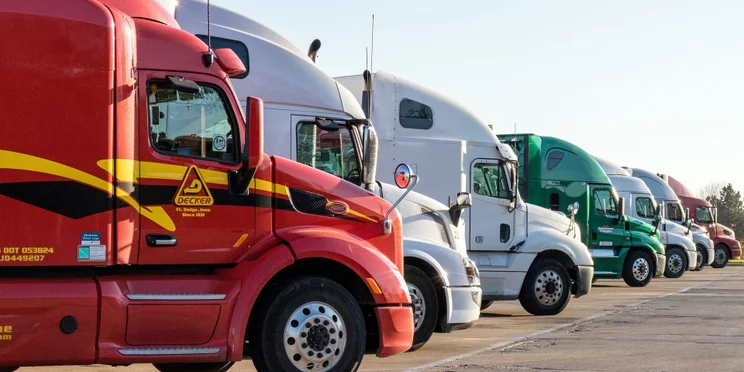
- President Trump announced a 25% tariff on imported heavy trucks starting on October 1st.
- The biggest importers of trucks are Mexico, Canada, Japan, Germany, and Finland, all of whom are firm allies of the US.
- 69% of businesses state that Trump’s tariffs have caused a change to their company’s operations.
President Trump announced new tariffs this week on imported trucks, a move that will almost exclusively have a negative impact on US allies rather than adversaries.
Tariffs have created a lot of issues for logistics industry over the last few months. The increasing cost of doing business is causing many companies to initiate layoffs or even go out of business.
Now, with more tariffs on imported trucks kicking off in October, the impacts will be hitting US allies as well as businesses stateside.
Trump Announces 25% Tariff on Imported Trucks
In a social media post — where else? — President Trump announced that a new 25% tariff will be imposed on all heavy trucks that are imported to the US from any foreign nation.
“In order to protect our Great Heavy Truck Manufacturers from unfair outside competition, I will be imposing, as of October 1, 2025, a 25% Tariff on all ‘Heavy (Big!) Trucks’ made in other parts of the World. Therefore, our Great Large Truck Company Manufacturers, such as Peterbilt, Kenworth, Freightliner, Mack Trucks, and others, will be protected from the onslaught of outside interruptions.”
As Trump noted in his eloquent social media post, the new tariff began on October 1st, and it is already poised to have a substantial financial impact on the logistics industry.
Heavy Truck Tariffs Mostly Target US Allies
The current administration has boasted about the revenue gleaned from tariffs, but at what cost? In addition to tariffs being import taxes on American businesses, the countries that are impacted the most are often quite friendly.
In fact, the Chamber of Commerce noted in a statement earlier this year that the majority of our commercial vehicles are imported from countries that we’ve typically worked very closely with.
“Imports of medium- and heavy-duty commercial trucks (commercial trucks) and parts used in their manufacture are sourced overwhelmingly from U.S. allies and defense partners.” – U.S. Chamber of Commerce statement
More specifically, the largest importers of heavy trucks to the US are Mexico, Canada, Japan, Germany, and Finland, all of which are obviously threat-free from a national security standpoint.
Tariffs Impact on the Logistics Industry
It’s been exactly six months since Trump announced his Liberation Day tariffs, and the logistics industry has been having trouble keeping up. In response to these specific tariffs, Ford CEO Jim Farley told CNBC that it “really restricts” the company’s future investment.
A lot of the industry is being forced to adapt to the new reality of tariffs in the US. In fact, our monthly survey data found that 69% of businesses have had to change their company’s operations in response to Trump’s tariffs.
Suffice to say, the future of the logistics industry remains a complete mystery considering the speed with which these tariffs change the landscape in an instant. And until things settle down, more businesses are going to need to aim for flexibility over profitability.


