
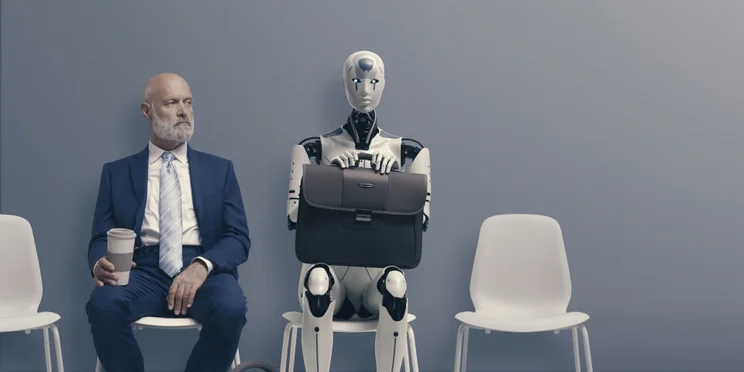
A new study has found that those who use LLMs like ChatGPT to write essays have lower brain activity than those who just used their own thoughts to write similar essays.
It’s not an unexpected finding. Teachers everywhere have been fond of the weight-lifting analogy to explain why you shouldn’t rely on generative AI to help you with your homework: You go to the gym to make your muscles bigger, not to lift weights really fast, so using robots to help you doesn’t make sense. Working hard is the point.
Now, we’ve got evidence to back up that claim.
How the New MIT Study Worked
The study, run by researchers at the Massachusetts Institute of Technology and available online this month, split up participants into three groups, dubbed “LLM, Search Engine, and Brain-only (no tools).”
The groups were studied across three sessions of essay-writing, while their cognitive load was tracked with electroencephalography (EEG). Their essays were analyzed, and were also scored by human teachers and an AI judge. The results?

This just in! View the top business tech deals for 2026 👨💻
“EEG revealed significant differences in brain connectivity: Brain-only participants exhibited the strongest, most distributed networks; Search Engine users showed moderate engagement; and LLM users displayed the weakest connectivity. Cognitive activity scaled down in relation to external tool use.” -the study
The study also notes that LLM users “struggled to accurately quote their own work,” which makes sense, given that it was more the LLM’s work.
AI for Homework Is Like a Motorcycle at the Tour de France
In short, LLM users saw a trade-off that limited their neural, linguistic, and behavioral levels, a result that the researchers concluded raises “concerns about the long-term educational implications of LLM reliance.”
It’s hard to argue with those results. AI definitely doesn’t seem set to go away any time soon, but schools may want to continue looking into banning its use for homework, for the same reason we’d ban a motorcycle at the Tour de France.
Regardless of anything else, this revelation gives us a nice break from the news cycles letting us know that social media use and microplastics are making us dumb.
Previous Studies Also Found AI Makes Us Dumb
Scientific research is all about verifying results through repetition, so we’re happy to announce that this isn’t the first study that has indicated that AI use makes humans use their brains less.
One January 2025 study titled “AI Tools in Society: Impacts on Cognitive Offloading and the Future of Critical Thinking” found that “Younger participants exhibited higher dependence on AI tools and lower critical thinking scores compared to older participants.” Using AI is a form of cognitive offloading, the study found — it saves the brain from completing cognitive tasks itself.
In another study from February, researchers at Microsoft and Carnegie Mellon University polled 319 “knowledge workers” to find that participants with higher confidence in AI tools held lower confidence in their own critical thinking skills.
AI tools may be able to supplement critical thinking. Use them too often, studies indicate, and they’ll replace it instead.


